Subcontractors at 985 Firms Demand Talks in a Month... Pressure Mounts on Auto, Semiconductor and Other Industries
- Input
- 2026-04-08 18:32:54
- Updated
- 2026-04-08 18:32:54
On top of this, a decision allowing multiple POSCO subcontractor unions, including the Korean Confederation of Trade Unions (KCTU)–affiliated Korean Metal Workers' Union (KMWU) and the Korean Plant Construction Workers’ Union, to each hold separate negotiations with principal contractor POSCO has amplified the impact. As individual subcontractor unions gain the ability to bargain separately, the business community argues that clear legal standards must be set for determining employer status.
■ First approval of a request to separate bargaining units
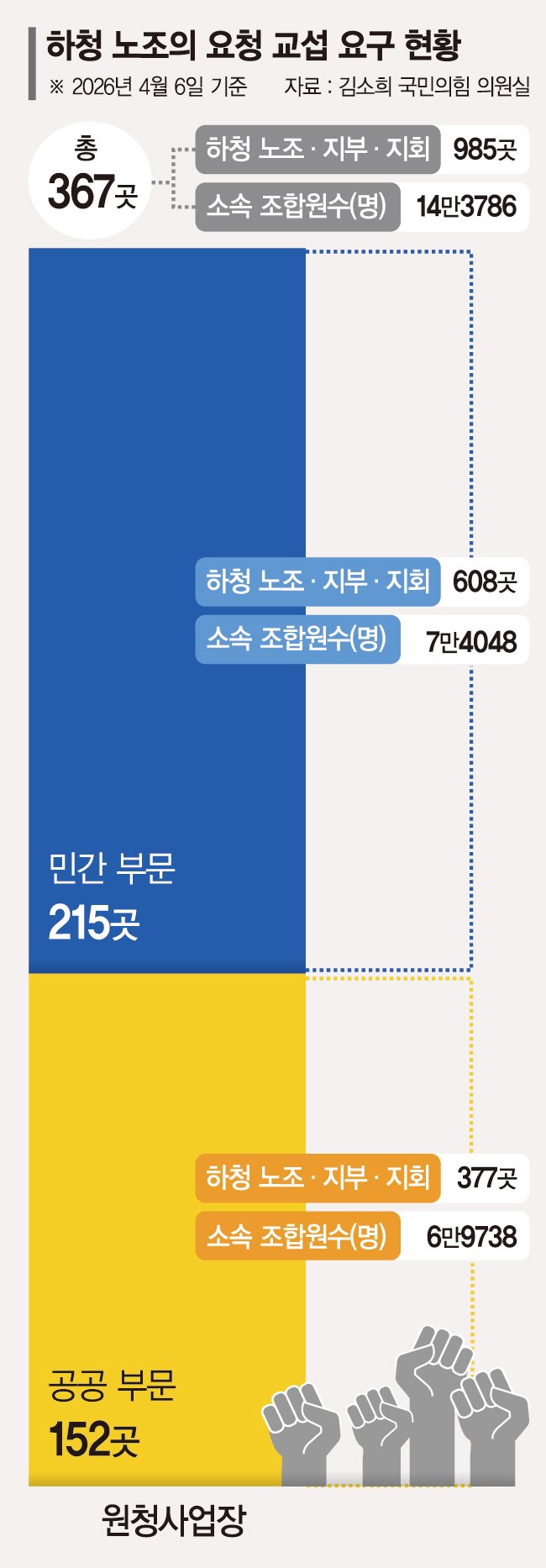
According to data that People Power Party (PPP) lawmaker Kim Sohee, a member of the National Assembly Committee on Climate, Energy, Environment and Labor, received from the Ministry of Employment and Labor (MOEL), as of the 6th of this month a total of 985 subcontractor unions, representing 143,786 members, had demanded negotiations with 367 principal contractors. As of the 3rd, 273 bargaining-related adjudication cases had been filed with labor relations commissions, and 65 inquiries had been submitted to the Collective Bargaining Assessment Support Committee run by MOEL as of the 30th of last month.
While demands from subcontracted workers to negotiate directly with principal contractors are pouring in, the Gyeongbuk Regional Labor Relations Commission on the same day concluded that POSCO has status as an employer for its subcontractor unions. This is expected to further accelerate demands by subcontractor unions to bargain directly with principal contractors. It is the first time a private company has been recognized as an employer for subcontractor unions.
Moreover, the decision that multiple POSCO subcontractor unions, including the higher-level KCTU-affiliated KMWU and the Korean Plant Construction Workers’ Union, can each hold separate negotiations with principal contractor POSCO is seen as particularly far-reaching. In principle, unions at principal contractors and subcontractors can each negotiate separately with the principal contractor, but among subcontractor unions themselves, unifying the bargaining channel has been the rule. The latest ruling by the labor commission, however, raises the likelihood that workers at partner firms will bring similar demands directly to principal contractors.
Major manufacturing conglomerates with principal–subcontractor structures, not only in the steel industry but also in the automotive and semiconductor industries, are growing increasingly nervous. In fact, in the roughly one month since the Yellow Envelope Law—an amendment to Articles 2 and 3 of the Trade Union and Labor Relations Adjustment Act—took effect on the 10th of last month, subcontractors in manufacturing sectors with many partner firms, such as automotive, shipbuilding, construction and the steel industry, have been filing a flurry of bargaining demands. Hyundai Motor Company, Hyundai Mobis, GM Korea, Hankook Tire & Technology, HD Hyundai Heavy Industries, Hanwha Ocean and Hyundai Engineering and Construction (Hyundai E&C) are among the most prominent examples.
A business community representative noted, "Domestic manufacturing companies are already facing deep labor–management conflict just from negotiations with their own in-house unions," and warned, "If subcontractor unions in the private sector also take seats at the bargaining table, there is a high possibility that the manufacturing sector, which underpins the Korean economy, will suffer damage."
■ Direct hiring risk spreads across manufacturing
The issue of direct hiring is also causing major ripples. As a response to the long-running controversy over illegal dispatch arrangements, POSCO abruptly announced the previous day that it would directly hire about 7,000 "operations support" workers who are directly involved in steel production, out of roughly 10,000 employees at its partner firms. Many in industry expect significant aftershocks across the broader economy.
Because principal–subcontractor structures differ by sector and company, it will be difficult for this direct hiring model to spread uniformly across industry. It is also not a process that can be completed in a short period. If worker movements between firms become visible, obstacles such as restructuring among partner companies could emerge.
Park Ji-soon, a professor at Korea University School of Law, commented, "POSCO’s decision on direct hiring should be seen as driven by its internal need to resolve a long-standing risk of illegal dispatch," and added, "There are almost no other principal workplaces that carry a similar level of risk, so it is difficult to generalize this case immediately."
On top of that, conflicts between unions over wages and other working conditions are expected to intensify. Backlash from existing regular employees is also likely to become more pronounced. Professor Park added, "If it is difficult to stipulate clear criteria for determining employer status directly in the law, those standards should be delegated to and defined in enforcement decrees in order to enhance market predictability."
eastcold@fnnews.com Kim Dong-chan and Jung Won-il Reporter