"Low birth rates and aging are structural problems society must bear, not individuals" [9th Seoul Population Symposium]
- Input
- 2026-04-08 18:25:04
- Updated
- 2026-04-08 18:25:04
Low birth rates and population aging are no longer matters of individual choice but structural problems that society as a whole must shoulder. They cannot be solved with short-term fiscal support or one-off policies; instead, companies, the government, and society at large must change their awareness and systems through a long-term response.
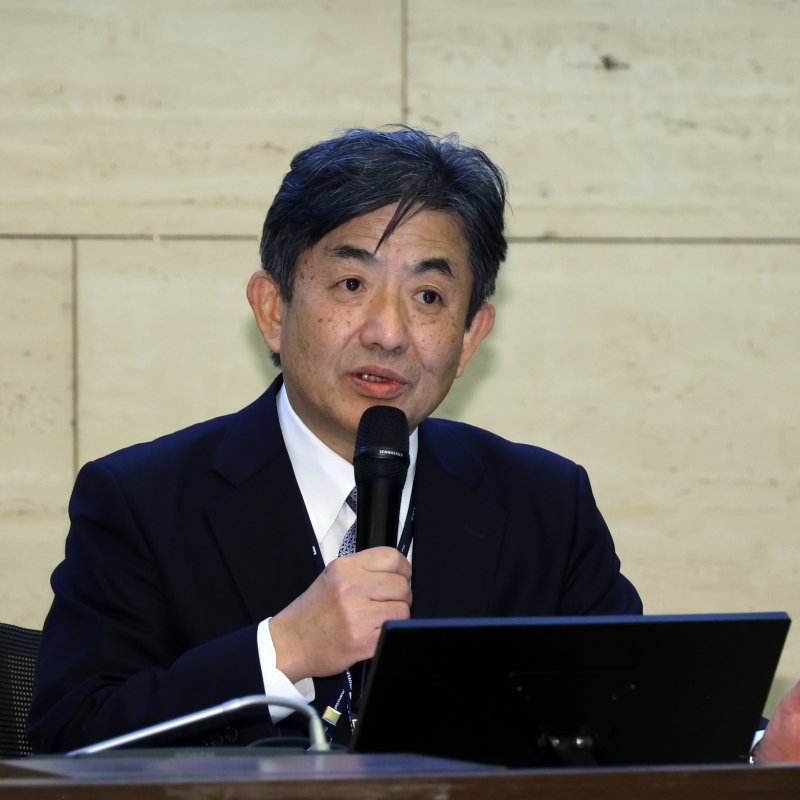
Shiro Yamasaki, a counselor at the Cabinet Secretariat of Japan, delivered a keynote at the 9th Seoul Population Symposium, hosted on the 8th by Financial News and the Korean Peninsula Population Future Research Institute at the Korea Chamber of Commerce and Industry (KCCI) in Jung District, Seoul. He said, "The key question is how we perceive the problems of low birth rates and aging," stressing, "We used to think of them as individual issues, but low birth rates and aging must be recognized as challenges that require a response from society as a whole."
Yamasaki has spent the past 20 years exploring ways to address Japan's low birth rate and aging population. Through this work, he concluded that the two issues require different approaches. He explained, "Measures for low birth rates and for aging have different characteristics. Low birth rates require changing the social phenomenon itself, in which the number of children falls and the population declines," adding, "For aging, the goal is how well society can adapt to the social phenomenon of a growing elderly population."
Regarding low birth rates, he noted that there is no single decisive solution, but argued that the entire society—including the central government, local governments, and businesses—must step forward.
To change social perceptions, he argued, policies must be pursued with a long-term perspective and steady, sustained effort. Yamasaki's advice draws on Japan's past failures in responding to its fertility crisis, which he analyzed as the result of failing to overcome three major "waves." He said, "The first wave came in the 1940s, when people believed the population would keep growing because of the Baby Boom Generation and tried to control births," adding, "The second wave began in the 1970s, when women entered the workforce in large numbers, and the third wave came after the 1990s, when an economic downturn pushed up the unmarried rate among men, which in turn led to more women remaining unmarried."
He pointed out that South Korea shows a similar pattern to Japan, and identified rapid economic development as a key cause. "Countries such as Japan and the Republic of Korea (South Korea) experienced rapid economic growth, yet paradoxically faced low birth rates," he said. "The pace of economic development was so fast that a gap emerged between changes in the economic and labor environment and shifts in social attitudes."
As a solution to aging, he proposed a care system in which the entire society participates. "There used to be a conflict between family responsibility and social responsibility," he noted, "but after long debate, we reached the conclusion that society as a whole must be involved."
In line with this, Japan introduced Long-term Care Insurance in 2000 and has achieved significant results. This Long-Term Care Insurance system aims to enable older people to continue living in their existing communities while maintaining a life that reflects who they are. To that end, it links home-based and institutional care with medical services to provide integrated management for the elderly.
[email protected] Seo Young-jun, Jung Sang-gyun, Lee Yu-beom, Park Ji-young, Choi Yong-jun, Kim Jun-hyuk, Kim Chan-mi Reporter