"74% of Koreans Do Not Trust People With Different Values"—How Distrust Is Holding Back Growth
- Input
- 2026-04-09 08:43:37
- Updated
- 2026-04-09 08:43:37
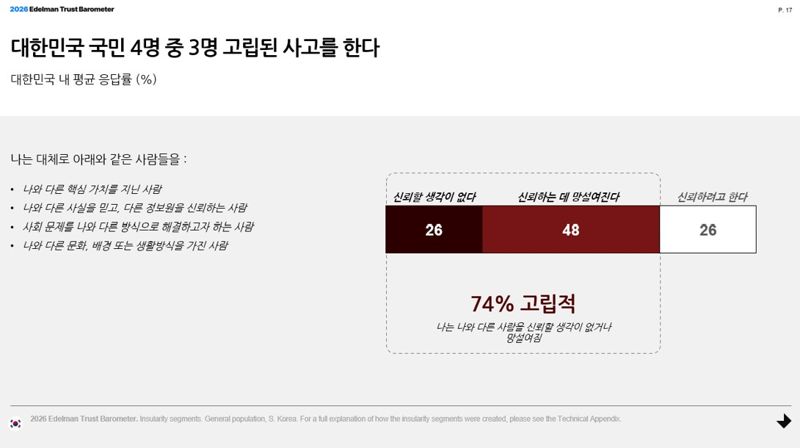
A survey has found that 74% of Koreans display what researchers call "isolated thinking": they either do not trust, or hesitate to trust, people who hold different values or approaches to social issues. Experts warn that this goes beyond simple differences of opinion and may signal a structural crisis in which social networks themselves begin to break down.
Global PR consulting group Edelman Korea, led by President Jang Sungbin, released its annual online survey, the "2026 Edelman Trust Barometer," on the 9th. This year’s study was conducted under the theme "Trust in Isolation," examining how the collapse of shared values and standards of trust is fragmenting society into separate worlds.
The survey showed that South Korea’s trust index stands at 46 points, meaning the country remains in the zone of distrust toward major institutions.
Edelman Korea analyzed, "This figure shows that the foundations of trust in Korean society are being structurally weakened, and it suggests that key social institutions have stalled below the threshold needed to restore trust."
The share of Koreans exhibiting isolated thinking was measured at 74%. The proportion of respondents who said they consume information at least once a week from sources with a different political leaning fell by 6 percentage points from a year earlier. Meanwhile, concern that foreign actors will use disinformation to fuel internal division in Korea jumped by 21 percentage points. In this environment, trust in domestic companies (64%) has strengthened relative to foreign companies (35%), pointing to a growing trend of geopolitical closure.
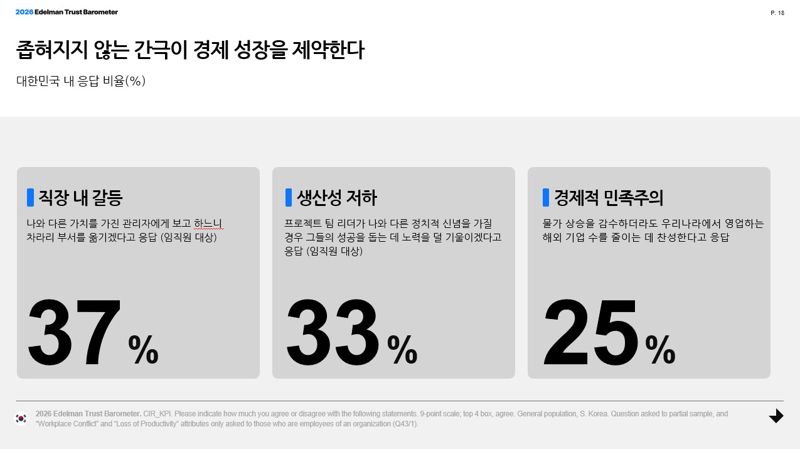
Social isolation is no longer just a psychological phenomenon; it is translating into real economic losses. According to the survey, 33% of Korean workers said that if a project team leader holds different political beliefs from their own, "I would put less effort into helping them succeed."
In addition, 25% of respondents said, "I would rather transfer to another department than report to a manager whose values differ from mine," revealing a serious crisis in workplace collaboration. This mindset is also affecting external economic activity: 37% agreed that "the number of foreign companies operating in Korea should be reduced, even if it means higher prices," suggesting that isolationist attitudes are evolving into a form of economic nationalism.
When asked whether they could trust an institution led by someone whose values differ from their own, respondents expressed difficulty trusting, in the following order: businesses (40%), government (39%), NGOs (35%), and media (27%). This indicates that social isolation is undermining confidence in leadership across institutions.
Promoting cooperation emerged as a key way to overcome conflict and isolation. The survey found that Koreans place greater trust in companies that, rather than taking sides on contentious social issues, play a role in "facilitating cooperation to find solutions" (33%).
Furthermore, 74% of respondents said the media should provide balanced coverage of diverse viewpoints and accurate headlines. The same share (74%) said the government should refrain from rhetoric that blames or stigmatizes particular groups.
Shin-il Kwon, head of the public affairs practice at Edelman Korea, stated, "Distrust is even more deeply entrenched in our country, and this is making things harder for both businesses and politicians." He added, "In response, companies will increasingly compete to carry out more responsible environmental, social and governance (ESG) initiatives that earn trust, and for governments and politicians, activities that are genuine and have a clear narrative will become even more important."