"Hormuz Will Generate Huge Profits"... Trump Tolerates Iran's Transit Fees [US–Iran Two-Week Truce]
- Input
- 2026-04-08 18:08:11
- Updated
- 2026-04-08 18:08:11
■ Is the era of transit fees becoming official?
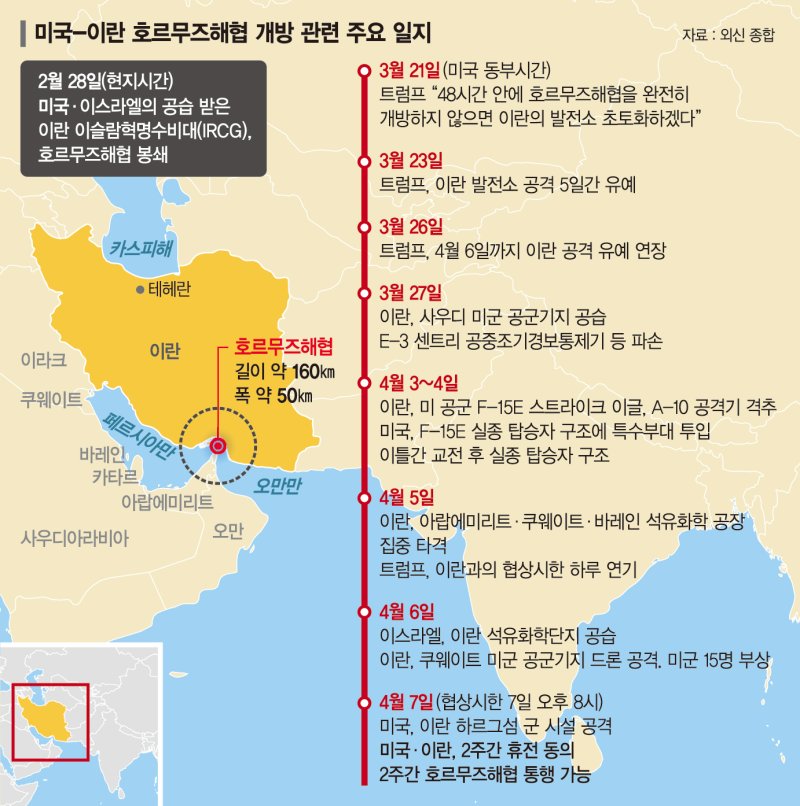
The move to reopen the Strait of Hormuz, in exchange for the US halting its attacks on Iran, falls far short of the "unconditional freedom of navigation" that the international community has been demanding. On 28 February, immediately after US strikes, Iran moved to fully control the strait as an asymmetric strategy, holding the world economy hostage to offset its overwhelming military disadvantage. Having confirmed the effectiveness of this approach, Tehran is making it clear that it has no intention of easily relinquishing control over the waterway.
Abbas Araghchi, Iran's foreign minister, stated that "safe passage through the Strait of Hormuz will be possible for two weeks, in coordination with the Iranian military and with due consideration for technical limitations." His remarks are being interpreted to mean that ships will only be allowed to pass under strict monitoring and management, such as designated routes or prior approval from Iranian forces.
The biggest flashpoint is whether transit fees will be imposed. At its narrowest point, the Strait of Hormuz is only 54 kilometers wide, making it a geography where Iran can easily project force. Yet it is also an international waterway, and no tolls have ever been charged there. Now, however, Iran and the Sultanate of Oman are pushing a plan to levy fees on vessels passing through the strait, starting from this two-week truce period. A Middle Eastern official familiar with the negotiations told The Associated Press (AP), "The two-week cease-fire plan includes a provision allowing Iran and Oman to charge transit fees to ships passing through the Strait of Hormuz," adding, "Iran will use the funds it collects for reconstruction." Earlier, CNN reported that Iran had been demanding up to $2 million (about 3 billion won) per vessel in exchange for passage through the strait.
■ Trump turns a blind eye: "They can start rebuilding"
The US appears to be effectively tolerating Iran's overt bid to control the strait and collect fees, even though it shakes the foundations of the international maritime order. U.S. President Donald Trump wrote on Truth Social, "The United States will help clear the traffic jam in the Strait of Hormuz," adding, "There will be many positive developments and huge profits will be generated. Iran can begin the rebuilding process." His comments suggest that Washington has, as part of the truce terms, accepted at least in part Iran's plan to finance its postwar reconstruction by collecting transit fees in the Strait of Hormuz.
Trump went on to say, "We will be sending in all kinds of supplies, and we will stay around to make sure everything is going well," adding, "Just as the United States is experiencing now, this could be a golden age for the Middle East." Analysts say that, for the US as well, which could not be fully insulated from the severe damage to European and Asian economies and the risk of a global supply-chain collapse, securing the visible outcome of reopening the strait was the top priority.
Iran's effective exercise of control and its plan to charge fees represent a massive burden and a new risk factor for global shipping companies. Shipping firms and insurers are taking a cautious stance, hesitating to immediately return to previous routes. They are concerned not only about steep transit fees but also about the lack of clarity over navigation routes and the duration of any security guarantees.
Owners of more than 800 vessels trapped in the Persian Gulf are scrambling to obtain detailed information on passage through the Strait of Hormuz. The ships currently stuck in Gulf waters include 97 crude oil and condensate tankers, 121 refined-product tankers, 208 petrochemical and biofuel carriers, 34 liquefied petroleum gas (LPG) carriers, and 19 liquefied natural gas (LNG) carriers. Outside the strait, more than 200 additional vessels are waiting at anchor.
[email protected] Kim Kyung-min Reporter