April Nationwide Apartment Occupancy Outlook Index Falls to Lowest Level Since Impeachment Crisis
- Input
- 2026-04-09 11:00:00
- Updated
- 2026-04-09 11:00:00
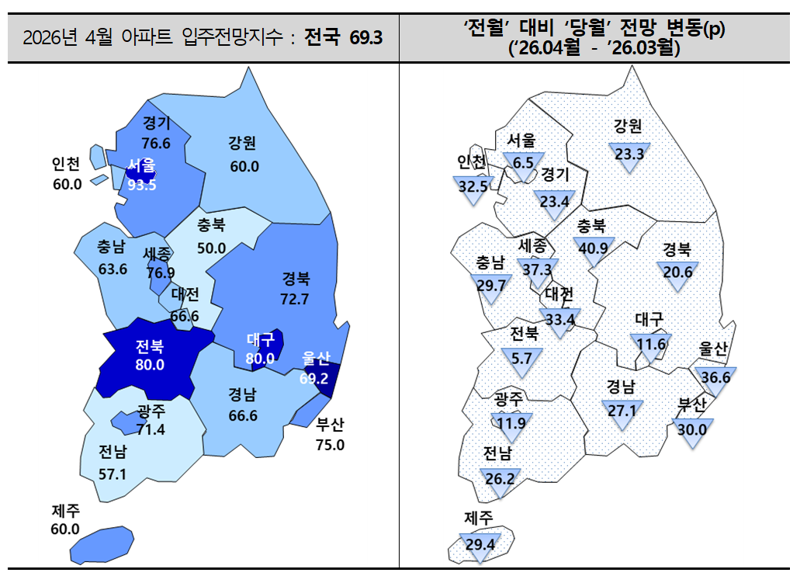
On the 9th, a survey of housing developers by the Housing Industry Research Institute showed that the nationwide apartment occupancy outlook index for April stood at 69.3, down 25.1 points from the previous month. This is the first time the nationwide index has dropped below 70 since January last year, when uncertainty surged amid the impeachment crisis.
The Housing Industry Research Institute attributed the sharp decline in the outlook to several factors: the burden of rising mortgage rates, tighter regulations on interim and final payment loans for new apartments, and a continued slump in transactions. It also noted that the scheduled end next month of the temporary easing of Capital Gains Tax surcharges and concerns over a prolonged war in the Middle East have added to domestic and external uncertainty.
In the Seoul Capital Area, the index is projected to fall to 76.7, down 20.8 points from the previous month. Within this, Seoul recorded 93.5, a decline of only 6.5 points. This is interpreted as reflecting smaller declines in the move-in outlook for new apartments, as areas on the outskirts of Gangbuk (northern Seoul) with many apartments priced at 1.5 billion won or less have seen fewer listings and rising prices.
Incheon Metropolitan City came in at 60, and Gyeonggi Province at 76.6, down 32.5 points and 23.4 points, respectively, from the previous month.
In the metropolitan cities, the index fell 26.8 points to 73.2, while in the provincial regions it dropped 25.4 points to 63.7, indicating steep declines across the board.
The Housing Industry Research Institute analyzed that the relatively larger drop in non-capital regions was driven by stronger pressure to dispose of properties outside Seoul. It explained that regulations on owners of multiple homes have accelerated the so‐called "one smart home" phenomenon centered on Seoul, where households concentrate on holding a single high-quality property. The institute added that this trend is likely to intensify if extensions of mortgage loans for owners of multiple homes are restricted under the government's "2026 Household Debt Management Plan" announced on the 1st.
Meanwhile, the nationwide apartment occupancy rate in March was 60.6%, down 1.4 percentage points from February. The occupancy rate was 81.8% in the Seoul Capital Area and 56.1% in non-capital regions.
In Seoul, the occupancy rate reached 91%, up 5.8 percentage points from 85.2% in the previous month. In Incheon and Gyeonggi Province, the rate was 77.3%, down 3.7 percentage points from 81% a month earlier.
The main reasons cited for non-occupancy were: failure to secure final-payment loans (32.1%), delays in selling existing homes (32.1%), failure to secure tenants (17%), and delays in selling pre-sale rights (3.8%).
[email protected] Choi Ga-young Reporter