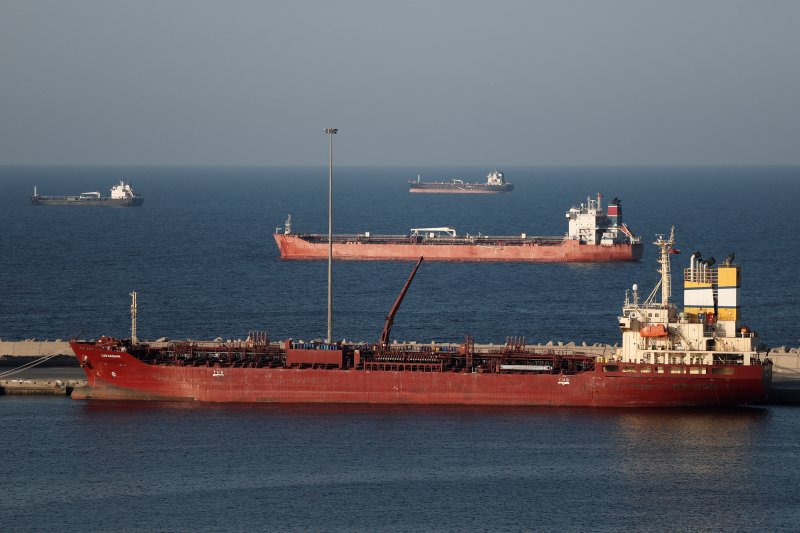
"There’s a Cease-Fire, So Why Aren’t Ships Leaving Hormuz?" Government Still Hasn’t Issued Routing Orders for 26 Vessels
- Input
- 2026-04-08 15:13:23
- Updated
- 2026-04-08 15:13:23
On the 8th, after the United States and the Islamic Republic of Iran agreed to a temporary two-week cease-fire, the Iranian government announced that passage through the Strait of Hormuz would be allowed during the truce. Even so, the Korean government has not been able to promptly determine whether it is now safe enough for Korean ships to leave the Strait of Hormuz. The government plans to decide whether the 26 stranded vessels can safely transit the area through consultations among the Ministry of Foreign Affairs of the Republic of Korea, the Ministry of Oceans and Fisheries (MOF), the Ministry of Trade, Industry and Energy of the Republic of Korea, and other relevant ministries.
To that end, the Ministry of Foreign Affairs of the Republic of Korea has begun gathering information through diplomatic channels with various countries on when the blockade of the Strait of Hormuz will be lifted and on possible routes for resuming operations. The ministry has been coordinating the timing of resuming sailings while communicating with countries including Japan, France, and the Islamic Republic of Iran.
According to the International Maritime Organization (IMO), about 2,000 vessels worldwide are stranded in the Strait of Hormuz, with more than 20,000 seafarers on board. Ships from Japan, France, China, India, Thailand, Southeast Asia, and other countries have been trapped there.
Of the 26 Korean vessels stuck in the Strait of Hormuz, seven are oil tankers operated by domestic refiners. The crude oil they are carrying is reported to total around 14 million barrels. Four of the seven tankers are operated by Korean shipping companies. There are no liquefied natural gas (LNG) carriers among the stranded vessels.
In a spokesperson’s statement on the cease-fire in the Middle East, the Ministry of Foreign Affairs of the Republic of Korea said, "The government hopes that the free navigation of all vessels, including Korean ships, in the Strait of Hormuz will be restored swiftly and safely, and will continue communication and consultations with the countries concerned to that end." It also welcomed the fact that the cease-fire between the United States and the Islamic Republic of Iran has created conditions for resuming traffic through the Strait of Hormuz, and highly praised the mediation efforts of Pakistan and other related countries. However, it did not present any specific position on the movement of Korean vessels still stranded in the strait.
Differing interpretations among countries over when exactly the cease-fire takes effect have also been a factor. One view holds that the cease-fire took effect immediately after the agreement between the United States and the Islamic Republic of Iran was announced, while another argues that it begins only after the Strait of Hormuz is reopened.
A White House official told the U.S. online outlet Axios that the cease-fire would take effect as soon as the Strait of Hormuz is reopened.
By contrast, Prime Minister Shehbaz Sharif of Pakistan, who mediated the truce, wrote on X (social network) that "the Islamic Republic of Iran and the United States, together with their allies, have agreed to an immediate cease-fire across all regions of the Middle East, including Lebanon," adding, "This measure takes effect immediately."
Donald Trump wrote on Truth Social, "On the condition that the Islamic Republic of Iran agrees to the full, immediate, and safe opening of the Strait of Hormuz, I agree to suspend bombing and attacks on the Islamic Republic of Iran for two weeks." Citing three Iranian officials, The New York Times (NYT) reported that "the Islamic Republic of Iran has accepted the two-week cease-fire proposal, and Ayatollah Mojtaba Hosseini Khamenei has approved it." Iranian Foreign Minister Abbas Araghchi also stated that safe passage through the Strait of Hormuz would be possible for the two-week period.