Manufacturing Outlook Index Falls in Q2, While Semiconductors and Cosmetics Surge Ahead
- Input
- 2026-04-08 13:50:15
- Updated
- 2026-04-08 13:50:15
[Financial News] Despite strong exports led by semiconductors, the manufacturing Business Outlook Index for the second quarter edged down slightly from the previous quarter. Analysts say the decline reflects concerns over supply chain instability stemming from the Middle East situation, rising freight rates, and exchange rate volatility.
The Korea Chamber of Commerce and Industry (KCCI) announced on the 8th that the Business Survey Index (BSI) for the second quarter came in at 76, down 1 point from the previous quarter. The survey was conducted over 13 days from March 5 to 18, immediately after the outbreak of the Middle East wars, and covered 2,600 manufacturing companies nationwide, of which 2,271 responded. It was a period when concerns and tensions over the Middle East wars were beginning to intensify.
A reading of 100 or above means more companies view the quarter’s business conditions more positively than in the previous quarter, while a reading below 100 indicates the opposite.
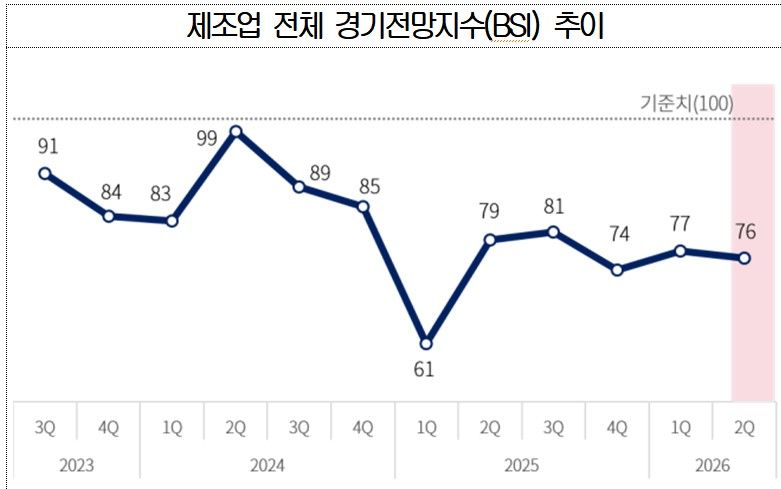
For domestic demand-oriented companies, the second-quarter outlook index rose 4 points from the previous quarter to 78. In contrast, the index for export-oriented firms plunged 20 points to 70, as the Middle East situation emerged as a key risk factor. Among 14 major industries, only two—semiconductors (118) and cosmetics (103)—expected favorable conditions, while the remaining 12 sectors all fell below the benchmark of 100. Negative sentiment was particularly strong in the petroleum refining and petrochemical sector (56), which has been hit directly by the Middle East situation, and in steel (64), where weakness continues due to the construction downturn.
Manufacturers cited "rising raw material and energy costs" as the top internal and external risk affecting their performance in the first half of this year, with 70.2% selecting it in multiple responses. This was followed by "geopolitical risks such as wars" (29.8%), "greater exchange rate volatility" (27.6%), "slower recovery in consumption" (19.1%), and "weaker export demand" (13.9%).

Even as external risks such as the Middle East situation persist, 61.1% of responding companies—about 6 out of 10—said they are "carrying out their first-half investment plans as scheduled, as decided late last year or at the beginning of this year." Another 3.8% replied that their investments are "being expanded beyond the original plan." However, 35.1% said investments are "being reduced or delayed compared with the original plan," suggesting that policymakers need to closely monitor the situation to prevent a broader pullback in investment.
Companies most frequently pointed to "worsening demand and market conditions" (26.9%) as the reason their first-half investments were reduced or delayed from initial plans. This was followed by "higher production costs such as energy and raw materials" (24.4%), "changes in the trade environment such as tariffs and wars" (23.9%), and "deteriorating financing conditions" (19.9%).
Kang Min-jae, Head of Economic Policy Team at KCCI, said, "Despite the strength in semiconductors, trade uncertainties and upward pressure on energy and raw material prices caused by the Middle East wars are weighing on the manufacturing sector as a whole," adding, "We will maintain close communication so that effective countermeasures can be put in place."
[email protected] Jo Eun-hyo Reporter