Mortgage Balances Hold Steady, While Middle East Tensions Fuel Leveraged Stock Bets
- Input
- 2026-04-08 12:00:00
- Updated
- 2026-04-08 12:00:00

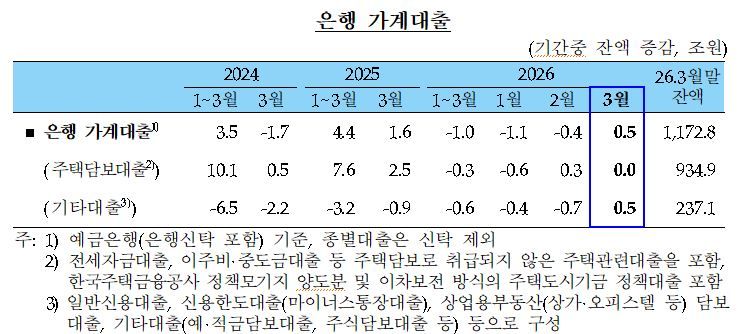
According to the "Financial Market Trends in March 2026" released by the Bank of Korea (BOK) on the 8th, outstanding mortgage loans at the end of March came to 934.9 trillion won. On a 100-billion-won basis, the level was the same as a month earlier. The indicator had posted continuous growth for 34 months since February 2023, when it fell by 300 billion won, before turning to a decline in December last year and solidifying that trend in January. It then swung back to a 300-billion-won increase in February.
The BOK interpreted the freeze as stemming from banks’ continued management of household lending and a slowdown in demand for jeonse funds. In fact, jeonse loans shrank by 300 billion won in January, 200 billion won in February, and another 400 billion won in March.
However, housing transaction activity has not cooled significantly. Apartment sales in the greater Seoul area reached 18,000 units in November and 19,000 in December last year, then rose to 22,000 in January and 20,000 in February. In Seoul alone, apartment transactions increased from 3,400 and 4,800 units in those two months to 5,400 in January and 5,700 in February.
Other household loans expanded. Their outstanding balance at the end of March was 237.1 trillion won, up 500 billion won from the previous month, breaking a three-month streak of declines. Despite write-offs and sales of non-performing loans at the end of the quarter, continued stock investment drove a turnaround in growth, mainly through credit loans.
Total outstanding household loans at banks stood at 1,172.8 trillion won. The balance increased by the same 500 billion won as the rise in other loans from a month earlier, reversing a three-month period of contraction.
Park Min-cheol, deputy head of the Market Management Team in the BOK’s Financial Markets Department, said, "With the government’s household loan management measures announced on the 1st, financial institutions are also tightening oversight, so household lending is likely to remain subdued for the time being." He added, "However, the slowdown in housing prices in the Seoul metropolitan area has only been evident since February, and some regions are still seeing gains, so we need to watch whether this turns into a sustained decline."
Regarding other loans, Park noted, "Since the outbreak of the Middle East crisis, we have seen them increase on days when stock prices fall sharply," and warned, "If stock investment using credit financing grows, it can amplify the scale of declines when the market corrects."
Loans to large corporations climbed from 5.2 trillion won to 3.4 trillion won in net new lending, driven by banks’ more aggressive loan marketing and demand for funds to repay corporate bonds. Loans to small and mid-sized firms expanded from 4.3 trillion won to 4.5 trillion won, as major banks increased business lending in the name of "productive finance" and companies’ working capital needs grew, widening the pace of growth.
Corporate bonds saw net redemptions of 300 billion won. Larger volumes of maturing bonds, seasonal factors such as shareholder meetings and business report filings, and heightened interest-rate volatility all played a role. Commercial paper (CP) and short-term corporate bonds also shifted from a net issuance of 100 billion won in the previous month to net redemptions of 3 trillion won, as some firms repaid short-term debt to manage quarter-end financial ratios even while raising funds to repay corporate bonds.
Bank deposits increased by 20.5 trillion won, down sharply from a 47.3 trillion won rise a month earlier, but the upward trend remained intact. Demand deposits grew by 25.8 trillion won, helped by inflows of corporate funds for quarter-end financial ratio management and dividend payments.
Time deposits, however, swung from a 10.7 trillion won increase to a 4.4 trillion won decrease, as household funds flowed out for stock investment and a large volume of asset-backed commercial paper (ABCP) linked to time deposits reached maturity.
At asset management companies, client assets shifted from a 48.6 trillion won increase to a 29.1 trillion won decrease. Measured on a total net assets basis, this reflected valuation losses stemming from the sharp stock market drop triggered by the Middle East crisis.
Equity funds swung from a 34.1 trillion won increase to an 18.8 trillion won decrease, while other funds moved from a 7.6 trillion won rise to a 1.1 trillion won decline. Bond funds saw their net outflows widen dramatically, from 200 billion won to 6.1 trillion won.
Money market funds (MMFs) also reversed direction, shifting from a 5.5 trillion won increase in the previous month to a 4.7 trillion won decrease. This was attributed to outflows of corporate funds used to manage quarter-end financial ratios.
[email protected] Kim Tae-il Reporter