Can the Strait of Hormuz Ever Return to the Way It Was?
- Input
- 2026-04-08 09:30:34
- Updated
- 2026-04-08 09:30:34
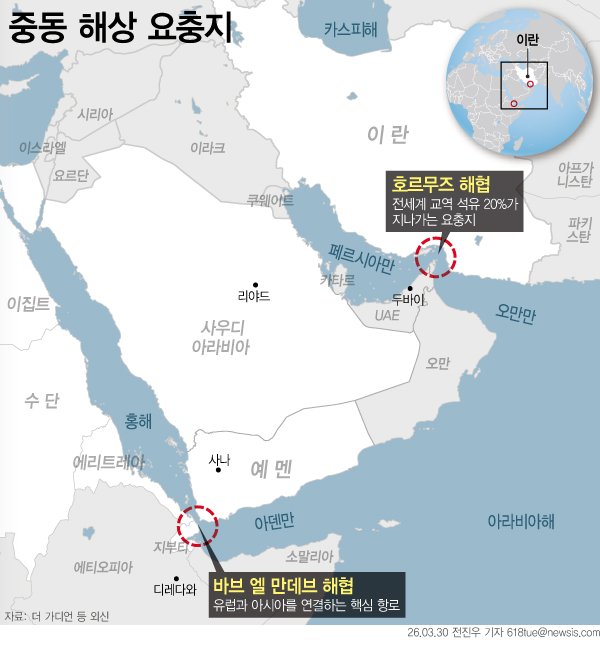
[Financial News] The United States and the Islamic Republic of Iran have agreed to a two-week ceasefire, offering temporary relief for the Strait of Hormuz, a key chokepoint for global maritime logistics. International oil prices, which had surged to around 120 dollars per barrel on fears of a blockade, dropped more than 12% on news of the talks and moved back toward stability. However, the measure is only a conditional opening rather than a full return to normal, leading many in the global energy and shipping markets to describe it as "a temporary stability that could be reversed at any time." Analysts also note that the "controlled passage" approach proposed by the Islamic Republic of Iran has emerged as a new variable that could unsettle the international maritime order, leaving significant uncertainty even after the ceasefire.
Opened, but far from fully free passage
According to major foreign media on the 7th (local time), the core of the ceasefire deal is a conditional trade-off: the Islamic Republic of Iran agrees to a full and safe opening of the Strait of Hormuz, while the United States halts its attacks. On the surface, this appears to remove the risk of a blockade, but observers point out that the arrangement falls short of restoring the kind of free navigation that existed before.
The method proposed by the Islamic Republic of Iran is closer to managed or controlled passage than simple reopening. If specific routes are designated or prior approval procedures are required, the Islamic Republic of Iran would in effect become the gatekeeper for transit through the strait. This could clash with the basic principle of international maritime transport: freedom of navigation. The strait may be open, but effective control still appears to rest with the Islamic Republic of Iran.
The current opening is strictly tied to the ceasefire conditions. If negotiations break down during the limited two-week period, the fear remains that the Strait of Hormuz could be closed again at any moment. For global shipping companies, predictability matters more than the mere fact that passage is technically possible, and the risk of renewed closure is a key factor preventing them from fully returning to former routes. It also adds a new layer of risk for insurers. Specific details such as vessel routes, transit times, and passage conditions could change depending on the talks between the two sides on the 10th of this month.
Oil plunges from 120 dollars... "The real test comes in two weeks"
International oil prices, which had been soaring on fears of a supply chain collapse, reacted immediately to the ceasefire news.
On the New York Mercantile Exchange (NYMEX), West Texas Intermediate crude oil (WTI) closed at 98.75 dollars per barrel, down more than 12% from the previous session, while Brent Crude Oil also plunged about 14% to 95.07 dollars. Since the conflict erupted at the end of February, prices had climbed above 120 dollars per barrel, signaling an impending energy shock, but the market has at least pulled back from a state of extreme fear for now.
Even so, market experts view this decline as a temporary correction. If the two-week ceasefire does not lead to a more structural peace agreement, they warn that oil prices are highly likely to return to triple digits.
In a recent report, Goldman Sachs warned, "If the negotiations succeed, the geopolitical premium will be removed and oil prices will stabilize, but if the talks collapse, renewed fears of a reclosure of the Strait of Hormuz will intensify, putting strong upward pressure on prices, potentially pushing them above 130 dollars per barrel."
Energy consulting firm Kpler described the Strait of Hormuz as "an artery that handles 20% of the world's seaborne oil flows," and explained, "Unless safety within the strait is fully guaranteed, beyond the mere resumption of passage, the geopolitical risk premium will inevitably continue to be reflected in prices."
[email protected] Kim Kyung-min Reporter