U.S. undersecretary optimistic about "constructive dialogue and cooperation" on South Korea’s network law revision
- Input
- 2026-04-08 07:40:24
- Updated
- 2026-04-08 07:40:24
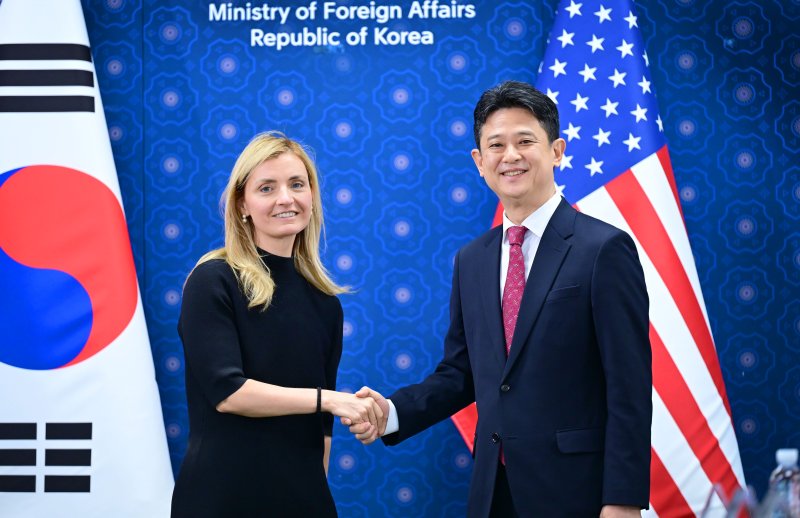
The Financial News reported that a U.S. government official who had criticized South Korea’s revision of the Act on Promotion of Information and Communications Network Utilization and Information Protection has now said she held constructive talks with the South Korean government and looks forward to continued consultations.
U.S. Under Secretary of State for Public Diplomacy Sarah Rogers held a press briefing on the 7th (local time) at the Foreign Press Center in Washington, D.C. Referring to the amendment to the Act on Promotion of Information and Communications Network Utilization and Information Protection that passed the National Assembly of the Republic of Korea last December, she said that she had "very productive conversations" with the South Korean government. Overall, she added, "those conversations were constructive and made me optimistic about our cooperation" in South Korea–United States relations. Rogers met Ambassador and Deputy Minister for Public Diplomacy Lim Sang-woo in Seoul on the 1st to discuss pending issues and conveyed in detail U.S. concerns over the amended act, which is set to take effect in July.
The revised law allows courts to impose punitive damages of up to five times the actual loss on media outlets, YouTubers and others that distribute false information. It also significantly strengthens the duty of platforms such as YouTube to monitor and manage content. In the United States, critics have raised suspicions that the measure is aimed at major U.S. IT companies such as Google, Meta and X (social network).
Rogers had criticized the amendment on social media shortly after it passed in December, arguing that it threatened South Korea–United States relations. The United States Department of State (State Department) also issued a statement at the time, warning that the revised law could single out U.S. IT companies.
Speaking about the amended Act on Promotion of Information and Communications Network Utilization and Information Protection, Rogers said, "We wanted to make clear that there should be appropriate, step-by-step communication between governments and companies to potentially limit censorship of freedom of expression." She went on to say that the dialogue with South Korea on this issue "was quite encouraging."
Rogers also said she had questioned whether the content monitoring obligations imposed on platform companies might "improperly encourage companies to control content in ways they think the government wants." She explained that talks with South Korean officials had made her "more optimistic" on that point.
She noted, "We discussed how to ensure that platform companies, including U.S. technology firms, are not excessively burdened by these regulations, and that defamation provisions apply only to statements that are factually false, not to controversial political claims." At the same time, she stressed, "I believe the discussions were very productive." Rogers added, "Through these conversations, I gained the impression that the Korean side understands the issue, and I look forward to continued consultations as the law is implemented."
Rogers, meanwhile, declined to speculate on how South Korea’s amended Act on Promotion of Information and Communications Network Utilization and Information Protection might affect future U.S. trade policy toward South Korea. "With regard to Section 301 of U.S. trade law, I will leave any response to the Office of the United States Trade Representative (USTR), which is responsible for that process," she said.
[email protected] Park Jong-won Reporter