"The Bomb Hit South Korea"...U.S. Think Tank Names South Korea the Biggest Victim of the Iran War
- Input
- 2026-04-08 07:28:34
- Updated
- 2026-04-08 07:28:34
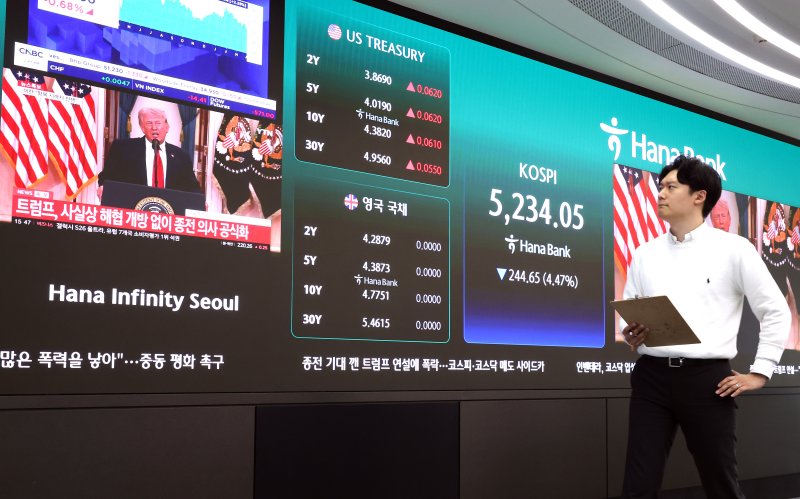
[The Financial News] As the Middle East war involving the USA and the State of Israel on one side and Iran on the other stretches beyond a month, South Korea has been singled out as one of the countries suffering severe damage despite not taking part in the fighting.
A U.S. think tank assessed that, with the Strait of Hormuz—South Korea’s key maritime route for crude oil imports—effectively blocked, the country has exposed serious vulnerabilities across energy, petrochemicals, semiconductors, and the broader macroeconomy.
As a result, the KOSPI recorded the worst single-day drop in its 43-year history, and the Korean won fell to its lowest level in 17 years.
Energy vulnerabilities exposed by dependence on the Strait of Hormuz
The Center for Strategic and International Studies (CSIS) stated in a report released on the 2nd (local time), titled "The Impact of the Iran Conflict on South Korea: A Data-Driven Analysis," that among non-belligerent countries, South Korea is the biggest victim of the current conflict.
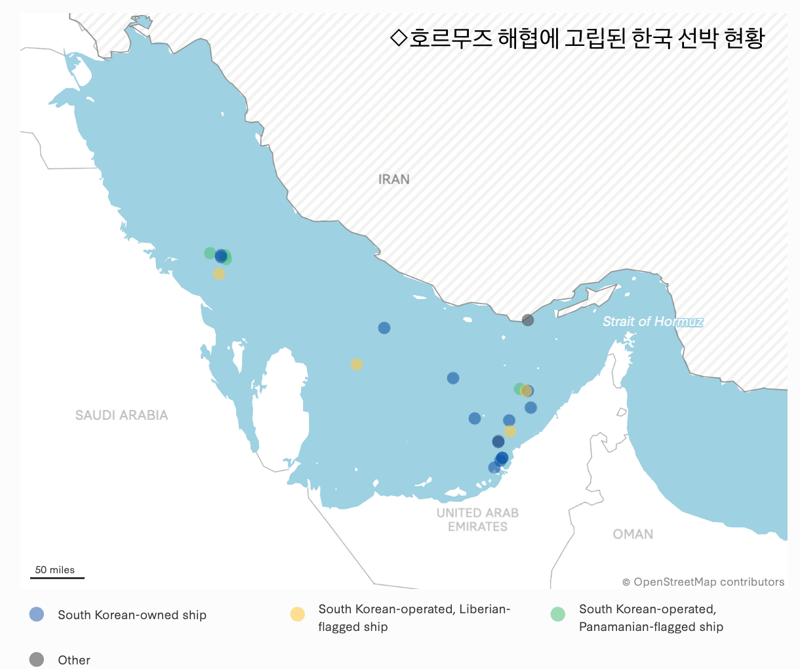
CSIS pointed to Iran’s blockade of the Strait of Hormuz as the decisive factor behind the damage inflicted on South Korea.
In February, before the conflict escalated, 33 South Korean-flagged vessels passed through the Strait of Hormuz. Now, 26 of them are stranded in the Persian Gulf. Of these, as many as 17 are crude oil and oil product tankers. There are also 5 bulk carriers, 2 gas carriers, and one container ship and one car carrier.
Accordingly, the government’s strategic petroleum reserves are estimated to cover only about 26 days of actual consumption.
The Organisation for Economic Co-operation and Development (OECD) has lowered its forecast for South Korea’s economic growth by 0.4 percentage points, the sharpest downgrade among major economies, while raising its inflation outlook to 2.7%.
CSIS noted, "South Korea is highly dependent on the Strait of Hormuz for crude oil and a range of other critical resources," and projected, "Over the next two to six months, the disruption is likely to affect all sectors, including transportation, logistics, petrochemicals, agriculture, and food and beverages."
Industrial damage from disrupted crude oil imports
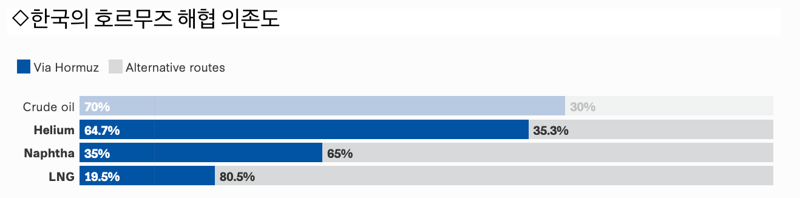
Seventy percent of South Korea’s crude oil imports pass through the Strait of Hormuz. As energy imports run into trouble, the petrochemical sector has been hit directly.
About 35% of the Naphtha used in South Korea as a key feedstock for plastics, synthetic fibers, and petrochemical products is imported via the Strait of Hormuz. The government has now designated Naphtha as a strategic economic security item and imposed an export ban.
Warning lights have also come on for the semiconductor supply chain. The State of Qatar, which supplies 64.7% of the helium used in semiconductor manufacturing processes, has come under Iranian attack. With production halted at Ras Laffan Industrial City in Qatar, helium prices are reported to have surged by more than 40%.
The Korea Semiconductor Industry Association has said that short-term helium supplies are sufficient and that companies have diversified their sources. Even so, the government has tightened monitoring of 14 semiconductor raw material items, including helium.
CSIS also argued that, although South Korea’s official oil reserves appear solid on paper, the outlook is "pessimistic" from an operational standpoint.
Under International Energy Agency (IEA) criteria, South Korea is recorded as holding strategic petroleum reserves equivalent to 208 days of net imports. However, because this is based on net import volumes, CSIS estimated that, using the actual refining throughput of 2.9 million barrels per day as the benchmark, the government’s 101 million barrels of reserves would last only about 34 days. Even when private-sector reserves are included, the total is only around 67 days.
On top of that, South Korea joined the IEA’s emergency release of 400 million barrels on the 12th of last month, drawing down an additional 22.5 million barrels. This reduced government reserves to 77.6 million barrels, estimated to cover roughly 26 days of consumption. South Korea then secured an emergency 24 million barrels from the United Arab Emirates (UAE) on the 18th of last month, which appears to have extended its buffer by about eight to nine days.
CSIS assessed, "The likelihood that South Korea will enter into direct negotiations with Iran is low," and advised, "It would be prudent for Seoul to watch Japan’s moves closely and calibrate its own response accordingly."
[email protected] Seo Yoon-kyung Reporter