A ‘switch’ for colorectal cancer immunotherapy found: what wakes up dormant immune cells? [Unboxing Lab]
- Input
- 2026-04-08 05:57:00
- Updated
- 2026-04-08 05:57:00
Do you remember the excitement of opening a package that just arrived? In university labs, discoveries that could transform our lives are being made at this very moment. They are simply wrapped in thick "paper" called academic journals. In Unboxing Lab, we skip the complicated equations and theories and pull out only the core ideas you really want to know. So, shall we open today’s box? The study we are unboxing today is this one.
■ A new weapon to break through the 10% barrier
This achievement is expected to offer tangible hope especially to the majority of CRC patients for whom immunotherapy has not worked well. About 85% of CRC patients have tumors with a trait known in technical terms as mismatch repair-proficient (pMMR) and microsatellite stable (MSS). These cancer cells are exceptionally good at hiding their own defects, making it extremely difficult for immune cells to recognize them as enemies. As a result, even when immune checkpoint inhibitor therapies are administered, response rates have remained below 10%, clearly revealing the limits of current treatment.
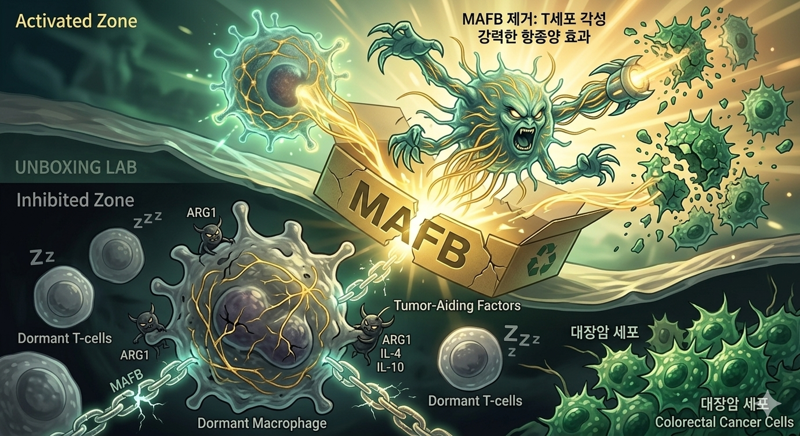
However, by using the newly identified technique to regulate transcription factor MafB (MAFB), the research team can revert the inactivated tumor microenvironment back to an "immune-active" state. If drugs are developed that selectively inhibit this protein, they could be combined with existing therapies to dramatically increase cure rates for CRC and establish a new standard treatment strategy.
■ Proving the saboteur’s identity with data from 62 patients
To understand why immunotherapy fails in most patients, the team performed high-precision, single-cell–level analysis of the tumor microenvironment in 62 CRC patients and 36 non-cancer controls. They discovered that in patients who did not respond to treatment, the area around the cancer cells contained unusually high levels of transcription factor MafB (MAFB) inside tumor-associated macrophages (TAMs).
Through experiments, the researchers confirmed a clear inverse relationship: the higher the level of transcription factor MafB (MAFB), the lower the therapeutic effect of immune checkpoint inhibitor treatment. In other words, elevated MAFB was actively interfering with the proper functioning of the body’s defense system.
An even more striking twist emerged when transcription factor MafB (MAFB) was removed. MAFB normally acts as a "genetic switch" (a transcriptional regulator) that directs the production of three key factors—arginase 1 (ARG1), Interleukin-4 (IL-4), and Interleukin-10 (IL-10)—which turn macrophages into helpers of cancer cells. When the team switched off this control (by eliminating MAFB), the tumor microenvironment flipped 180 degrees into one that attacks, rather than supports, cancer cells.
As a result, the researchers experimentally confirmed that the killing power of friendly immune cells that directly target cancer cells increased markedly. Of course, additional research and clinical trials are needed before this can become an actual new drug. Even so, this study presents the clearest milestone yet for CRC treatment, which has long been trapped behind the 10% response-rate barrier.
■ Lead researchers and journal
This important discovery was made possible by the dedicated efforts of the research team led by Professor Tae-Hoon Chun in the Department of Convergence Biotechnology at Korea University (KU). Sang-Pil Choi, Jun Yang, and In-Byung Park participated as co–first authors and played key roles in the study.
The team published their findings in Translational Research: The Journal of Laboratory and Clinical Medicine, a leading international journal in medicine and life sciences, thereby gaining recognition for the work’s academic value. The study is drawing significant attention because it proposes a new therapeutic avenue based directly on real patient data.
[email protected] Kim Man-gi Reporter