"I'll pay you after your next paycheck": Wage arrears reached 2 trillion won last year
- Input
- 2026-04-07 18:30:25
- Updated
- 2026-04-07 18:30:25
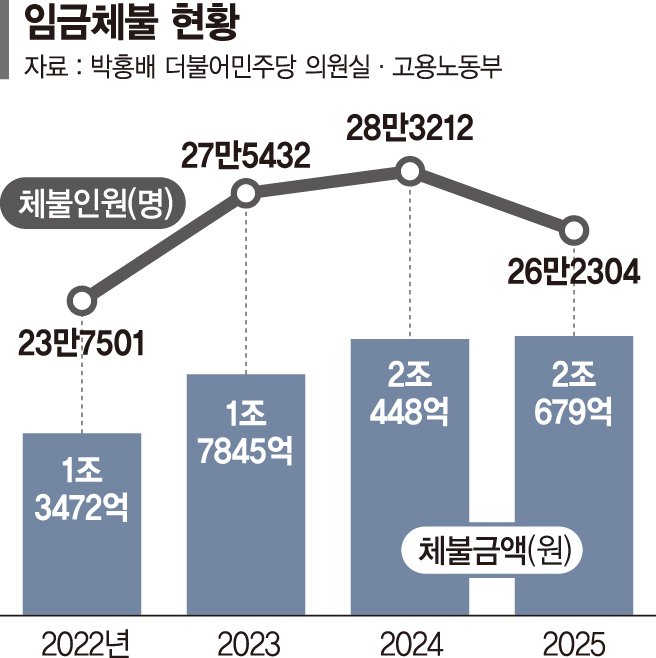
The scale of unpaid wages has exceeded 2 trillion won for two consecutive years, and the number of affected workers has stayed above 200,000 for four years in a row, leading to repeated damage. On the ground, many say that penalties lack real effectiveness and that employers still believe they can "pay overdue wages later." The subcontracting structure, which disperses responsibility, and systems that make it hard for workers to prove wage arrears are also cited as key causes.
According to data submitted by the Ministry of Employment and Labor (MOEL) to Representative Park Hong-bae of the Democratic Party of Korea (DPK), a member of the Environment and Labor Committee of the National Assembly of the Republic of Korea, and obtained by The Financial News on the 7th, total wage arrears last year reached 2.0679 trillion won, the highest level on record. The number of workers affected came to 262,304. Over the past four years, unpaid wages have continued to rise: 1.3472 trillion won in 2022 (237,501 workers), 1.7845 trillion won in 2023 (275,432 workers), 2.0448 trillion won in 2024 (283,212 workers), and 2.0679 trillion won in 2025 (262,304 workers).
203.5 billion won, or 9.8%, remains unpaid
Unsettled unpaid wages alone amount to several hundred billion won. Of last year’s total arrears, 1.8644 trillion won (90.2%) was eventually paid, but 203.5 billion won (9.8%) remains outstanding. The number of workers who have still not been paid was 5,022.
Wage arrears disproportionately affected older workers. As of last year, about 117,000 victims were in their 50s or older, accounting for roughly 44.8% of all affected workers. The unpaid amount owed to this age group reached 990.9 billion won, or about 47.9% of the total.
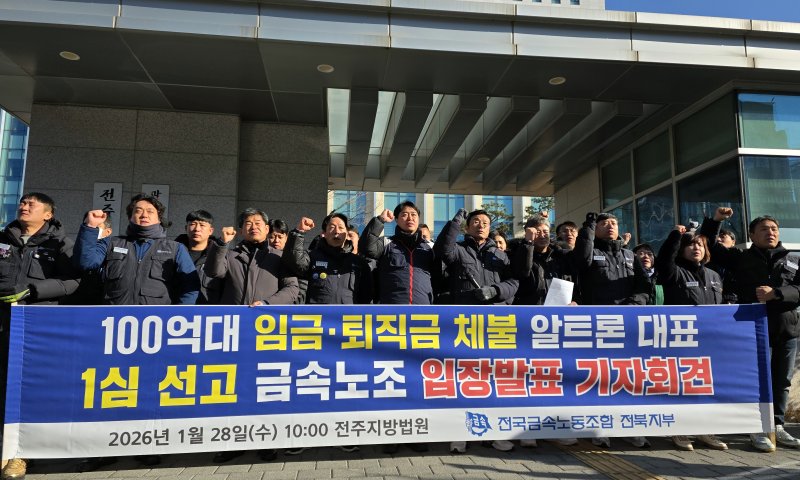
Government labels it as "theft" and toughens penalties on employers
The government has defined wage arrears as a form of "theft" and is stepping up its response. As President Lee Jae-myung has called for a hard-line stance on unpaid wages, the National Assembly passed a bill at its plenary session last month raising the maximum prison term for employers who fail to pay wages from three years to five years. However, observers note that on the ground, many still view wage arrears as a problem caused by "business difficulties" or as a simple delay in payment, so workers feel little real change.
Experts argue that lenient penalties and institutional limitations are reinforcing misguided perceptions about wage arrears.
[email protected] Reporter Kim Ye-ji Reporter