Samsung Electronics Posts 57 Trillion Won in Operating Profit... Set to Overtake Nvidia Next Year [A New Chapter in Samsung Electronics’ Earnings]
- Input
- 2026-04-07 18:30:23
- Updated
- 2026-04-07 18:30:23
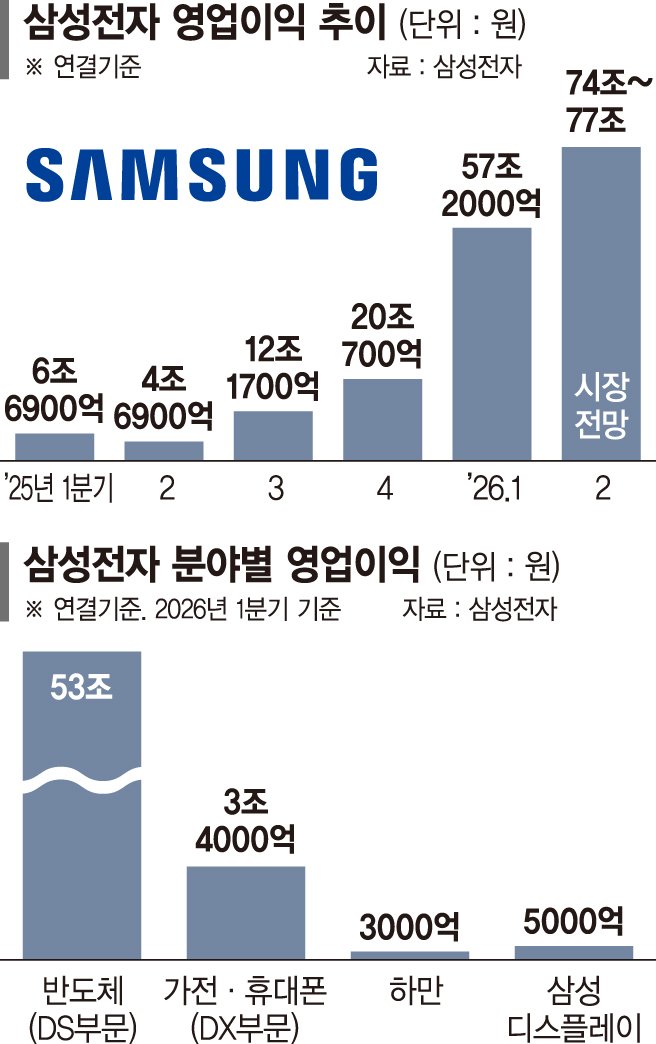
The company has not only opened a new chapter in the history of Korean enterprises, but has also achieved the feat of entering the global top five big tech companies by earnings for the first time. If this trend continues, analysts say its operating profit could exceed 300 trillion won this year and approach 500 trillion won next year, potentially surpassing Nvidia Corporation to claim the title of "world No. 1 in operating profit." The prevailing view in the market is that Samsung Electronics’ record-breaking earnings streak could last at least through 2028.
On the 7th, Samsung Electronics announced that its first-quarter operating profit was tentatively estimated at 57.2 trillion won on a consolidated basis, up 755.01% from a year earlier. This smashes its previous all-time quarterly record of 20.07 trillion won in last year’s fourth quarter by a factor of 2.7. It also beat the market consensus of about 38 trillion won by nearly 20 trillion won, making it a textbook "earnings surprise."
Revenue came in at 133 trillion won, an increase of 68.06%. With profits rising sharply, the operating margin reached an exceptional 43%.
A Samsung Electronics official stated, "The company achieved its highest-ever consolidated results as revenue and profit increased in the Device Solutions (DS) division of Samsung Electronics, centered on the memory business, while the Device eXperience (DX) Division for mobile phones and home appliances strengthened its market competitiveness."
Of the 57.2 trillion won in quarterly operating profit, about 53 trillion won, or 92.7%, is estimated to have come from the semiconductor business. Over the past year, the average price of generic dynamic random access memory (DRAM) has soared about 9.6 times. NAND flash memory for USB devices has also risen 6.8 times. Expanded production of high bandwidth memory (HBM) based on DRAM, the resulting shortage of generic DRAM, and surging DRAM demand from big tech companies have all combined to drive this outcome.
Samsung’s strategy of maintaining a commanding lead in advanced memory such as HBM has also paid off. In February, Samsung Electronics became the first to mass-produce and supply HBM4 high-bandwidth memory (HBM4) to global big tech clients.
Recently, Jun Young-hyun, vice chairman of Samsung Electronics and head of the DS division, said, "We are hearing from our customers that 'Samsung is back,'" expressing strong confidence in the company’s restored technology leadership.
Its status as a global big tech company has also been elevated. Based on the latest quarterly results, Apple Inc. (50.9 billion dollars), Nvidia Corporation (44.3 billion dollars), Microsoft Corporation (38.3 billion dollars), Samsung Electronics (about 38 billion dollars, provisional), and Alphabet Inc. (Google LLC, 35.93 billion dollars) now form the group of the top five companies by earnings.
The market has already begun revising up forecasts for the second quarter and for the full year. Many expect the upward trend in memory semiconductor prices will not easily come to an end. As recently as mid-February, the highest full-year earnings forecast stood at 245 trillion won, suggested by Morgan Stanley. Now, most projections cluster in the low 300 trillion won range, with some reaching the mid-330 trillion won level.
Kim Sun-woo, an analyst at Meritz Securities, commented, "The first-quarter results are only the very beginning," and predicted, "Earnings will grow even more explosively between the fourth quarter of this year and the second quarter of next year."
[email protected] Cho Eun-hyo Reporter