"Naphtha Supply at 80–90% of Normal Levels... All-Out Push to Secure May Cargoes" [US–Iran War]
- Input
- 2026-04-07 18:25:00
- Updated
- 2026-04-07 18:25:00
The government plans to make an all-out effort in April to secure sufficient naphtha and head off a supply crunch in May. Unlike crude oil, naphtha is mostly traded under short-term contracts, so May cargoes must be fixed in April. Officials believe that missing this window would inevitably disrupt petrochemical production.
On the 7th, Yang Ki-uk, Director-General for Industrial and Resource Security at the Ministry of Trade, Industry and Resources, said at the daily briefing of the Middle East Situation Response Headquarters, "Crude oil is imported under long-term contracts, but in most cases, naphtha volumes for May are decided in April." He stressed, "It is crucial that we do everything we can in April to secure sufficient volumes." Yang explained, "Naphtha imports in April are expected to reach about 770,000 tons, roughly 70% of the usual level," adding, "If we include around 1.1 million tons of domestic production, we will secure 80–90% of normal supply, but securing May cargoes remains the key issue."
The government will allocate a budget for naphtha price-difference compensation through a supplementary budget and apply the support retroactively from April 1. Yang stated, "Once the funds are allocated through the supplementary budget, we will work with companies to secure naphtha, using price-difference support and the trade networks of the Korea Trade-Investment Promotion Agency (KOTRA) and others."
Securing alternative crude oil is proceeding as planned. The government has lined up 50 million barrels for April and 60 million barrels for May, equivalent to about 60% and 70% of average-year levels, respectively. Supplies are being diversified across 17 countries, including Saudi Arabia, the United States of America (US), United Arab Emirates (UAE), Brazil, Australia, Republic of the Congo, Gabonese Republic, and Canada.
Use of strategic oil stock swaps is also expanding. Refiners have applied for more than 30 million barrels in swap volumes, up 10 million barrels from the previous announcement. Two deals totaling 2.8 million barrels have already been contracted and delivered, and at least four additional contracts are scheduled this week. By the end of the week, total swap contracts are expected to reach about 8 million barrels. Refinery operating rates are currently being maintained at around 90%. Yang noted, "Operating rates are closely tied to refiners' efficiency and profitability, so they are not lowering them," while adding, "However, overall volumes may fluctuate somewhat depending on spring maintenance schedules."
Overall, supply chains remain largely stable. Packaging materials for intravenous (IV) solutions are expected to see no supply disruptions through the end of June, and inventories of syringes and medical gloves are at normal levels. However, for liquid medicine bottles such as those used for syrups, stock assessments and discussions on raw material supply are still under way.
Helium for semiconductor production is now being sourced from the United States of America (US), while aluminum wheels are being imported from Malaysia, India, and China as alternative supply routes. All nickel sulfate for batteries destined for the domestic market is being produced within Korea, and ethylene gas for shipbuilding is being supplied normally through coordination with petrochemical companies.
The packaging industry, however, is struggling with rising raw material prices and reduced supply. In response, the Ministry of Trade, Industry and Energy of the Republic of Korea, the Ministry of Food and Drug Safety, and the Ministry of SMEs and Startups have formed a task force (TF) to monitor supply conditions and draw up measures to ensure stable supplies of packaging for everyday essentials such as instant noodles and powdered infant formula.
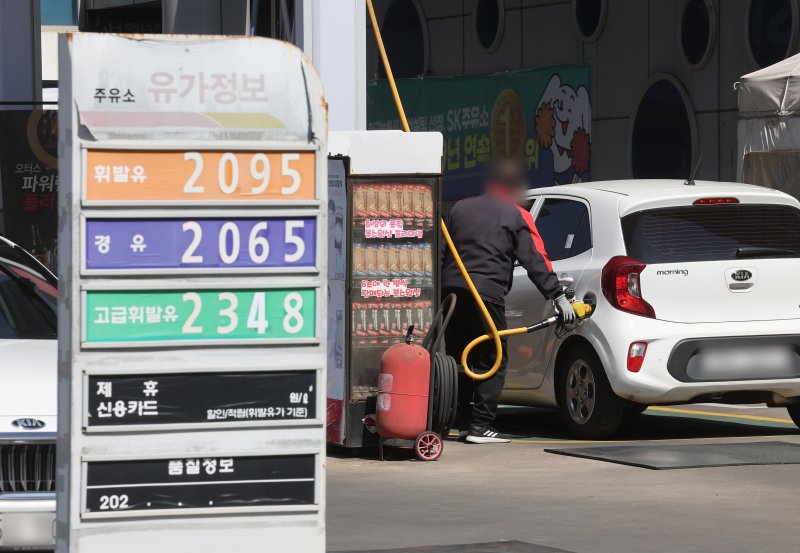
Meanwhile, fuel prices at domestic gas stations continue to rise. According to Opinet, as of 4 p.m. that day, the nationwide average gasoline price at gas stations stood at 1,968.4 won per liter, up 10 won from the previous day. Over the same period, the average diesel price rose 10.6 won to 1,959.8 won per liter.
In Seoul, the average gasoline price reached 2,002.8 won per liter, an increase of 12.4 won from the previous day. The average diesel price in Seoul also climbed 15.3 won to 1,983.3 won per liter. This is the first time in about three years and eight months that gasoline prices in Seoul have been in the 2,000-won range, since July 25, 2022, when they hit 2,005 won amid persistently high oil prices following the Russia–Ukraine war.
[email protected] Koo Ja-yoon and Park Ji-young Reporter