Four astronauts travel 406,771 kilometers and see the far side of the Moon with the naked eye
- Input
- 2026-04-07 18:23:01
- Updated
- 2026-04-07 18:23:01
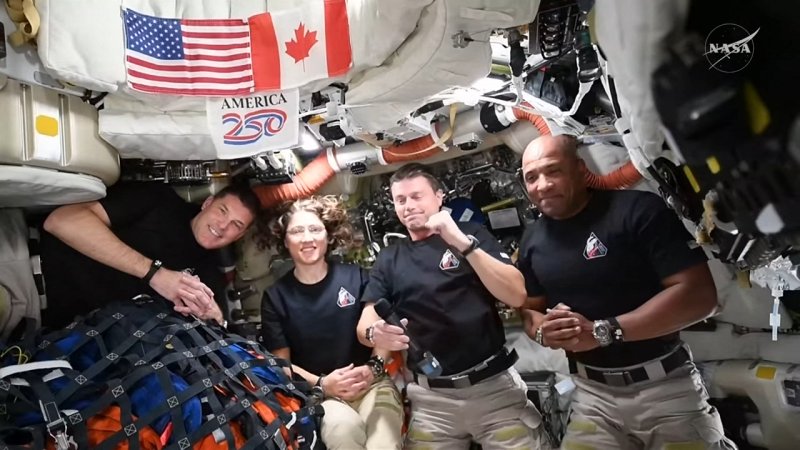
The four astronauts flying NASA’s Artemis II mission, which aims to return humanity to the Moon, successfully carried out a close flyby of the far side of the Moon on the 6th local time. They also set a new record for the farthest distance humans have ever traveled from Earth. Foreign media including Associated Press (AP) reported that the Artemis II crew—three Americans and one Canadian—surpassed the previous distance record of about 400,171 kilometers, set by Apollo 13 in April 1970, just before beginning their lunar flyby.
Ultimately, they reached about 406,771 kilometers from Earth, roughly 6,600 kilometers beyond the old record. Canadian astronaut Jeremy Hansen said over the radio, "The view we can see of the Moon with our own eyes right now is truly unbelievable," expressing his emotion. This is also the first time in history that humans have observed the far side of the Moon with the naked eye. The crew then orbited the Moon, studying craters, basins and other features. They visually observed the lunar surface from a distance of 6,437 kilometers and collected video and photographic data.
■ A precursor to a 2028 landing at the Moon’s south pole
During the close flyby, Artemis II safely passed through a 40-minute communications "blackout" period when contact with Earth was lost, and has now begun its journey home. The spacecraft is scheduled to splash down in the Pacific Ocean near San Diego on the 10th.
After the flyby, U.S. President Donald Trump called the astronauts and praised them as "pioneers of our time." He told them, "Today you made history, and you made all Americans very proud, incredibly proud." He went on to say there would be many more lunar missions to come, culminating in a grand journey to Mars.
This mission is the first crewed lunar voyage in more than 50 years, since Apollo 17 in 1972, and it is a critical step toward future lunar landing missions. During the flight, the astronauts witnessed "Earthrise," the sight of Earth rising above the lunar horizon, and observed flashes caused by meteoroids striking the Moon. Next year, Artemis III is scheduled to rehearse docking between the Orion spacecraft and a lunar lander, and in 2028 Artemis IV is planned to land two astronauts near the Moon’s south pole.
Lori Glaze, acting associate administrator at NASA, said, "We dare to climb higher, explore farther and achieve what once seemed impossible," adding, "The dedication of the Artemis astronauts is about more than breaking records. They are inspiring hope in a bold future." She continued, "Their mission is about keeping our promise to return to the lunar surface and to build a base there so we can stay."
■ Splashdown in the Pacific near San Diego on the 10th
Right after breaking the distance record, the crew asked mission control for permission to name two newly observed lunar craters. They proposed "Integrity," after the name of their spacecraft, and "Carol," after Artemis II commander Reid Wiseman’s wife. Carol died of cancer in 2020.
As Hansen relayed the request to mission control, Commander Wiseman was moved to tears, and the four astronauts embraced one another, sharing the historic moment. Regaining his composure, Wiseman said, "The landscape here is so majestic," and used a high-resolution camera and an iPhone to capture and send images showing the Moon and Earth together in a single frame.
The mission also has deep ties to the heroes of the Apollo era. Each day, the crew woke up to a recorded wake-up message from Apollo 13 commander Jim Lovell, who died last August, saying, "Welcome back to my old neighborhood." They also carried with them a silk mission patch that Lovell had with him on Apollo 8, symbolically linking past and present.
jjyoon@fnnews.com Yoon Jae-joon Reporter