[Editorial] Ruling and Opposition Leaders and the President Meet Amid Crisis, Must Share Responsibility for Protecting People’s Livelihoods
- Input
- 2026-04-07 18:11:01
- Updated
- 2026-04-07 18:11:01
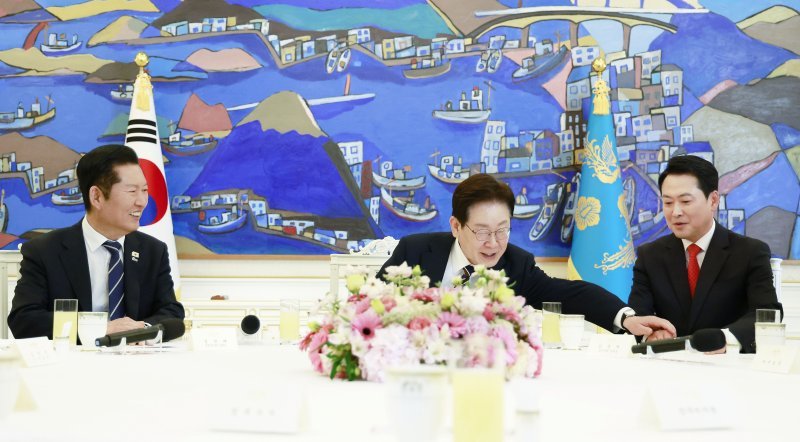
Jang emphasized that political capacity should be focused on people’s livelihoods, raising issues such as an extra budget, the exchange rate, real estate, and parliamentary investigations. Jung, for his part, said that in the face of war there can be no division between ruling and opposition camps, and asked the opposition to cooperate in passing the extra budget bill. In a time of national crisis, it is meaningful that the ruling and opposition parties and the government have come together to seek solutions.
This was the first meeting in seven months between President Lee and the ruling and opposition leaders at Cheong Wa Dae since last September. Given that the Korean economy is now facing a "triple squeeze" of rising oil prices, inflation, and exchange rates due to the shock of the Middle East war, it is also true that this gathering came late. Precisely for that reason, the meeting must go beyond a one-off encounter and develop into regular consultations and practical cooperation. As economic uncertainty grows, the responsibility and role of politics inevitably become heavier.
People are already feeling the strain as higher fuel prices push the gasoline price in Seoul above 2,000 won per liter for the first time in three years and eight months. Prices of manufactured goods have surged to their highest level since statistics began, and companies are under pressure from higher production costs due to difficulties in securing crude oil and naphtha. Costs related to most manufacturing sectors, including packaging materials, construction materials, fertilizers, and daily necessities, are rising, rapidly increasing the burden across the economy. Warning signs are growing louder simultaneously in everyday life and on industrial sites.
Amid this, the Korea Development Institute (KDI) has warned that downside risks to the Korean economy are increasing. It noted that the spike in global oil prices and instability in supply chains are having negative effects across prices, consumption, investment, and exports. Weakened consumer sentiment and greater investment uncertainty are exposing the vulnerabilities of our economy to external shocks. The semiconductor boom is serving as a pillar of support, but given how sensitive the economy remains to external variables, there is little room for complacency. The more serious problem is that domestic and external headwinds are piling up before the economy’s fundamentals have fully recovered.
Despite this growing economic uncertainty, the political sphere remains mired in old patterns of confrontation over various political issues. When external crises and internal conflicts persist at the same time, markets begin to doubt the consistency of policy direction, which can lead to reduced investment and consumption. If fiscal and monetary responses are delayed, the risk increases of falling into a dilemma where inflation instability and economic slowdown occur together. Politicians must soberly recognize that the longer political strife drags on, the heavier the burden on the economy becomes.
What is required of the political class now is not words but action. The president should recognize the opposition as a partner in governing, share key economic issues transparently, and institutionalize regular consultations. The ruling party must refrain from one-sided moves that rely on its numerical advantage, while the opposition should present realistic alternatives instead of criticizing for its own sake. As the triple squeeze becomes a reality, only when the president and both the ruling and opposition camps fully assume their shared responsibility to protect people’s livelihoods will public trust in politics be restored.