Chinese cosmetics labeled 'Made in Korea'? Outlook for K-beauty’s ‘Big Three’ ODMs this year
- Input
- 2026-04-08 06:36:28
- Updated
- 2026-04-08 06:36:28
[The Financial News] As growth in K-beauty gains momentum, expectations are rising for this year’s results at manufacturers Kolmar Korea and COSMAX. Both companies are increasing the share of K-beauty indie brands, which have become hit items overseas, and they are also expected to benefit from the recent global push by "C-beauty" brands from China.
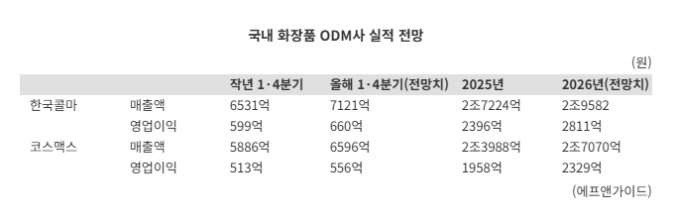
According to financial data provider FnGuide on the 8th, first-quarter consolidated sales at original design manufacturing (ODM) companies Kolmar Korea and COSMAX are projected to reach 712.1 billion won and 659.6 billion won, respectively, up 9% and 12% from a year earlier. Operating profit is expected to grow by around 8–10%.
Kolmar Korea, which has particular strength in skincare such as sun care, is expanding sales to indie brands and thereby accelerating its growth.
Goodai Global, which is preparing for an initial public offering, has been growing rapidly and has emerged as Kolmar Korea’s largest client. Private-label brands from CJ Olive Young, such as BIOHEAL BOH and BRINGGREEN, are increasing order volumes as they move beyond Japan and step up expansion into Europe and other overseas markets. d'Alba Global, the company’s fourth-largest client, is also seeing rising overseas sales, led by its multi balm sticks. By contrast, the shares of Atomy and Carver Korea’s AHC, previously Kolmar Korea’s No. 1 and No. 2 clients, have relatively declined as indie brands have grown.
Skincare accounts for 70% of Kolmar Korea’s portfolio, so it is expected to benefit directly from K-beauty’s skincare-focused exports. According to the Ministry of Food and Drug Safety, skincare products made up about 80% of total cosmetics exports in the first quarter of this year, reaching 2.403 billion dollars. Color cosmetics, by contrast, totaled only 330 million dollars. On top of this, orders from global beauty groups such as L'Oréal, which are looking to tap into K-beauty’s rapid product development capabilities, have been ramping up in earnest since the fourth quarter of last year.
COSMAX, which previously had a relatively high share of makeup products, is also rapidly expanding into indie-brand skincare, now seen as the core driver of K-beauty’s growth. Thanks to the strong performance of major indie brands such as Benow’s Numbuzin, The Founders’ Anua, and APR’s Medicube, skincare has recently grown to account for more than half of its business.
The company is also expected to gain from the global expansion of C-beauty. An increasing number of Chinese brands are outsourcing production to Korean ODM firms, riding on the popularity of K-beauty and marketing their products as "Made in Korea."
COSMAX, whose sales exposure to China is relatively high, is the most aggressive in winning orders from Chinese brands. Its Shanghai subsidiary manufactures makeup products for Chinese luxury beauty label Mao Geping, as well as for Heilai and Judydoll, and produces skincare items for Proya. The Guangzhou subsidiary counts SKINTIFIC, a Chinese skincare brand popular in Indonesia and other Southeast Asian markets, as a major client. As of last year, China accounted for close to 30% of COSMAX’s total sales. Flower Knows, which has recently gained traction among women in their teens and twenties with its princess-style packaging, also outsources part of its production to local subsidiaries of Korean ODMs such as COSMAX and Kolmar Korea. Kolmar Korea, which recently shut down its Beijing plant and consolidated production at its Wuxi facility, is likewise expanding sales efforts targeting local Chinese brands. However, there are concerns that rising prices of raw materials such as Naphtha, driven by the war in the Middle East, and higher costs for cosmetic ingredients and packaging could become a drag on this year’s overall performance.
An industry official said, "K-beauty is expanding its market globally, from the United States to Europe, while C-beauty is also attempting global expansion, so ODM companies are likely to benefit."
unsaid@fnnews.com Kang Myung-yeon Reporter