Ruling party and government accelerate Middle East-driven energy transition, push for mandatory solar power
- Input
- 2026-04-07 11:00:42
- Updated
- 2026-04-07 11:00:42
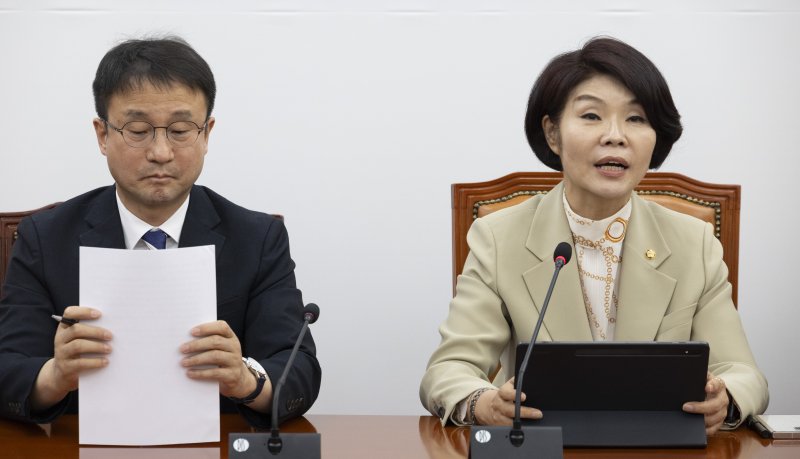
[Financial News] The Democratic Party of Korea (DPK) and the Lee Jae-myung administration are using the surge in oil prices caused by the war involving Iran as an opportunity to accelerate a shift toward renewable energy such as solar and wind power. In the case of solar power, they are also pushing legislation to make installation mandatory in newly built factories.
Han Jeoung-ae, Chair of the Policy Committee of the Democratic Party of Korea, said at the floor countermeasures meeting on the 7th, "With the existing energy security strategy, our economy and people's livelihoods are bound to be severely shaken whenever geopolitical risks arise, such as the current Middle East war or past oil shocks," adding, "We must shift the energy security paradigm to one centered on renewable energy."
Han argued, "The more we expand energy that can be produced domestically by harnessing sunlight and wind, the more we can reduce import dependence, which is the most realistic way to strengthen our energy sovereignty," and continued, "In particular, as electricity demand is surging due to the expansion of investment in AI data centers and high-tech industries, establishing a stable and sustainable power supply base is not a choice but a necessity."
She went on, "This is the right time to push for a major energy transition that promotes electrification across all sectors, including industry, transport and buildings," stressing, "We must use every available means to expand the spread of renewable energy as much as possible, including Sunlight Income Village projects, solar panels on the roofs of industrial complexes, and agrivoltaic and floating solar power."
She further explained, "We need to foster solar cells and modules, wind turbines, Energy Storage System (ESS) equipment, and power-related hardware as domestic industries so that the expansion of renewable energy directly leads to industrial growth," adding, "At the same time, we should build a distributed power grid and introduce region-based electricity pricing, while also establishing an 'energy income' system in which citizens share the benefits, such as income from sunlight and wind."
Budget items related to expanding renewable energy are already reflected in the supplementary budget bill currently under review in the National Assembly of the Republic of Korea. In addition, the Ministry of Climate, Energy and Environment is reportedly reviewing, through legislation, a plan to make solar installation mandatory when constructing large-scale factories. Starting with industrial complexes, various mandatory measures are expected across multiple sectors to accelerate the spread of renewable energy.
[email protected] Kim Yun-ho, Kim Hyeong-gu Reporter