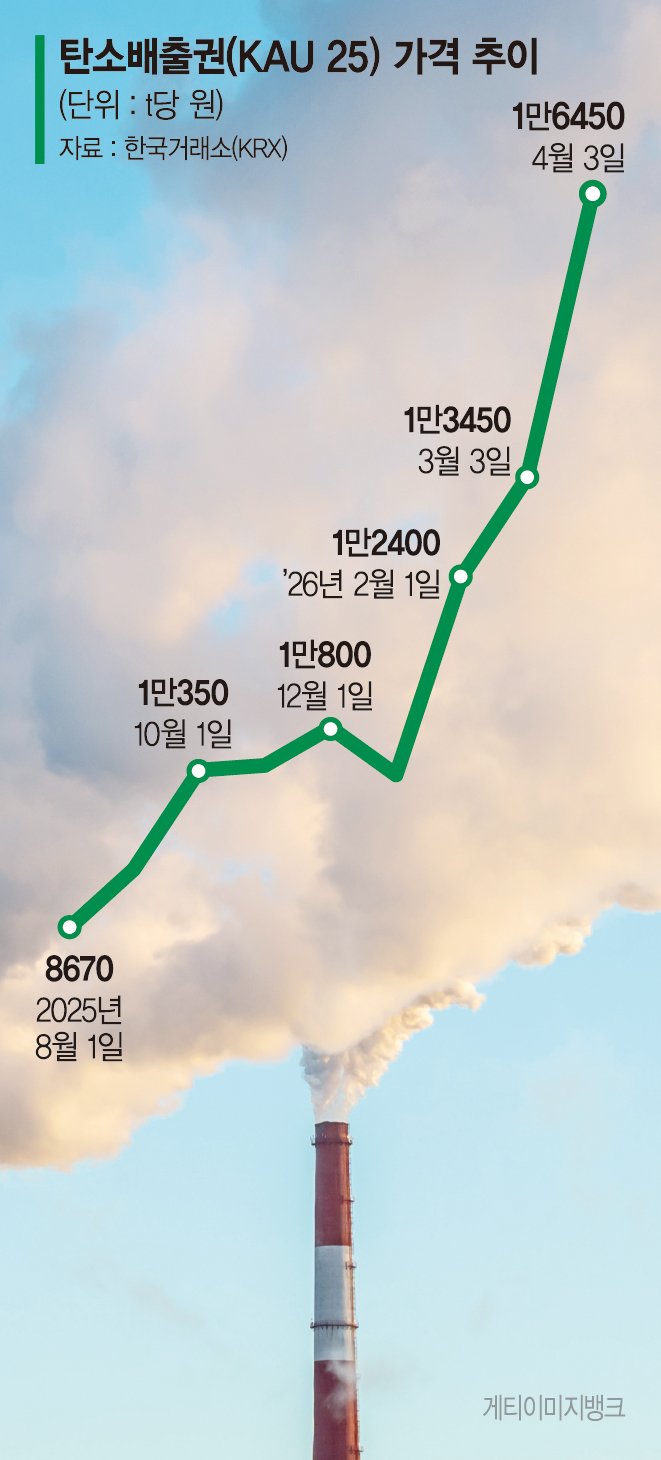
Carbon credit prices double in eight months as expanded paid allocation fuels rally
- Input
- 2026-04-06 18:26:22
- Updated
- 2026-04-06 18:26:22
■ Higher share of paid allocation
According to the Korea Exchange (KRX) on the 6th, the price of Korea Allowance Unit 2025 (KAU25) rose from the 8,000-won-per-ton range last August to 16,450 won on the 3rd of this month. Prices that had hovered around 10,000 won through the second half of last year have seen their gains accelerate since the start of this year.
Market participants believe the impact of the fourth allocation plan is now being reflected in earnest with a time lag. Growing demand from companies trying to secure shortfalls is pushing prices higher. Under the fourth plan, the government set the total emissions cap at 2.5373 billion tons, 16.8% lower than the previous period’s 3.04825 billion tons. In particular, it decided to raise the share of paid allocation, gradually increasing it to 50% for the power sector and 15% for non‐power sectors by 2030. As a result, the burden of securing allowances has grown, structurally boosting demand from industry.
However, the policy changes did not feed through to prices immediately. After the allocation plan was finalized in November last year, the first allowance auction even ended undersubscribed as companies took a wait‐and‐see approach.
An industry official explained, "The emissions trading market does not react as instantly as financial products," adding, "Because it is difficult for companies to quickly change their purchasing and spending plans, demand is reflected with a certain time lag."
Many expect strong buying to emerge in earnest after April. By the end of March, companies will have submitted their emissions reports, confirming whether they face shortages or surpluses, and they will then flesh out their buying and selling strategies based on that information.
The recent boom in the auction market is also cited as a factor behind the price rise. Kwon Dong-hyuk, deputy head at BNZ, said, "Allowances secured through auctions can be carried over, so companies are moving to preemptively secure volumes by using this mechanism."
The war in the Middle East is seen as a key variable going forward. If higher Liquefied natural gas (LNG) prices prompt the power sector to burn more coal, demand for allowances could increase. At the same time, however, an economic slowdown that curbs industrial production could dampen demand. Experts note that with both upward and downward pressures in play, the short‐term direction of prices is hard to predict.
■ Easing the burden of allowance supply and demand
Against this backdrop, the government is seeking to ease supply‐demand pressures by invigorating external greenhouse gas reduction projects as a complementary measure. The Ministry of Climate, Energy and Environment has commissioned a study titled "Measures to activate external greenhouse gas reduction projects under the Emissions Trading Scheme (ETS)" and has begun work on institutional reforms.
An external greenhouse gas reduction project allows companies that find it difficult to cut emissions in‐house to reduce greenhouse gases in other sectors and have those reductions recognized as allowances. Currently, the share of reductions that can be met through such external projects is capped at 5%, and the scheme has seen limited use due to complex procedures and high costs. The government plans to raise utilization by streamlining procedures, developing new business models, and aligning the system with international standards. In particular, introducing a digital Measurement, Reporting and Verification (MRV) system that uses satellites and artificial intelligence (AI) is also under review.
An official at the Ministry of Climate, Energy and Environment stated, "As emissions reduction obligations are strengthened, companies increasingly need to tap a wider range of reduction options," and added, "We will refine the system so that external greenhouse gas reduction projects can be used more easily."
[email protected] Park Ji-young Reporter