16 Trillion Won in Share Cancellations in a Month... "Value-Up Phase Begins in Earnest"
- Input
- 2026-04-06 18:26:19
- Updated
- 2026-04-06 18:26:19
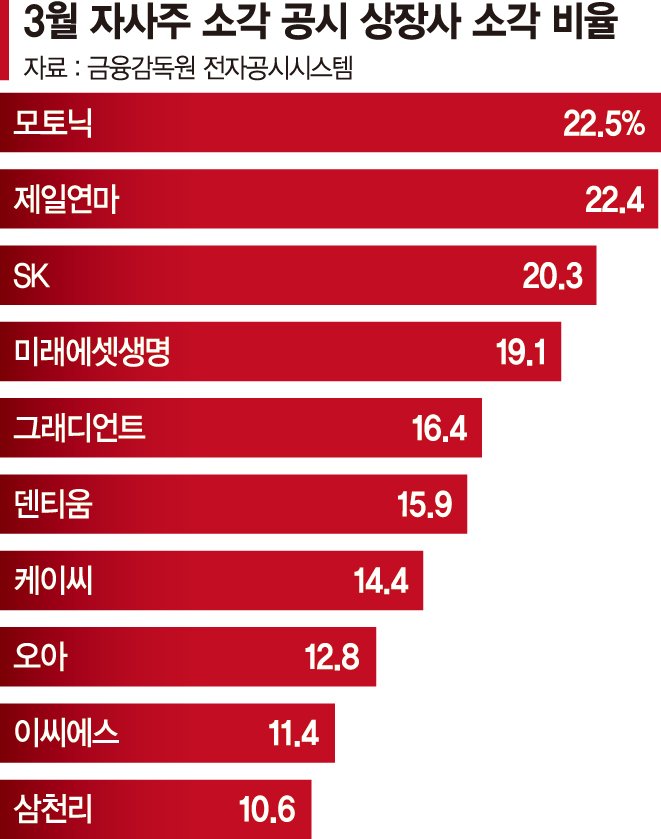
According to the Korea Exchange (KRX) on the 6th, 102 listed companies decided to cancel treasury shares at shareholder meetings and other gatherings during March alone, with the total amount reaching 15.8 trillion won. Based on public disclosures of share cancellations, this represents a 159% surge from a year earlier, an unusually high level. In just one month, companies have already decided on about 70% of last year’s record annual cancellation total of 21.4 trillion won. Given this pace, most analysts believe it will be easy to set a new all-time high this year.
The cancellations are heavily concentrated among large-cap stocks and holding companies, led by about 5.3 trillion won at Samsung Electronics. As major holding companies, including Financial Holding Companies (FHCs), join in, share cancellations are evolving from isolated corporate events into a broader market-wide trend.
Choi Kwan-soon, an analyst at SK Securities, explained, "The Third Amendment Bill to the Commercial Act, which includes mandatory cancellation of treasury shares, took effect on the 6th of last month, and in principle, companies must cancel existing treasury shares within one year."
Market participants view this as a case where a regulatory change has led directly to swift corporate action.
Park Jong-ryeol, an analyst at Heungkuk Securities, noted, "After this year’s amendment to the Commercial Act, treasury shares are no longer long-term assets to be held, but in principle a shareholder-return tool that must be cancelled," adding, "The market is projecting that the total amount of share cancellations could reach up to around 60 trillion won under the new regime."
The shift in treasury share policy has a direct impact on corporate value. Cancelling treasury shares reduces the number of shares outstanding, which in turn boosts Earnings Per Share (EPS) and Book Value Per Share (BPS). For holding companies, it is directly linked to narrowing the discount to their Net Asset Value (NAV). Experts also point out that a smaller free float eases supply overhang in the market and simultaneously sends a "signaling effect" that management believes the stock is undervalued.
Kim Dong-young, an analyst at Samsung Securities, said, "Share buybacks and cancellations, together with cash dividends, are core shareholder-return policies that provide capital gains through higher share prices," and added, "In theory, the share price rises in proportion to the cancellation ratio."
In the market, many believe that last month’s wave of cancellation announcements is only the beginning. Because the law now compels action and share cancellations led by holding companies are becoming established practice, there is a strong likelihood that other firms will follow suit.
A securities industry official commented, "The key variable for corporate value is shifting from how many treasury shares a company holds to how it disposes of them," and added, "The amendment to the Commercial Act is likely to become the trigger that fully launches the value-up phase in the South Korean stock market."
[email protected] Choi Doo-seon Reporter