In the Age of Fake News and Algorithms, a Question Posed Through Theater
- Input
- 2026-04-06 18:10:03
- Updated
- 2026-04-06 18:10:03
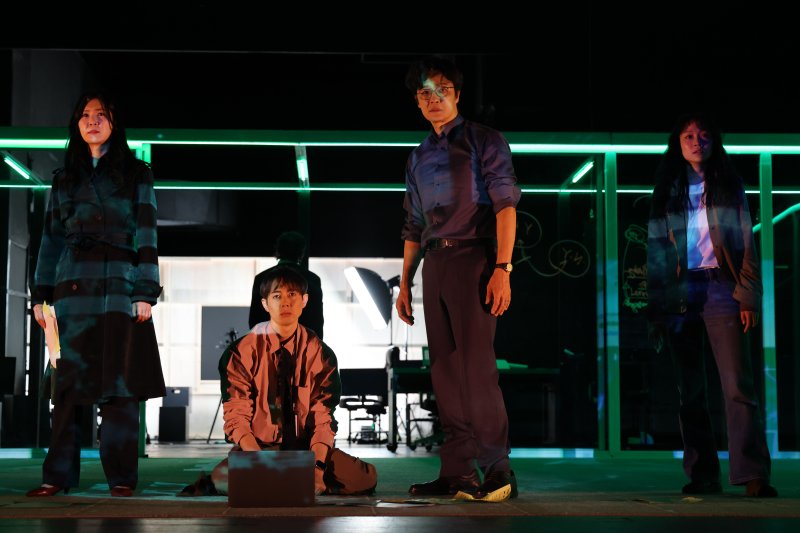
“Big Mother” is based on the play of the same name by Melodie Mourey, which premiered in France in 2022. In an era when advertising, consumption, and even political content are recommended and exposed based on data, the play follows investigative reporters in New York City as they risk everything to expose a vast conspiracy of power. On the eve of a presidential election in the United States, a sex scandal video involving the president is released, and reporters already overwhelmed by their own personal lives begin to track down whether the footage is real. In the process, they uncover an invisible system of manipulation operating behind the scenes.
The production stands out with an experimental staging that maximizes the “live” nature of news. A large screen at center stage broadcasts real-time news, while live close-ups of actors on and off stage help drive the narrative forward. A transparent glass-walled studio set that lays everything bare, combined with performances unfolding simultaneously in multiple spaces, injects a strong sense of immediacy into the stage. In particular, around 60 short, tightly constructed scenes—far more than in a conventional play—follow one after another, leaving little room for boredom.
The play reveals how the news and information we consume every day are actually produced. Along the way, real events that once dominated global headlines naturally come to mind. Among them are the scandals surrounding Donald John Trump in the run-up to the presidential election, and the case of Jeffrey Edward Epstein, who caused an uproar with charges of underage sexual exploitation and sex trafficking. The cutting-edge technology of Neuralink, founded by Elon Musk, also suggests itself.
While the work raises a range of contemporary issues, it ultimately concludes by reminding audiences of the fundamental value of journalism: a steadfast commitment to truthful reporting.
At the press call on opening day, director Lee Jun-woo said, “I wanted to ask whether even what we see, think, and dream is being steered by algorithms.” Speaking about the staging, he explained, “We designed the set as a transparent studio so we could show both the process and the outcome of news production at the same time,” adding, “I hope audiences will reflect on what lies behind the images they encounter.” He went on, “Theater has a unique power that comes from actors and audiences facing each other directly,” and added, “By contrasting media imagery with the physical stage, we wanted to highlight what makes theater special.”
The production runs at Sejong M Theater in the Sejong Center for the Performing Arts through the 25th.