"One comment that pads are too expensive" triggers butterfly effect as retailers wage an ultra-low-price war
- Input
- 2026-04-07 06:00:00
- Updated
- 2026-04-07 06:00:00
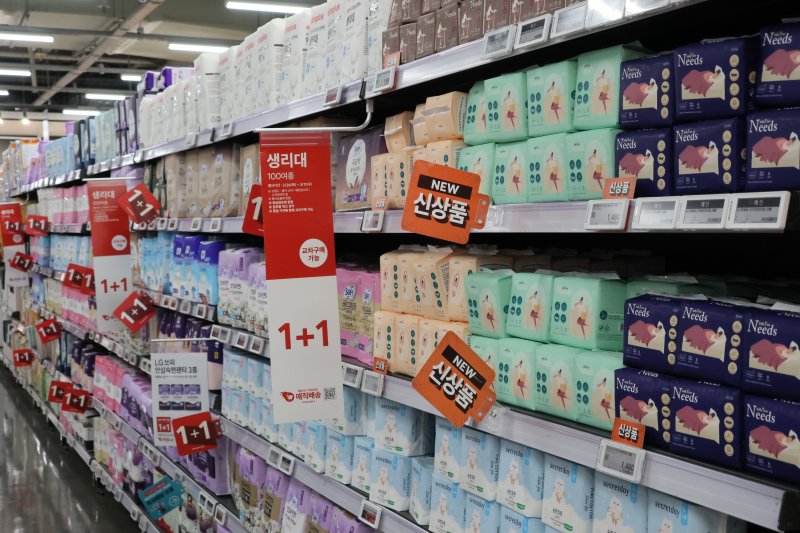
According to Financial News, after President Lee Jae-myung pointed out that sanitary pads cost more in Korea than overseas, the retail industry’s ultra-low-price competition has shifted from one-off discounts to a standing strategy. Retailers had already been pushing value-for-money strategies focused on daily necessities, and the recent price controversy has only strengthened this trend. The price debate sparked a wave of sanitary pad discounts that led to sellouts, and as retailers expanded related product lines and set up permanent discount systems, the trend has spread across everyday essentials.
As of the 7th, major retail channels such as Coupang, Emart, Homeplus, convenience stores, and Daiso have been rolling out a series of ultra-low-priced sanitary pad products, intensifying price competition. With products priced in the 100-won and 1,000-won per pad range hitting the market, demand has surged, and some items have repeatedly sold out shortly after launch.
This ultra-low-price strategy is not entirely new, but rather an upgraded version of existing discount events and value-for-money product tactics. Initially, price competition centered on promotions such as "buy one, get one free" or "buy two, get one free." Recently, however, the focus has shifted to exclusive products developed in collaboration with manufacturers. Retailers are securing price competitiveness by dealing directly with manufacturers to cut out middle distribution stages, minimizing marketing costs, and accepting lower margins on their side.
The retail industry now views low-priced sanitary pads not as a temporary promotion but as a key strategic product, and is moving toward launching items with sharply reduced prices or strengthening product competitiveness. On the 1st, Emart, together with Sofy, released an exclusive product, "Sofy Safe Sleep Panty Cooling Fresh," priced at 1,000 won per piece, about 20–25% cheaper than existing products. Homeplus, after its "99-won sanitary pads" sold out, recently introduced 98-won pads. 7-Eleven has also expanded its value-for-money lineup by partnering with KleanNara to offer sanitary pads priced in the 900-won range.
GS25 has been selling an exclusive Goodfeel sanitary pad line developed with Yuhan-Kimberly and is expanding its range of value-for-money products that are more price-competitive than similar items. CU is likewise offering ultra-low-priced menstrual products at prices up to more than 70% lower than its existing lineup, while pushing to expand manufacturer-collaboration-based products.
In particular, President Lee’s remarks on sanitary pad prices have heightened public interest in the overall cost of living, leading to a growing number of cases where ultra-low-priced food and household goods are offered year-round. Price-focused Private Brand (PB) products and rock-bottom food and daily necessities are becoming hits one after another, and an "everyday ultra-low price" strategy is spreading across all categories. Emart launched gimbap priced in the 3,000-won range and sold more than 60,000 rolls in just ten days, while ultra-low-priced items such as a 4,000-won steam iron and 1,000-won French fries have also driven strong sales. GS25’s 1,500-won flat-price dessert series sold over 1 million units within a month of launch, showing how quickly consumer demand for value-for-money products is growing. Homeplus is also expanding its ultra-low-price lineup beyond food into fashion and alcohol, with items such as jeans in the low-10,000-won range and wine in the 5,000-won range. This trend is evolving beyond simple discount battles into changes in product planning and the overall distribution structure. 7-Eleven has formed a PB Development Council with Lotte Mart to strengthen a cost-saving structure based on joint sourcing. Through this, it has launched a variety of everyday items—such as large-pouch beverages, fresh foods, and batteries—as its own PB products, securing price competitiveness.
A retail industry official said, "As high inflation persists, consumers are becoming more sensitive to prices," adding, "The ultra-low-price strategy is no longer a short-term promotion but is taking root as a constant competitive strategy."
[email protected] Lee Jeong-hwa Reporter