Debate on Launching a Fourth Internet-Only Bank Rekindled: "It Needs a SOHO Finance Model and a Stable Deposit Base"
- Input
- 2026-04-06 15:05:49
- Updated
- 2026-04-06 15:05:49
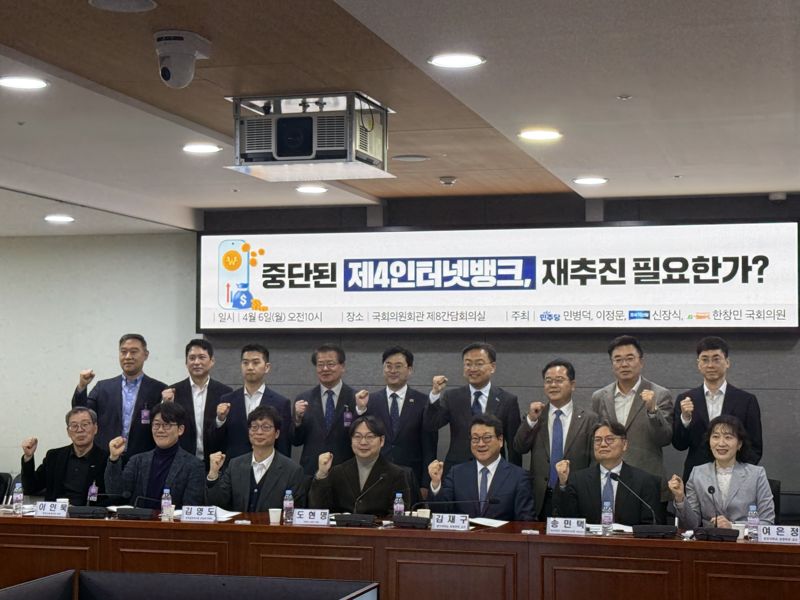
At the debate titled "The Suspended Fourth Internet-Only Bank, Is It Necessary to Restart the Process?" held at the National Assembly Members' Office Building in Yeouido, Seoul, on the 6th, Song Min-taek, adjunct professor at the Hanyang University Graduate School of Business, noted, "SOHO finance for small merchants, self-employed workers, and individual business owners accounts for a large share of the Korean economy, and financial debt related to individual businesses alone amounts to 460 trillion won at banks." He added, "In contrast, the volume of loans to individual business owners handled by the three existing internet-only banks is only about 7 trillion won."
Song assessed that SOHO finance remains a market with low accessibility and insufficient supply. He explained that the bar for obtaining loans from commercial banks is high, while interest rates at internet-only banks are higher than those at traditional banks, which increases the likelihood that borrowers will be pushed toward secondary financial institutions or even illegal private lenders.
In September last year, all four consortia that applied to establish the fourth internet-only bank failed to obtain preliminary approval. At the time, the Financial Services Commission (FSC) cited reasons such as unclear major shareholder structures, insufficient capital strength and limited capacity for additional capital injections, and concerns over business sustainability and stability.
Some experts also argued that a stable deposit base is a prerequisite for relaunching the fourth internet-only bank.
Kim Young-do, senior research fellow at the Korea Institute of Finance (KIF), stated, "The banking business is based on a model of taking deposits and extending loans, so deposits are a precondition." He continued, "The three existing internet-only banks were able to secure deposits because they already had platforms that allowed them to attract funds." According to Kim, KakaoBank leverages the accessibility of the KakaoTalk app, K Bank uses virtual assets as a channel for deposits, and Toss has built retail finance touchpoints through its payment services. He stressed, "For a fourth or even a fifth internet-only bank to emerge, they must first secure deposits and thereby establish stability."
Kim also pointed out that, because existing banks already hold most of the prime customers, the fourth internet-only bank would inevitably end up serving borrowers with relatively lower credit ratings. He said, "Those preparing to launch a fourth internet-only bank are highlighting their ability to provide timely funding through alternative credit scoring," but warned, "If they rely heavily on such credit models and expand lending to marginal borrowers, it could increase the burden of managing asset quality."
The financial authorities maintain that, given the importance of stability and public interest in the banking sector, they must proceed cautiously with any move to establish a fourth internet-only bank. They note that, if problems arise, the damage would not only affect consumers but could also spill over to the broader financial system.
Lee Jong-jin, team head at the Bank Supervision Department of the Financial Supervisory Service (FSS), said, "We agree with the goal of inclusive finance, which seeks to improve financial access for mid- to low-credit borrowers who are in the blind spots of the financial system." He added, "However, we need to have sufficient discussions with the FSC on how banks can supply funds to areas that currently lack access while still maintaining soundness." In February, FSC Vice Chair Lee Eog-weon also commented on the licensing of a fourth internet-only bank, saying, "We will comprehensively consider the necessity of a fourth internet-only bank and whether the conditions are mature."
The debate was co-hosted by Min Byeong-deok and Lee Jeong-moon of the Democratic Party of Korea (DPK), Shin Jang-sik of the Rebuilding Korea Party, and Han Chang-min of the Social Democratic Party.
[email protected] Reporter Lee Hyun-jung Reporter