104 Trillion Won Fiscal Deficit, Fourth Largest on Record... Government Considering Fiscal Anchor
- Input
- 2026-04-06 14:36:11
- Updated
- 2026-04-06 14:36:11
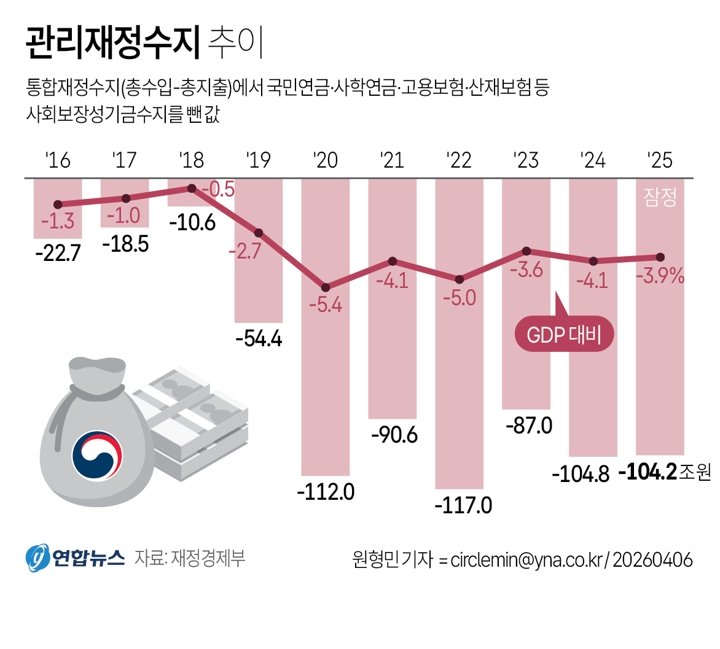
[Financial News] The deficit in the Managed Fiscal Balance, a net fiscal indicator that reflects the state of public finances, has exceeded 100 trillion won. It is the fourth-largest shortfall on record. The government argues that, given the high level of domestic and external uncertainty, active fiscal spending is necessary, and it is therefore considering adopting a "fiscal anchor" recommended by the International Monetary Fund (IMF) rather than legislating strict Fiscal Rules. A fiscal anchor serves as a medium- to long-term reference point for fiscal management and is more flexible than Fiscal Rules that rigidly cap specific numerical targets.
According to the "2025 fiscal year National Fiscal Settlement Report" that the Ministry of Economy and Finance (MOEF) presented to the State Council of South Korea on the 6th, total revenue came to 597.9 trillion won and total expenditure to 591 trillion won. The consolidated fiscal balance, which is total revenue minus total expenditure, recorded a deficit of 46.7 trillion won. When excluding the 57.5 trillion won surplus of social security funds (National Pension Service (NPS), Teachers' Pension, Workers' Compensation Insurance, Employment Insurance Fund), the Managed Fiscal Balance showed a deficit of 104.2 trillion won, equivalent to -3.9% of Gross Domestic Product (GDP).
The government assessed that the fiscal indicators have improved. Officials stressed that more weight should be placed on the "ratio to GDP," which reflects the government's ability to service its debt, rather than on the absolute size of the deficit. The Managed Fiscal Balance deficit as a share of GDP narrowed to the -3% range last year, from -4.2% based on the second supplementary budget in the previous year and -4.1% on a 2024 settlement basis.
Government Debt continued to rise. Combined central and local government debt reached 1,304.5 trillion won on a settlement basis last year, or about 49% of GDP. This is 0.3 percentage points higher than the 2024 settlement ratio of 46.0%, but 0.1 percentage points lower than the 49.1% projected in last year's budget. The fact that the fiscal balance and debt ratios improved relative to the budget means the actual increase was smaller than initially expected.
MOEF cited higher-than-expected tax revenue as the main reason for the improvement in the balance. Corporate tax receipts rose on the back of a boom in semiconductors and automobiles, while higher labor income tax and increased capital gains tax from a more active stock market also contributed. In addition, the rise in the won–dollar exchange rate boosted nominal GDP, which helped improve the indicators. On the spending side, expenditures from the housing fund declined after it shifted from direct lending to a secondary support scheme that utilizes bank financing, which also had a positive effect.
Hwang Soon-kwan, Director General for Treasury at MOEF, explained, "There may be criticism regarding the absolute size of the Managed Fiscal Balance deficit and Government Debt, but last year was a period when domestic demand was dampened by the aftermath of martial law and external shocks such as rapid changes in the U.S.-driven trade environment overlapped." He continued, "Rather than pursuing a passive fiscal stance focused on cutting total expenditure, we strengthened the active role of fiscal policy through two rounds of supplementary budgets to support advanced strategic industries and expand investment to revive domestic demand," adding, "This was a policy decision aimed at reinforcing the foundations for growth and ensuring sustainable fiscal management."
MOEF drew a clear line under the Fiscal Rules pursued by the Yoon Suk Yeol administration, which sought to cap the Managed Fiscal Balance deficit at within -3% of GDP, saying they do not fit current economic conditions. The ministry argued that, in an environment of heightened uncertainty, including the war in the Middle East, fiscal operations must retain flexibility. Previously, the Moon Jae-in administration had proposed Fiscal Rules that set a 3% deficit limit for the consolidated fiscal balance and a 60% of GDP ceiling for Government Debt.
A bill to codify Fiscal Rules is currently pending in the National Assembly of the Republic of Korea. A MOEF official stated, "We will participate in the deliberations in the National Assembly, but no specific direction has been finalized yet," and added, "We are reviewing the introduction of a fiscal anchor recommended by the IMF."
Meanwhile, on a settlement basis last year, national assets totaled 3,584 trillion won, up 365.6 trillion won (11.4%) from a year earlier. The surge was largely driven by a sharp increase in financial assets, as the National Pension Fund posted an 18.8% investment return, the highest on record. Financial assets reached 2,353.2 trillion won, an increase of 345.5 trillion won (17.2%). Of this, assets related to the National Pension Fund grew by 244.4 trillion won, accounting for more than two-thirds of the total increase. This amount is roughly equivalent to about five years of pension benefit payments, given that last year's payouts stood at 49.7 trillion won.
[email protected] Choi Yong-jun Reporter