Ruling party and government move to secure alternative oil supplies, eye special envoys to Saudi Arabia, Oman and Algeria
- Input
- 2026-04-06 10:32:42
- Updated
- 2026-04-06 10:32:42
According to The Financial News, the Democratic Party of Korea (DPK) and the South Korean government decided on the 6th to begin full-fledged talks with oil-producing countries that can serve as alternative import routes, including the Kingdom of Saudi Arabia (KSA), Oman and Algeria, in order to secure substitute crude oil supplies as the Strait of Hormuz has effectively been blocked by the Middle East war.
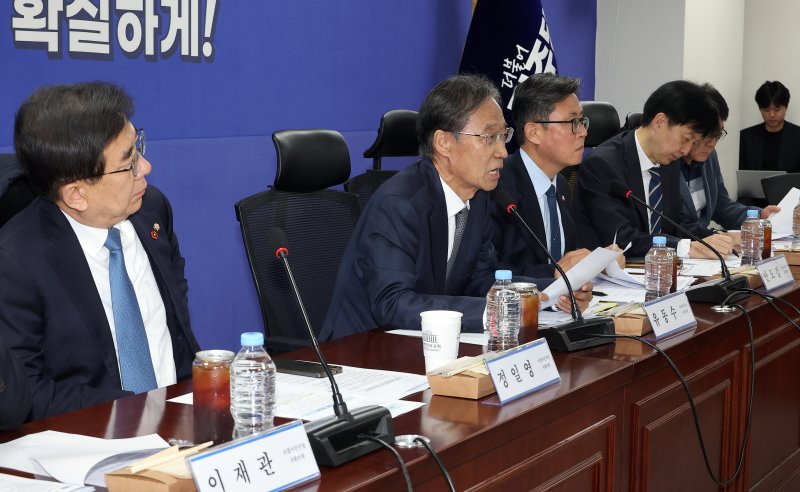
The DPK and the South Korean government held a plenary session of the Special Committee on Economic Response to the Middle East War at the National Assembly of the Republic of Korea that day. They focused on measures to stabilize the supply of petroleum products such as crude oil and naphtha.
Ahn Do-geol, a lawmaker serving as secretary of the special committee, stated, "Securing alternative crude oil supplies is the most urgent task," adding, "What the government is currently doing is securing crude volumes through consultations with oil-producing countries that have alternative import routes."
The DPK and the South Korean government have selected three target countries—KSA, Oman and Algeria—and plan to step up diplomatic efforts led by the Ministry of Foreign Affairs of the Republic of Korea, including sending special envoys. The Ministry of Trade, Industry and Resources is also pushing to deploy a total of five national shipping companies’ vessels to the Red Sea along alternative routes. In addition, to help private refiners secure as much alternative crude as possible via third countries, the government plans to pursue swap arrangements between its strategic oil reserves and crude secured by the private sector.
Supply issues for petroleum-based products such as naphtha and plastics were also put on the table. At present, the DPK and the South Korean government are prioritizing and managing demand for petroleum products in essential sectors, such as IV fluid plastic bags in the healthcare field, through administrative measures. They indicated that if supply instability for essential items worsens, they may move to impose supply adjustment measures, including export restrictions on products like naphtha.
The DPK and the South Korean government also disclosed the results of social dialogue between refiners and the gas station industry. The post-settlement system, which has been cited as a key reason for passing the burden of higher oil prices onto gas stations, will be effectively phased out by shortening the settlement cycle from the current one month to one week. The practice of exclusive dealing will also be eased, with mandatory purchase volumes under exclusive supply contracts to be reduced from 100% to around 60%, thereby giving individual gas stations much greater freedom in choosing their fuel suppliers.
As deliberations on the supplementary budget are under way, the DPK and the South Korean government have also decided to consider increasing support for export companies affected by the crisis. Currently, 470 billion won has been allocated to cover about 50% of the cost difference arising from securing alternative naphtha supplies. However, industry has asked the DPK and the South Korean government to raise this support level to around 80%. In response, the Democratic Party of Korea (DPK) decided to actively consider increasing the related budget during the National Assembly’s review.
Lee Kang-il, a member of the special committee, noted, "Since the Middle East war, the Republic of Korea (South Korea) has depended on imports for petrochemical products and petroleum, yet fuel prices here are relatively stable compared with Europe and other regions," explaining, "This is because the government and the National Assembly of the Republic of Korea have taken preemptive measures to mitigate the shock as much as possible."
He continued, "Because of our diplomatic relations and geopolitical dynamics, we face difficulties with passage through the Strait of Hormuz, yet even under such circumstances we are moving quickly by using alternative routes," adding, "Through the supplementary budget, we are also working to minimize the impact on people’s livelihoods."
[email protected] Reporter Kim Hyeong-gu Reporter