Gaza tensions flare amid Iran war as Hamas rejects disarmament
- Input
- 2026-04-06 09:08:13
- Updated
- 2026-04-06 09:08:13
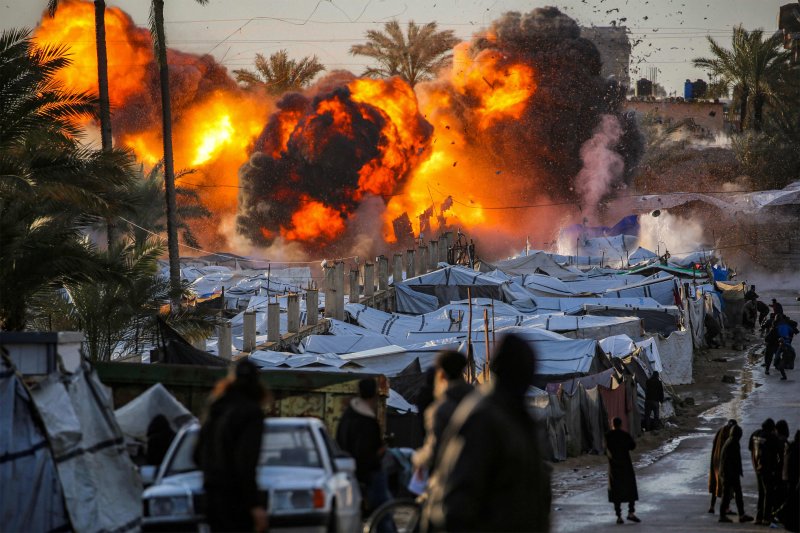
According to Financial News, while the United States of America (U.S.) and the State of Israel are preoccupied with the Iran war, sparks of conflict are once again flaring in the Gaza Strip in Palestine. Hamas, the local armed faction that began the first phase of a cease-fire last year, has declared that it will refuse to disarm, arguing that the State of Israel has not yet honored the cease-fire agreement.
According to State of Qatar-based Al Jazeera, Abu Obeida, spokesperson for the Izz ad-Din al-Qassam Brigades, the military wing under Hamas, stated on the 5th (local time), "We can never accept any discussion of disarmament until the State of Israel fully implements the first phase of the cease-fire agreement."
He argued that the State of Israel’s demand for Hamas to disarm is "nothing more than an overt attempt to continue the genocide of our people," adding, "We will not accept this under any circumstances." Abu Obeida also warned, "The enemy’s attempt to pressure our resistance forces through the mediator countries is extremely dangerous," and urged, "Before starting talks on the second phase, the mediator countries must first pressure the State of Israel to comply with the first-phase agreement."
Hamas launched an attack on the State of Israel on October 7, 2023, igniting the Gaza War, and from October 2025 it began a first-phase cease-fire with the State of Israel under mediation by the United States of America (U.S.). Under the U.S.-proposed three-phase cease-fire plan, the State of Israel and Hamas are to release Palestinian prisoners and Israeli hostages, respectively, in the first phase. At the same time, the State of Israel agreed to partially withdraw from the Gaza Strip.
In the second phase, Hamas’s disarmament and the State of Israel’s full withdrawal are to be negotiated. In the third phase, the international community and both sides are expected to discuss forming a civilian government that will govern the Gaza Strip in the future. Hamas returned all Israeli hostages it had held, as well as the remains of the dead, on January 27.
U.S. President Donald Trump launched an international body called the Board of Peace in January to resolve the Gaza War, but the process has not advanced to the second phase of the cease-fire. Hamas maintains that the State of Israel must first withdraw from key positions in the Gaza Strip and guarantee a complete withdrawal in the future. The State of Israel, on the other hand, insists that Hamas must begin disarmament before second-phase cease-fire talks can proceed. As the U.S. and the State of Israel began attacking the Islamic Republic of Iran in February, the standoff between the two sides has drawn little attention from the international community. During this time, the State of Israel has continued military operations, including airstrikes, in the Gaza Strip.
It was not immediately clear whether Hamas’s remarks on this day constituted an official rejection of the disarmament plan backed by the U.S.
[email protected] Jong-won Park Reporter