"Should I Cancel My Trip to Japan?" Record-Breaking Undersea Volcano Is Getting Ready to Erupt Again
- Input
- 2026-04-06 08:55:35
- Updated
- 2026-04-06 08:55:35
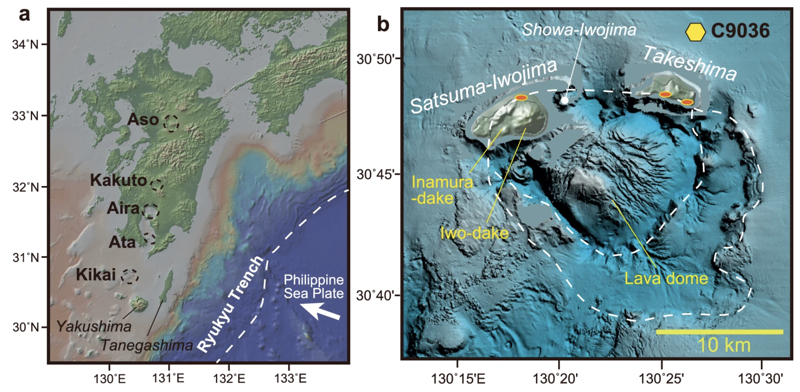
[Financial News] The Kikai Caldera, an undersea volcano in southern Japan that produced the largest eruption on Earth in the past 10,000 years, is showing signs of reawakening. A new study has detected evidence that magma is accumulating again directly beneath the site of its past giant eruption.
On the 4th, a research team at Kobe University reported in a paper recently published in the journal Communications Earth & Environment that magma appears to be slowly refilling the subsurface beneath the ancient eruption site of the Kikai Caldera, located near Io Island in the Ryukyu Islands of Kagoshima Prefecture, Japan.
About 7,300 years ago, the Kikai Caldera expelled roughly 160 cubic kilometers of volcanic material in a single eruption. For comparison, the 1980 eruption of Mount St. Helens in the United States released less than 1 cubic kilometer, while the 1991 eruption of Mount Pinatubo in the Philippines produced around 10 cubic kilometers. The scale of Kikai was extraordinary.
That eruption carved out an enormous crater on the seafloor, large enough to swallow a mid-sized city. Even after the eruption, over roughly 3,900 years, magma continued to break through the caldera floor, building what is now the world’s largest lava dome, with a volume of 32 cubic kilometers.
The goal of the new study was to map the location where magma is being supplied to this lava dome.
Lead geophysicist Nobukazu Seama stressed, "To understand how giant caldera eruptions occur, we first need to know how such large volumes of magma can accumulate."
Working with the Japan Agency for Marine-Earth Science and Technology (JAMSTEC), the team installed 39 underwater sensors along a 175-kilometer seismic refraction survey line crossing the caldera. They then fired sound waves into the seafloor using air guns mounted on a research vessel and analyzed more than 12,000 seismic wave records to reconstruct a three-dimensional image of the structures beneath the seabed.
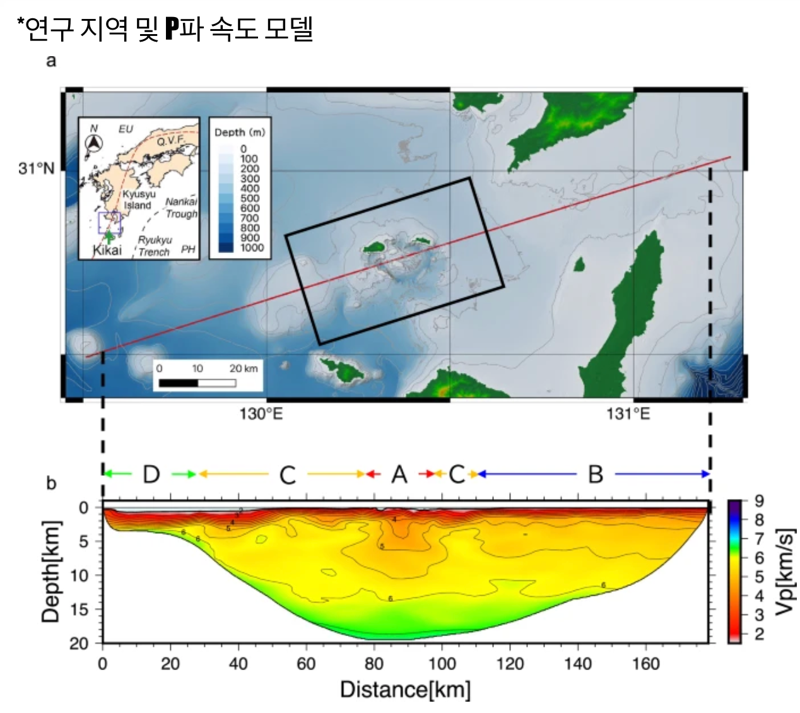
This approach allowed the researchers to obtain detailed images of what lies beneath the seafloor of the Kikai Caldera.
Their analysis found that the magma reservoir that fed the past super-eruption has remained active even thousands of years later.
Chemical analyses also showed that the composition of magma within the lava dome differs from that of the material erupted in the past.
Seama explained, "This suggests that the magma currently present in the reservoir beneath the lava dome is likely newly replenished magma."
The team estimates that, on average, more than 8.2 cubic kilometers of magma has flowed into the system every 1,000 years. Given the time elapsed since the last major eruption, they conclude that a substantial volume of magma has accumulated. They also estimate that the magma reservoir may now have a volume of about 220 cubic kilometers.
The paper notes, "The process in which melt is reinjected into a shallow magma reservoir located directly beneath the caldera may represent a stage that leads to a future giant caldera-forming eruption."
The pattern of magma recharge at the Kikai Caldera is essentially the same as the large, shallow magma systems observed beneath Yellowstone in the United States and Lake Toba in Indonesia.
The researchers pointed out, "The reinjection of magma into a reservoir directly beneath the caldera may be a stage that leads to a giant caldera eruption. Monitoring decreases in seismic wave velocities and gathering information on such changes could provide important indicators of an impending giant caldera eruption," emphasizing the need to establish a long-term monitoring system.
[email protected] Seo Yoon-kyung Reporter