K-food breaks through tariffs as exports to the U.S. rise 6%
- Input
- 2026-04-05 18:58:24
- Updated
- 2026-04-05 18:58:24
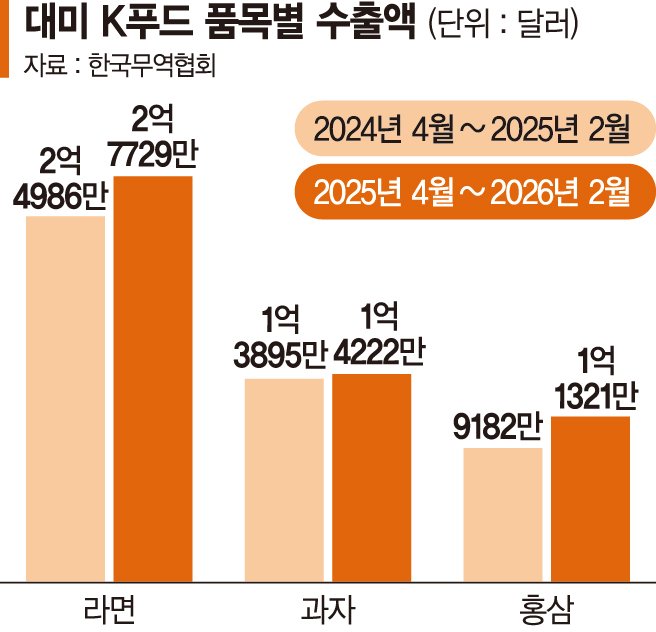
According to data from the Korea International Trade Association (KITA) and the Korea Agro-Fisheries & Food Trade Corporation (aT) on the 5th, K-food exports to the United States continued to grow even after U.S. President Donald Trump imposed a steep 25% reciprocal tariff on Korean products on April 2 last year, local time. Although the rate was partially lowered to 15% following the Asia-Pacific Economic Cooperation (APEC) summit, K-food has still held up well despite the high tariff barrier.
In the 11 months from April 2025, when the tariffs took effect, through this February, K-food exports to the United States totaled 1.94825 billion dollars. This is an increase of 108.59 million dollars, or 5.9%, compared with 1.83966 billion dollars in the same period a year earlier.
By product category, instant noodles, the flagship of K-food, recorded exports of 277.29 million dollars in the 11 months after the reciprocal tariffs took effect, up 27.43 million dollars, or 11.0%, from a year earlier. Ice cream and red ginseng products also saw sharp gains. Over the same period, ice cream exports jumped from 25.25 million dollars to 32.48 million dollars, an increase of 7.23 million dollars, or 28.6%, while red ginseng products rose from 91.82 million dollars to 113.21 million dollars, up 21.39 million dollars, or 23.2%.
Analysts point to K-food’s entry into mainstream liquor and retail channels and its strong value for money as key reasons for its resilience despite high tariffs. Once sold mainly through Korean grocery stores, K-food has expanded into major local retailers such as Costco and Walmart, greatly increasing its visibility. In addition, with restaurant prices and tips in the United States climbing to the point where a single meal can cost more than 20 dollars, K-food has emerged as an attractive alternative.
This year, however, signs of strain have begun to appear in K-food exports to the United States. Prolonged high oil prices and a strong dollar caused by the Iran war, combined with uncertainty over tariff policy, are casting a shadow over the export outlook. In fact, K-food exports to the U.S. in January–February this year came to 330.84 million dollars, down 9.4 million dollars, or 2.8%, from 340.24 million dollars a year earlier.
[email protected] Park Kyung-ho Reporter