DRAM prices ease, but NAND surges: "SD card sales halted amid supply shortage"
- Input
- 2026-04-05 18:55:05
- Updated
- 2026-04-05 18:55:05
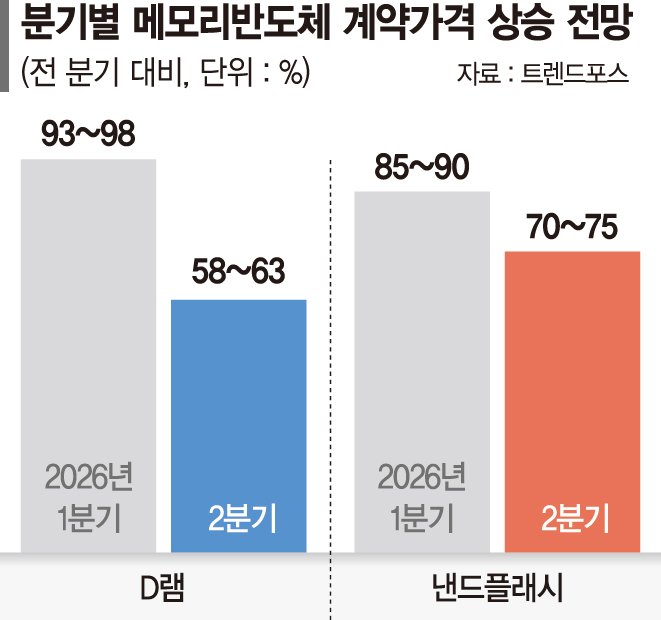
According to market research firm TrendForce on the 5th, contract prices for DRAM and NAND in the second quarter of this year are projected to rise by about 58–63% and 70–75%, respectively, compared with the previous quarter. This means the pace of DRAM price increases will slow sharply from the 93–98% jump seen in the first quarter, while NAND prices are expected to post an even higher growth rate than DRAM.
Strength in NAND prices is also evident in the spot market. According to DRAMeXchange, as of the end of March, the average contract price for general-purpose NAND products for memory cards and USB drives (128Gb 16Gx8 MLC) was $17.73, a jump of about 40% from $12.67 a month earlier, marking the 15th consecutive month of gains. By contrast, the average contract price for general-purpose PC DRAM products (DDR4 8Gb 1Gx8) was unchanged from the previous month at $13.00, indicating that the upward trend has stalled. Spot prices are the temporary transaction prices between distributors and consumers. They account for only a small share of the overall DRAM market, but they reflect immediate market sentiment.
Companies in the Information Technology (IT) industry are struggling to absorb the rapid rise in NAND prices and are either raising prices or moving to halt sales.
Sony Japan recently announced that it will suspend orders for virtually all of its storage products, including professional CompactFlash and CFexpress cards and consumer SD cards. The price of SanDisk’s 4-terabyte (TB) SanDisk Professional PRO-G40 SSD, sold at retailers such as the Apple Store in the United States, has risen from $499.95 to $1,199.95, an increase of about 140%. The price of a 1TB SanDisk SSD has also climbed from around $120 to $360, a jump of roughly 200%.
Analysts say growing concerns over a shortage of NAND supply are adding to upward pressure on prices. TrendForce reported that NAND manufacturers are pursuing a strategy of limiting supply of solid-state drives (SSD) for PCs through the second quarter in order to maximize profits. Micron Technology has also halted production of lower-margin consumer memory products and is instead ramping up output of enterprise products to meet the demands of the AI era.
Surim Lee, equity research analyst at DS Investment & Securities, said, "In the consumer market, DRAM prices have recently seen their spot price gains moderate as suppliers work through inventory, but what really determines profitability and earnings in the memory market is the contract price between suppliers and buyers," adding, "The upcycle in contract prices is likely to continue through the end of this year."
[email protected] Jang Min-kwon Reporter