Construction Material Inventories Running Dry... Sites Struggle to Last Even a Month [Middle East Inflation Shock]
- Input
- 2026-04-05 18:54:58
- Updated
- 2026-04-05 18:54:58
■ Some builders have only a month of inventory left
According to the construction industry on the 5th, companies are increasingly anxious about the prospect of prolonged fighting in the Iran war, which could trigger further increases in construction costs and make it harder to secure raw materials.
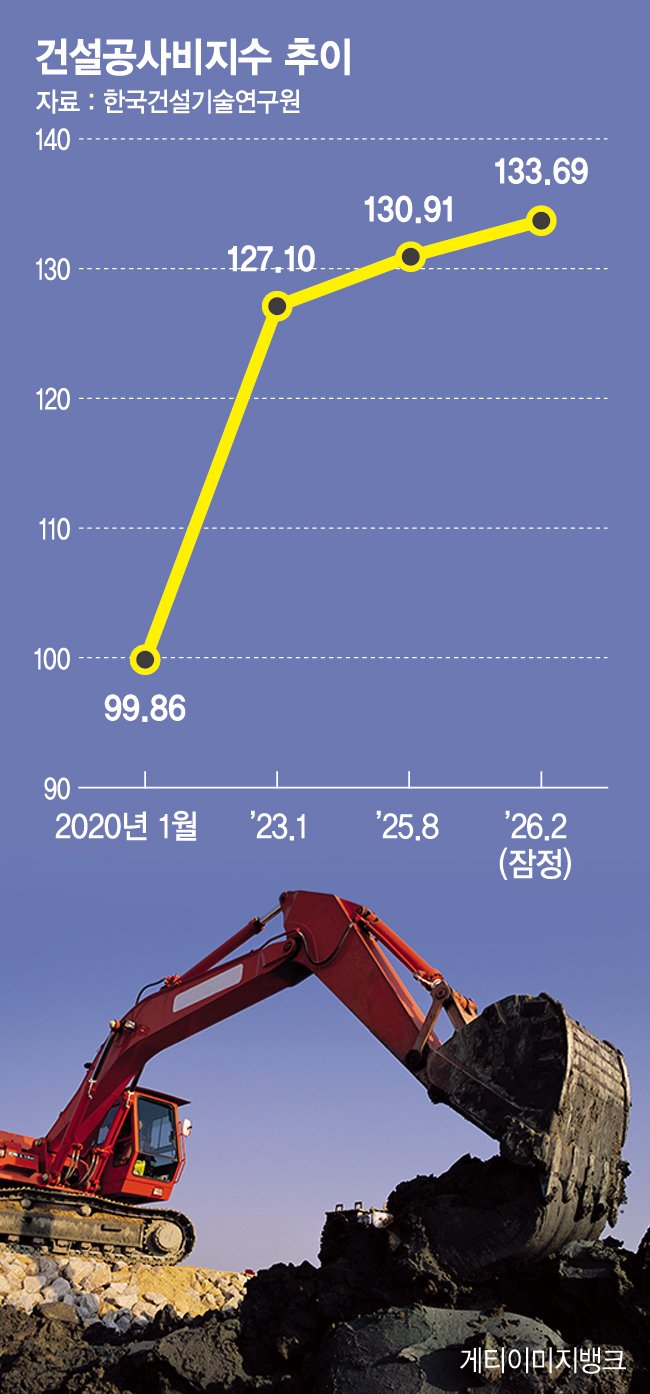
Builders already went through a sharp cost spike during the Russo-Ukrainian War. Data from the Korea Institute of Civil Engineering and Building Technology (KICT) show that the Construction Cost Index, which stood at 99.86 in January 2020, had jumped to 127.10 by January 2023. In other words, construction costs rose by more than 27% in just three years. The Construction Cost Index is a statistic designed to track price changes in direct construction costs such as raw materials, labor, and equipment. It uses 2020 as the base year of 100 and shows how much prices have increased compared with that period.
Recently, the Construction Cost Index has risen for six consecutive months since August 2025. The February reading, released at the end of March, was provisionally tallied at 133.69. That is more than 33% higher than in 2020.
Industry officials complain that conditions are deteriorating as another war overlaps with the still-unresolved Russo-Ukrainian War. They say they barely managed to hold on through March, but if the conflict continues through this month, the impact of raw material supply instability and price hikes will intensify. Some builders reportedly have only about a month’s worth of delivered material inventory left. Given that Korea’s construction sector relies heavily on domestic demand, any halt at construction sites would pass the burden directly on to subcontractors and partner firms.
The bigger concern is that there is still room for additional cost increases. Ji-Hye Lee, a research fellow at the Korea Research Institute for Construction Policy, explained, "If the Iran war drags on, securing raw materials will become even more difficult," adding, "In effect, further increases in construction costs will be unavoidable."
■ From delivery adjustments to diversifying supply sources
Construction companies are responding by stepping up monitoring, adjusting delivery volumes, and diversifying their supply channels. An official at a major construction firm said, "We are coordinating work with clients depending on conditions at each site," but added, "Even that is only possible through April, while we still have stockpiled materials."
Builders operating overseas are closely watching developments, holding emergency meetings and in some cases evacuating staff. At DL E&C, one employee at its Iran branch had already been evacuated earlier this year. Daewoo Engineering & Construction, which has projects in Iraq, is responding in stages based on real-time monitoring of the situation. At many firms, top management has personally stepped in to order preemptive measures.
Larger companies are in a relatively better position. Small and mid-sized builders, by contrast, appear to have few concrete countermeasures. A representative of a major construction company noted, "Most large firms sign a lot of annual contracts, so they can hedge price risks to some extent," and went on, "But smaller players, especially those that buy on a spot basis, are likely taking a direct hit."
A wave of bankruptcies is already under way. According to the Construction Industry Knowledge Information System (KISCON) of the Ministry of Land, Infrastructure and Transport, 397 general and specialty contractors closed down between February 28, when the Iran war began, and April 4. That is 7.9% more than the 368 firms that went out of business during the same period last year.
An industry official said, "For materials such as insulation and waterproofing products that are affected by naphtha prices, supply has become so tight that factories are even talking about halting production," and predicted, "If this situation continues for a long time, construction delays due to material shortages will be inevitable."
[email protected] Reporter Kwon Jun-ho Reporter