Import prices for wheat and soybeans surge, processed food industry faces the calm before the storm [High inflation shock from the Middle East]
- Input
- 2026-04-05 18:54:54
- Updated
- 2026-04-05 18:54:54
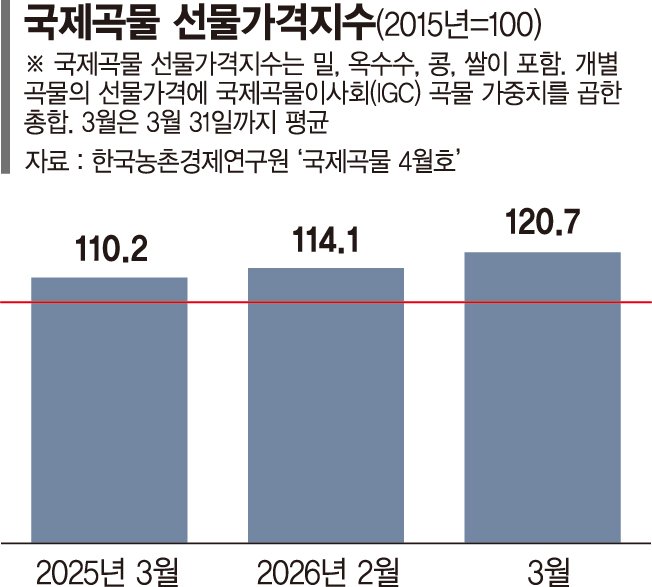
According to the Korea Rural Economic Institute (KREI) on the 5th, the international grain futures price index in March rose 5.8% from the previous month and 9.1% from a year earlier. For the second quarter of this year, the index is projected to increase 5.9% quarter-on-quarter and 7.2% year-on-year. If, instead of using mid-March figures, the market-expected exchange rate and international oil prices as of the 1st of this month are applied, the quarter-on-quarter increase widens to 6.4%. This suggests that the longer any blockade of the Strait of Hormuz continues, the steeper the rise in international grain prices could become.
Prices for wheat (about 99% of food-use demand), corn (about 80% of feed-use demand), and soybeans (about 70% of crushing-use demand), which South Korea largely imports from overseas, are all on the rise. In March, wheat futures prices reached 219 dollars per ton, up 8.4% from the previous month and 9.6% from a year earlier. Corn stood at 178 dollars per ton, down 0.4% year-on-year but 5.2% higher than the previous month. Soybeans jumped to 430 dollars per ton, surging 4.2% month-on-month and 16.5% from a year earlier.
For all three grains, higher international oil prices and expectations of growing demand for biofuels are cited as key factors pushing prices up. Concerns about reduced planting areas due to disruptions in fertilizer supply have also added to the upward pressure. In particular, prices of palm oil, which is closely linked to instant noodles and other products, and soybean oil, a major edible oil raw material, have risen sharply.
In March, soybean oil futures prices soared to 1,452 dollars per ton, up 14.1% from the previous month and 34.2% from a year earlier. Palm oil rose to 1,117 dollars per ton, an 8.0% increase month-on-month and 11.7% year-on-year. The sharp rise in soybean and soybean oil prices is largely due to increased demand for biodiesel feedstock following higher international oil prices. On March 27, the United States Environmental Protection Agency (EPA) announced that it would expand the use of biodiesel and other fuels in 2026–2027 by more than 60% compared with 2025.
Haksoo Kim, head of the South Korea office of the U.S. Grains Council, said, "Right now, it is not a shortage of production but increased demand driven by policy changes that is pushing prices higher," adding, "As the United States, Brazil, and other countries raise their mandatory blending ratios for renewable fuels, demand for soybeans has grown significantly."
The burden on domestic food companies is also mounting. These companies sign forward contracts based on international grain futures prices, then go through loading and shipping before making payments. During this process, rising ocean freight rates and a weaker currency are combining to push up actual import costs even faster. It takes about 40 days to ship soybeans and corn from Brazil and Argentina, and about 20 days for wheat from the U.S. West Coast.
[email protected] Choi Yong-jun Reporter