Vietnam's semiconductor industry dreams of escaping the periphery... to cultivate '50,000 talents' within 4 years
- Input
- 2026-04-05 18:45:14
- Updated
- 2026-04-05 18:45:14
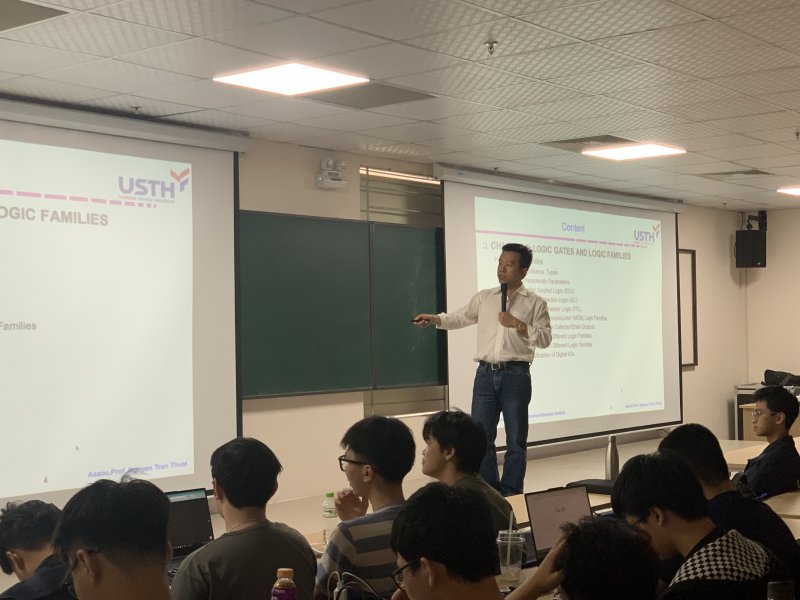
in Physics from the prestigious French Grandes École Polytechnique, returned to Vietnam after obtaining his doctorate and is a leading scholar in the semiconductor field representing Vietnam, currently serving as the Director of the Institute of Semiconductor and Advanced Materials (ISAM) at Hanoi National University. Students taking Professor Thuot's classes have immense expectations for Vietnam's semiconductor industry, which is beginning to grow as a national strategic industry. Quoc Anh, a sophomore majoring in Semiconductor Engineering at the university, expressed his aspirations, stating, "I want to go to Taiwan as an exchange student next year to study semiconductor manufacturing further," and added, "I plan to return to Vietnam after gaining experience by working for a Taiwanese company.
" In September 2024, the Vietnamese government unveiled the "Vision 2050 and Strategy for Semiconductor Industry Development through 2030," setting out to leap forward as a semiconductor hub in Southeast Asia. In line with this, major universities have established new semiconductor engineering majors since 2023 to cultivate talent. Admission scores for semiconductor-related departments are generally high, ranging from 24 to 28 points (out of a maximum of 30).
25 points, matching the cutoff score of major medical schools in Vietnam. This has positioned the semiconductor industry as a key sector attracting Vietnam's top talent. ■ Hanoi National University Equipped with Cleanrooms.
"Focus on Design and Packaging Needed" In an interview with this newspaper on the 29th of last month, Professor Thuot assessed the current state of Vietnam's semiconductor industry, stating, "Vietnam already possesses the basic conditions for semiconductor industry growth, but a long-term strategy of at least 5 to 10 years is required to secure industrial competitiveness. " The research institute, established in March 2025, serves as a key hub for the Vietnamese government's semiconductor workforce training plan. Hanoi National University is responsible for training approximately 12,000 personnel.
Currently, Hanoi National University’s Faculty of Natural Sciences, Faculty of Engineering, and Vietnam-Japan University select approximately 400 students annually to provide education in semiconductor engineering, integrated circuit (IC) design, and microelectronics technology. Professor Thuot explained, "Students experience everything from learning basic theory to actual chip fabrication and process practice," adding, "In their third and fourth years, they build practical skills by directly handling equipment in the laboratory. " The research institute plays a role in operating the curriculum in cooperation with the university's colleges and providing support for equipment and research personnel.
The key is national-level research infrastructure. Hanoi National University is currently pursuing the construction of a national semiconductor research laboratory that includes a 1,000-square-meter cleanroom. This represents a significant expansion of the university's existing experimental facilities, which were previously at the 150-square-meter level.
Industry-academia collaboration is also expanding. Regarding semiconductor R&D investments in Vietnam by global companies such as Samsung Electronics and Intel, Professor Thuot assessed them as "an important motivator that provides students with practical career paths. " However, he added, "Success or failure will depend on how closely a cooperative system is established between universities and companies.
" Regarding future strategies for fostering the semiconductor industry, Professor Thuot emphasized selection and concentration. "It is currently difficult for Vietnam to compete directly with advanced nations in the manufacturing sector," Professor Thuot said. "Focusing on high value-added areas such as design, packaging, and testing is a realistic approach.
" Professor Thuot predicted, "Vietnam must establish its own development path based on human resource competitiveness," adding, "Once design and packaging capabilities are secured, it will be possible to gradually expand into integrated circuit manufacturing processes. " ■ Construction Breaks Off on Vietnam's First Semiconductor Chip Factory. Global Big Tech Also Heading to Vietnam Vietnam has designated semiconductors as a national strategic industry and has set out to build a full-cycle industrial ecosystem.
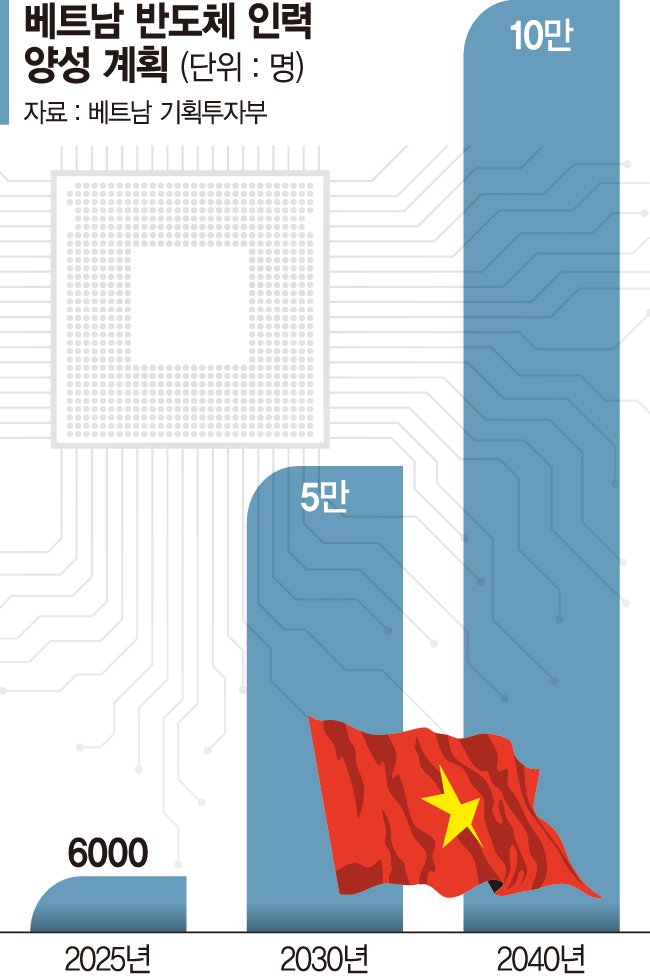
It is pursuing a 'National Semiconductor Strategy' that encompasses manufacturing processes and R&D, moving beyond a structure centered on design and packaging. According to Vietnamese government policy, the number of semiconductor engineers is planned to increase from the current 6,000 to 50,000 by 2030 and 100,000 by 2040. The Vietnamese government is also making it clear that it will no longer remain on the periphery of the semiconductor industry.
On January 16, Viettel, a Vietnamese state-owned enterprise, held a groundbreaking ceremony for Vietnam's first semiconductor chip manufacturing plant based on the 32-nanometer (1 nm = 1 billionth of a meter) process, spanning 27 hectares at the Hoa Lac Hi-Tech Park in Hanoi. The goal is to begin pilot production by 2028.
Top leaders, including Communist Party General Secretary To Lam and Prime Minister Pham Minh Chinh, attended the ceremony, clearly demonstrating the high expectations for the semiconductor industry. Semiconductor big tech companies are also showing interest in Vietnam.
Nvidia is expanding local R&D cooperation in Vietnam, while Intel is already operating a large-scale semiconductor packaging plant near Ho Chi Minh City. Korean semiconductor companies are also showing increasing interest in Vietnamese talent.
"Contrary to expectations, graduates from Vietnam's top engineering universities possess strong learning abilities and fundamental skills," said a semiconductor industry official. "We are keeping a close eye on them as there are many talented individuals who can grow into outstanding talents if given opportunities, including industry-academia collaborations.
Photo by Correspondent Vu Thuy Tien 【Financial News Hanoi (Vietnam) = Correspondent Kim Jun-seok & Correspondent Vu Thuy Tien】 "Now, everyone. Today, we will look at the basic terms of Boolean Algebra. This content is the foundation of digital logic design and, furthermore, a very important concept for understanding semiconductor systems.
"
Photo by Correspondent Vu Thuy Tien 【Financial News Hanoi (Vietnam) = Correspondent Kim Jun-seok & Correspondent Vu Thuy Tien】 "Now, everyone. Today, we will look at the basic terms of Boolean Algebra. This content is the foundation of digital logic design and, furthermore, a very important concept for understanding semiconductor systems.
Photo by Correspondent Vu Thuy Tien 【Financial News Hanoi (Vietnam) = Correspondent Kim Jun-seok & Correspondent Vu Thuy Tien】 "Now, everyone. Today, we will look at the basic terms of Boolean Algebra. This content is the foundation of digital logic design and, furthermore, a very important concept for understanding semiconductor systems.
Photo by Correspondent Vu Thuy Tien 【Financial News Hanoi (Vietnam) = Correspondent Kim Jun-seok & Correspondent Vu Thuy Tien】 "Now, everyone. Today, we will look at the basic terms of Boolean Algebra. This content is the foundation of digital logic design and, furthermore, a very important concept for understanding semiconductor systems.
Photo by Correspondent Vu Thuy Tien 【Financial News Hanoi (Vietnam) = Correspondent Kim Jun-seok & Correspondent Vu Thuy Tien】 "Now, everyone. Today, we will look at the basic terms of Boolean Algebra. This content is the foundation of digital logic design and, furthermore, a very important concept for understanding semiconductor systems.
[email protected] Reporter Kim Jun-seok, Correspondent Vu Thuy Tien Reporter