"Staying Home Instead of Cherry Blossoms"... Fine Dust Worse Than Last Year
- Input
- 2026-04-05 18:24:25
- Updated
- 2026-04-05 18:24:25
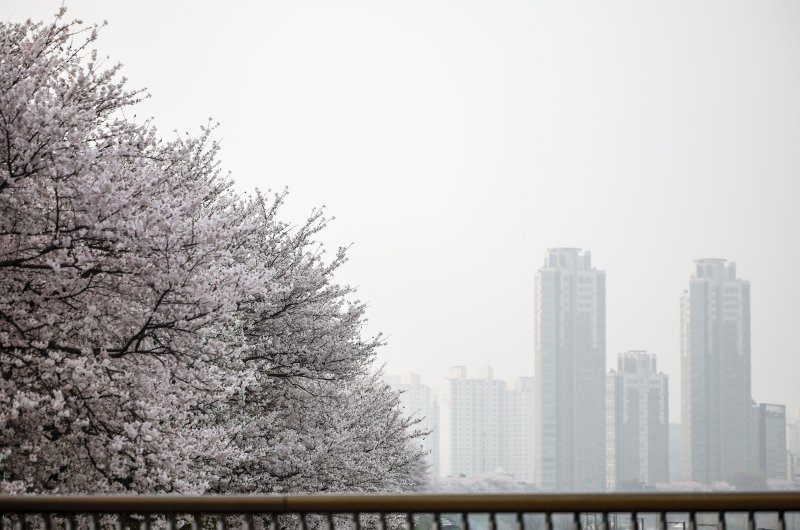
"It feels like I have no choice but to cut back on outdoor activities." Lee, a 32-year-old resident of Seodaemun District in Seoul who enjoys running outside every weekend, went out for a workout wearing a mask on the 28th of last month, when PM2.5 fine particulate matter levels were rated "high," but returned home after about 30 minutes. The air quality was so poor that the view in front of her looked foggy, and she became worried about her health. Lee said, "When I run with a mask on during heavy fine dust days, it is definitely harder to breathe than usual and I even get headaches," adding, "Even after coming home and drinking warm water, it doesn’t help, so I end up lying down for hours and wasting my precious weekend."
According to the Korea Meteorological Administration (KMA) on the 5th, as of the 30th of last month, Seoul recorded 19 days—63.3% of the month—when the average daily concentration of PM2.5 fine particulate matter exceeded 35 μg/m3, a level classified as "bad." This far surpassed last year’s figure of 15 days out of 31 (48.4%), indicating significantly worse air quality. Nationwide, between the 23rd and 30th of the same month, PM2.5 levels reached "bad" or higher on four days, nearly half of that period.
Fine dust is known to have serious health impacts. The particles are too small to be seen with the naked eye and are classified by size into particulate matter 10 (PM10), with a diameter of 10 μm or less, and PM2.5 fine particulate matter, with a diameter of 2.5 μm or less. When fine dust penetrates deep into the lungs, it can trigger inflammatory responses and lead to respiratory diseases. Experts warn that it can cause acute symptoms such as coughing and shortness of breath, and may also contribute to pneumonia or asthma. Studies have also suggested that, once it enters the bloodstream and travels through the body, long-term exposure can increase the risk of cardiovascular disease and cancer. Older adults, infants and young children, pregnant women, and patients with chronic illnesses are considered particularly vulnerable and need to take extra care.
As springtime fine dust worsens, many citizens say they are cutting back on the time they spend outdoors. Kim, a 32-year-old office worker, said, "I’m planning a cherry blossom tour with my girlfriend next week, but because of the fine dust we’ll probably just take a few photos outside and then spend most of our date at a café or restaurant with a view of the blossoms." He added, "It would be even better if the place has an air purifier."
Meteorologists attribute the higher fine dust levels to a migratory high-pressure system. Recently, a migratory high has lingered over the Korean Peninsula at relatively low altitudes, blocking air circulation and weakening convection, the vertical mixing of air. As a result, pollutants have not been dispersing properly, and a kind of "dome" has formed in the lower atmosphere. Frequent inflows of fine dust from China carried by westerly winds have further raised concentrations.
On top of this, reduced spring rainfall—which would normally help wash pollutants out of the air—means that fine dust levels are expected to remain high for the time being. According to data from the Seoul Weather Station in Songwol-dong, Jongno District, Seoul, cumulative precipitation in Seoul last month was 43.9 mm, down from 38.2 mm during the same period a year earlier.
Experts unanimously warn that people should exercise particular caution, including limiting trips outside, to reduce the health risks from fine dust. The longer you stay outdoors, they note, the more fine dust your body is likely to absorb. Professor Chun Eun-mi of the Department of Pulmonology at Ewha Womans University Mokdong Hospital said, "If you must go out, you should wear a KF94 mask and wash thoroughly as soon as you get home to remove fine dust particles," adding, "Cooking also generates fine dust, so it helps to ventilate indoors two or three times a day for about 10 minutes each time and to run an air purifier."
[email protected] Seo Ji-yoon Reporter