1,000 Trillion-Won AI Infrastructure Race Heats Up: Axis of AI Competition Shifts to Infrastructure [Special Report]
- Input
- 2026-04-05 14:08:49
- Updated
- 2026-04-05 14:08:49
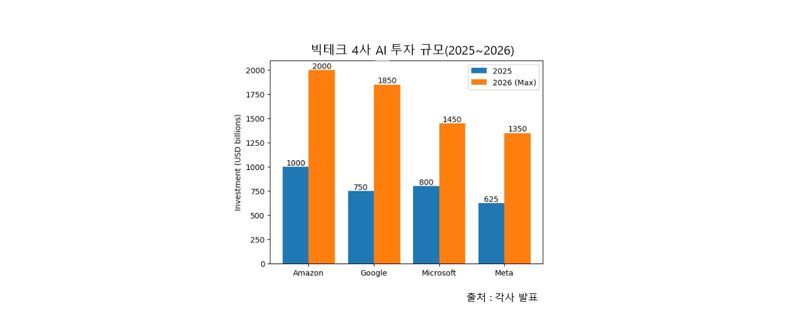
[Financial News] Global big tech companies such as Amazon, Google, Meta, and Microsoft (MS) are announcing record-breaking artificial intelligence (AI) investment plans, with up to $665 billion (about 1,004 trillion won) expected in 2026 alone. Most of this capital will go into AI production facilities, including AI data centers, GPUs, and the power grid.
These investment plans reveal how quickly the axis of competition in the global AI industry is shifting.
Just two to three years ago, the core of competition lay in the performance of models released by OpenAI, Google, Meta, and others. By 2026, however, the center of gravity in the AI market has moved to securing physical infrastructure such as power, semiconductors, and AI data centers.
IT experts say, "The essence of AI competition is no longer the algorithm," adding, "As the AI industry is clearly being reshaped into a capital-intensive infrastructure industry, the decisive factor will be who can secure more data centers and power."
Up to 1,000 trillion won in AI investment, focused on infrastructure build‐out
Amazon, Google, Meta, MS, and other big tech firms have presented capital expenditure plans of up to $665 billion for this year. This is a massive increase of about 70% compared with last year. Most of the funds will be poured into hyperscale AI data centers, AI-specific semiconductors, networks, and securing power supply.Market watchers describe this as the "digital‐age equivalent of building railroads and power grids." In other words, AI competition has already shifted from a race over software and algorithms to a capital race in the infrastructure industry.
Amazon to pour in $200 billion, Google drops a 'TurboQuant' bombshell
Amazon is poised to make the most aggressive investments. The company plans to invest up to $200 billion (about 302 trillion won) this year, more than 50% higher than last year’s $131.8 billion. The bulk of this spending will go toward expanding AI data centers centered on Amazon Web Services (AWS), developing in‐house chips, and building physical infrastructure.Alphabet, Google’s parent company, has outlined investment plans in the range of $175 billion to $185 billion. This is aimed at meeting the surge in computing demand driven by the spread of its own AI models such as Google Gemini, with spending focused on data centers, AI accelerators (TPUs), and network infrastructure. In particular, Google recently unveiled its TurboQuant technology, which shrinks AI model size and cuts AI memory usage to one‐sixth, thereby maximizing AI production efficiency by leveraging its overwhelming AI compute resources.
Meta and MS roll up their sleeves in the race to secure power
As AI data centers evolve into a power‐intensive industry that consumes dozens of times more electricity than conventional data centers, big tech companies are now fully engaged in a direct race to secure power supply.Meta has announced investment plans of up to $135 billion this year and is aggressively pushing ahead with AI data center construction. The company has drawn attention with its plan to build its own natural gas power plants to run what would be the world’s largest AI data center. To power its Hyperion data center in Louisiana in the United States, Meta has pledged to fully fund the construction of seven natural gas power plants with a combined capacity of 5.2 GW, effectively rolling up its sleeves to secure electricity dedicated to AI data centers.
MS is expected to invest around $145 billion this year. In Texas in the United States, Microsoft (MS) has launched a large‐scale power generation project worth about $7 billion (around 10 trillion won), marking a full‐fledged entry into the race to secure power for AI. Experts say this competition over power supply proves that AI competition is effectively expanding into an energy war.
AI: lower technological barriers, higher capital barriers
The global big tech race to expand AI infrastructure is widely seen as evidence that the axis of AI industry competition has shifted from who can build the smartest model to who can secure more power, semiconductors, and AI data centers.As entry barriers to AI model development fall, the performance gap among leading AI models such as ChatGPT, Google Gemini, and Claude is gradually narrowing, according to market assessments. With technological barriers declining, the core of competitiveness has shifted to a capital race to secure capital‐intensive infrastructure that combines power, semiconductors, and AI data centers. Commenting on this shift in the AI market, global investment bank Morgan Stanley analyzed, "AI has effectively entered the semiconductor and infrastructure industry cycle," and added, "It has become a battle of capital and resources, including competition over investment in GPUs and AI data centers."
As the AI infrastructure race accelerates, competition in the AI industry is increasingly expanding beyond corporate rivalry into the realm of national strategy. The United States is curbing China’s AI growth through semiconductor export controls, while Europe is working to build its own data centers and AI clouds. The struggle around AI is thus evolving into a question of "digital sovereignty."
[email protected] Lee Gu-soon Reporter