Lost workdays from strikes near 400,000...Concerns rise after Yellow Envelope Law takes effect
- Input
- 2026-04-05 09:34:24
- Updated
- 2026-04-05 09:34:24
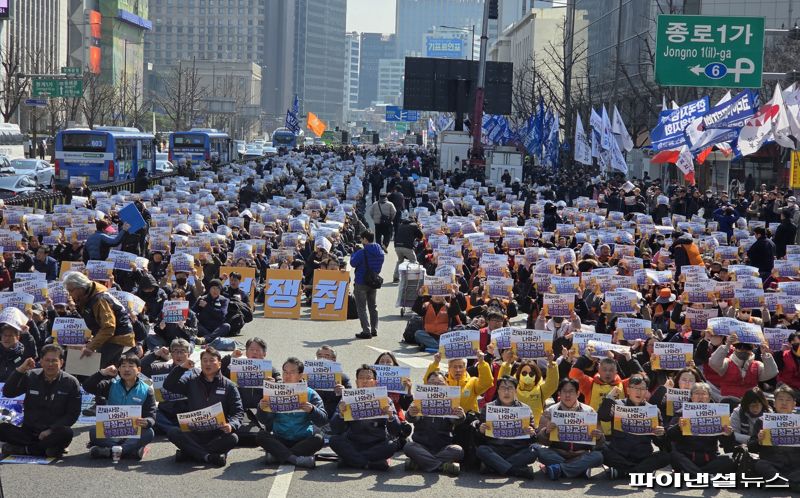
According to Financial News, the number of lost workdays due to strikes last year was close to 400,000. Although this was a decrease from the previous year, there are growing concerns that social costs could rise as strikes become more frequent following the enforcement this year of the Yellow Envelope Law, which amends the Trade Union and Labor Relations Adjustment Act.
Data from the Ministry of Employment and Labor (MOEL) on the 5th showed that lost workdays due to strikes last year totaled about 394,000, down 13.8% from 457,000 the year before. Lost workdays are an indicator that converts social losses directly caused by labor disputes—cases where unions stop work for at least eight hours due to disagreements with employers—into the number of working days.
Lost workdays peaked at 2.035 million in 2016 under the Park Geun-hye administration, which was then dealing with impeachment turmoil.
The figure fell to 862,000 in 2017 and then stayed in the 400,000 to 500,000 range between 2018 and 2021. It then declined to 344,000 in 2022 and 355,000 in 2023, rebounded to 457,000 in 2024, and fell again last year.
Analysts say this downward trend reflects a shift in union tactics away from prolonged strikes toward methods that focus more on securing practical gains.
The number of labor disputes has also been falling, from 223 cases in 2023 to 131 in 2024 and 123 last year. By industry, manufacturing accounted for the largest share of last year’s disputes with 52 cases, or 42.3%, followed by transportation and warehousing with 19 cases, or 15.4%. Disputes at small and mid-sized workplaces with fewer than 300 employees decreased from 64 to 52 cases, but disputes at large workplaces with 500 or more employees rose from 57 in 2024 to 64 last year.
However, labor disputes are expected to increase going forward, following the enforcement of the Yellow Envelope Law in March.
Under the new rules, a principal contractor is now obligated to respond to bargaining demands from subcontractor unions if it exercises substantial and specific influence over their working conditions. In addition, the legal concept of a labor dispute has been expanded from "determination of working conditions" to "determination of working conditions and business management decisions that affect working conditions."
This means that lawful strikes will now be possible in connection with management decisions such as overseas investment, mergers, transfers or sales of business, and plant expansions, when they involve layoffs or restructuring. Previously, disputes were largely limited to issues such as wages and working hours.
The labor movement is continuing pressure campaigns against principal contractors that avoid bargaining. The KCTU has announced a general strike for July.
[email protected] Park Sung-hyun Reporter