Won-dollar rate swings 11 won a day on Middle East war, FX trading hits record high
- Input
- 2026-04-05 09:07:09
- Updated
- 2026-04-05 09:07:09
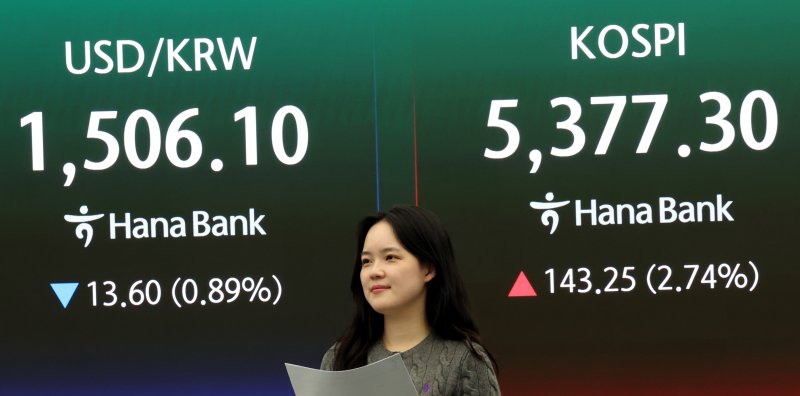
Data from the Seoul Foreign Exchange Market on the 5th showed that last month’s average daily spot won-dollar trading volume, combining Seoul Money Brokerage Services and Korea Money Brokerage, reached 13.919 billion dollars on a weekday basis.
For roughly two decades since the 2000s, daily foreign exchange turnover hovered between 6 and 9 billion dollars. It first broke above 10 billion dollars in 2023, reaching 10.597 billion dollars. After moving in the 10 to 11 billion dollar range, it surged last month to nearly 14 billion dollars, or about 21 trillion won.
The sharp increase in trading volume last month is widely attributed to heightened volatility in the exchange rate following the outbreak of war between the United States of America (US) and Iran.
When exchange rate volatility rises, it is generally known that both speculative trades seeking FX gains and hedging transactions to reduce currency risk increase, which in turn boosts overall trading volume.
According to the Bank of Korea (BOK) Economic Statistics System (ECOS), the average daily trading range of the exchange rate last month, measured on a weekday basis and compared with the previous trading day’s closing price, was 11.4 won.
This is the largest figure in three years and four months, since November 2022, when expectations of a policy shift by the Federal Reserve System (the Fed) caused the exchange rate to drop sharply and the daily range reached 12.3 won.
Last month, the market saw wild swings, with the exchange rate moving 20 to 30 won in a single day depending on former US President Donald Trump’s messages and speeches on social networking service (SNS) platforms.
On the first trading day after the war in the Middle East broke out, the rate jumped 26.4 won on the 3rd, the biggest rise since April 7 last year, when a US tariff shock sent it up 33.7 won. However, on the 10th of last month it plunged 26.2 won after former President Donald Trump said the war would end soon.
Even after the exchange rate closed above 1,500 won for the first time since the global financial crisis on the 19th of last month, this kind of see-saw trading continued.
On the 24th of last month, when Trump declared he would postpone an attack on Iran, the rate tumbled more than 22 won, falling back into the 1,490 won range. But as talks between the US and Iran broke down and tensions in the Middle East persisted, the rate climbed sharply again, surging intraday to 1,536.9 won on the 31st.
This month as well, large swings have continued in line with developments in the Middle East. On the 1st, the rate plunged by nearly 30 won, only to rebound by almost 20 won the following day. Over the three trading days, average daily turnover stood at 12.145 billion dollars.
Meanwhile, as the foreign exchange authorities actively intervened to defend the exchange rate last month, foreign exchange reserves fell by 3.97 billion dollars. This was the largest decline in 11 months, since April last year, when the announcement of reciprocal tariffs by the US led to a 4.99 billion dollar drop.
[email protected] Park Sung-hyun Reporter