"I paid 300,000 won more in just a few days" Airfares soar over Japan's Golden Week [Japan Inside]
- Input
- 2026-04-05 06:00:00
- Updated
- 2026-04-05 06:00:00
As in previous years, travel demand is concentrated during this period. On top of that, many travelers are trying to depart earlier to avoid further price hikes, which is overheating the market. Rising oil prices are adding to airlines’ costs, leading to both higher airfares and reduced capacity at the same time.
This year, Golden Week runs from April 29 to May 6. Public holidays such as Showa Day (April 29), Constitution Memorial Day (May 3), Greenery Day (May 4), and Children’s Day (May 5) are clustered together, allowing up to eight consecutive days off and concentrating travel demand every year. During this period, demand for air, rail, and accommodation typically surges, pushing prices higher.
The situation is more serious this year. On top of the usual holiday effect, a sharp rise in international oil prices is putting far greater upward pressure on airfares than in previous years.
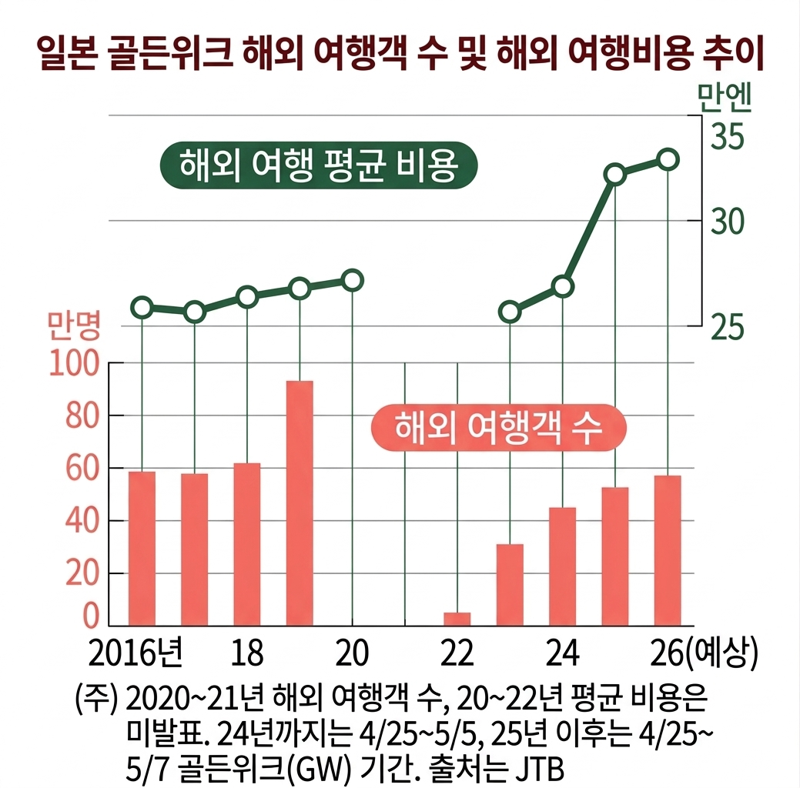
JTB Corporation (JTB) projects that the number of outbound travelers during Golden Week will reach 570,000, up 8.5% from a year earlier. This would be the largest figure since the COVID-19 pandemic. Average travel spending per person has also risen 2.2% to 329,000 yen.
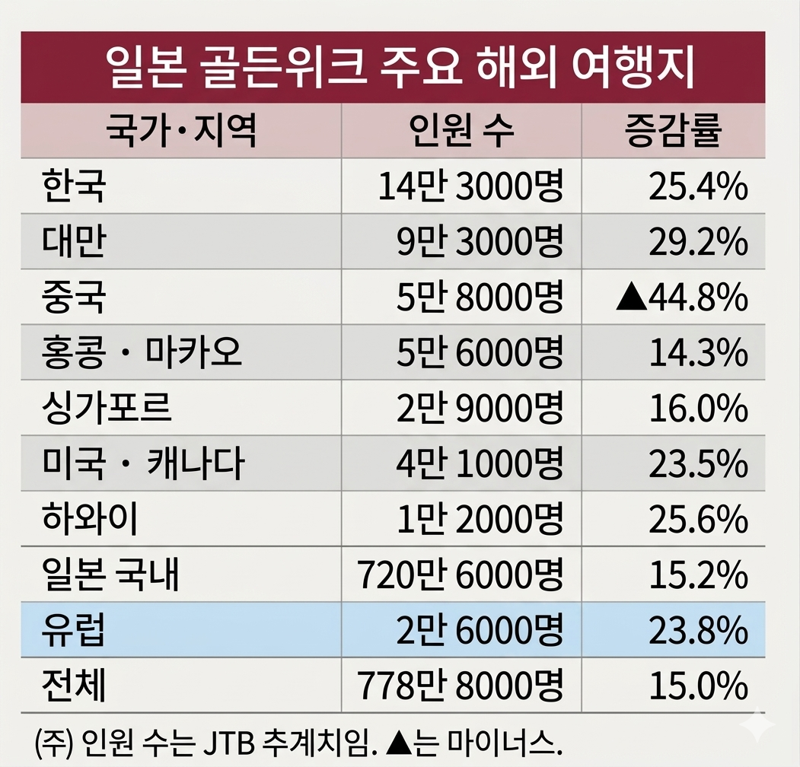
Demand is especially strong for overseas trips. A survey by H.I.S. Co., Ltd. found that the number of travelers heading to Europe during this Golden Week will jump 34.2%, while trips to South Korea, Taiwan, and Singapore in Asia will each increase by more than 20%.
Behind this surge in demand is a mindset of "booking early before fuel surcharges go up." As expectations grow that the fuel surcharge added to airfares will rise further, summer vacation demand is being pulled forward into the Golden Week period.
A fuel surcharge is an additional fee on top of the base airfare that reflects airlines’ higher fuel costs. It is usually adjusted every two months based on Singapore jet fuel prices and exchange rates, and it is applied according to the ticketing date, not the travel date. This is why the price of the same flight can differ greatly depending on when you pay for the ticket.
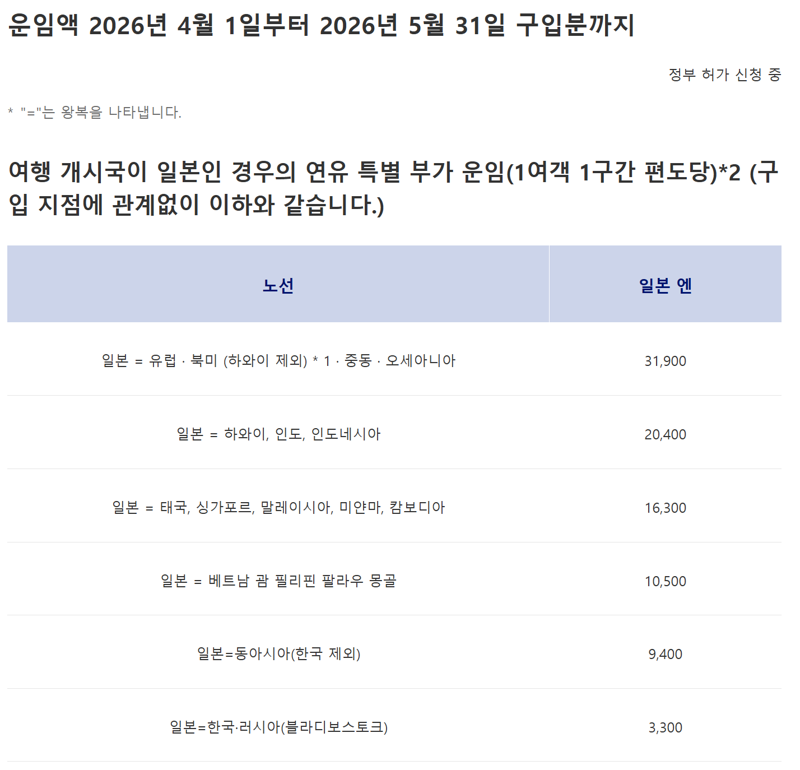
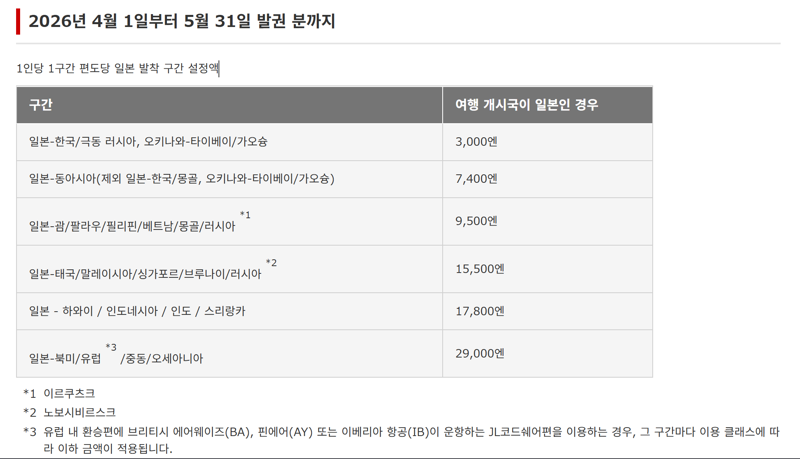
Japanese airlines are also moving to raise surcharges. Japan Airlines (JAL) is considering increasing fuel surcharges on its Europe and North America routes for tickets issued in June and July this year to around 50,000 yen, and All Nippon Airways (ANA) is planning a similar level of increase.
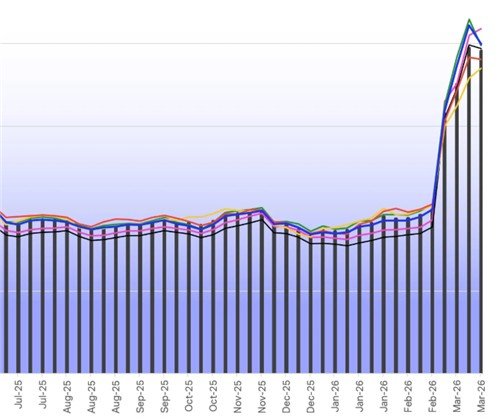
Instability in the Middle East lies behind these moves. Military tensions surrounding the Islamic Republic of Iran have heightened concerns about disruptions to crude oil supplies, driving up international oil prices. Jet fuel prices are estimated to have nearly doubled compared with pre-war levels.
Specifically, in March this year the average price of Dubai crude oil was 129 dollars per barrel, while Singapore jet fuel averaged 194 dollars per barrel. The weekly average price of Singapore jet fuel reached 197 dollars, roughly double the level before the United States of America (US) and the State of Israel launched attacks on the Islamic Republic of Iran.
On top of this, the weakness of the Japanese yen is further increasing cost burdens for Japanese airlines. Until recently, the perception in Japan that the "displayed fare is the final price," along with competition from the Shinkansen, made carriers cautious about imposing fuel surcharges, but that is now changing.
Hiroshi Watanabe, senior economist at Sony Financial Group, noted, "With rising oil prices and a weaker Japanese yen occurring at the same time, airlines are reaching the limits of what they can absorb on their own," adding, "An expansion of fuel surcharges is an unavoidable trend."
The rise in airfares is not limited to Japan. In China, Xiamen Airlines and China United Airlines have announced plans to raise domestic fuel surcharges by up to sixfold, and major carriers such as Air China are also facing mounting cost pressures.
Hong Kong’s Cathay Pacific Airways has increased fuel surcharges on long-haul routes by about 34%, while Australia’s Qantas Airways and Air India in the Republic of India have also moved to raise ticket prices or introduce fuel surcharges. In Europe, Air France–KLM and Scandinavian Airlines System (SAS) are likewise raising fares, particularly on long-haul routes.
Another notable feature is that both demand and supply are pushing prices up at the same time. Due to airspace instability over the Middle East, many routes are being diverted, which lengthens flight times and reduces capacity, even as demand for long-haul travel to regions such as Europe continues to grow.
As a result, travelers are being forced either to accept much higher airfares or to move their trips forward. In practice, as the belief spreads that "prices will only go up from here," more people are choosing to travel now while they still can.
Experts warn that if the current trend in oil prices continues, the burden of airfares will become even heavier by the summer vacation season. Some say the oil shock originating in the Middle East is reshaping even the typical holiday landscape of Japan’s major vacation periods.
Takayuki Miyajima, a senior economist at Sony Financial Group, predicted, "If higher oil prices and a weak Japanese yen persist, we are likely to see more people switch from overseas trips to domestic travel, or give up on traveling altogether."
[email protected] Seo Hye-jin Reporter