"You owe 4 million won, I'll settle it for 1.5 million"... New type of coin phishing exploiting hacking gaps [Chosun Phishing Chronicles]
- Input
- 2026-04-05 05:00:00
- Updated
- 2026-04-05 05:00:00
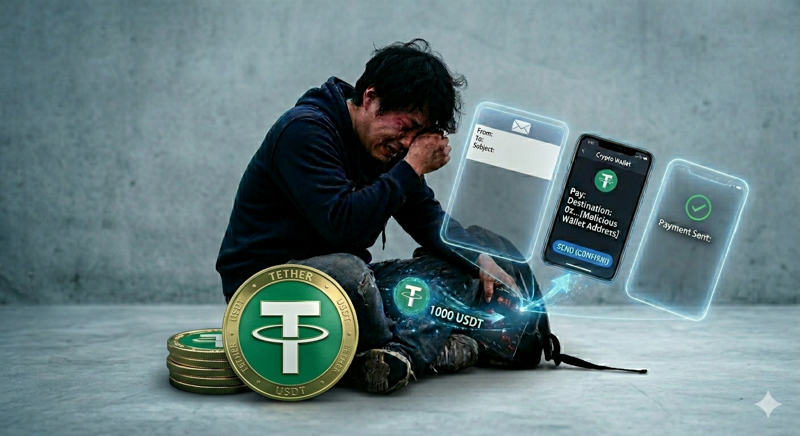
According to the Financial Supervisory Service (FSS) on the 5th, the email specifically stated that"Customers with debts of more than 3 million won can have the entire amount canceled if they send 1,000 Tether (USDT)."This was the condition written in the email.
A had recently been notified that the lender had been hacked and personal data had been leaked, which was already upsetting. In that state of irritation, the offer of debt cancellation sounded tempting. One thousand Tether (USDT) is about 1.5 million won, so for A, who had borrowed close to 4 million won, it seemed like a big gain to clear the debt for less than half the amount. The email also claimed that compensation had already been provided in similar cases, which further lowered A’s guard.
At first A was skeptical, but the thought "I have to repay this anyway, so why not settle it by paying only part of it?" began to sway the decision.The email even listed the company’s name, address, and a contact person’s phone number, which convinced A that it had really been sent by the lender.The instructions said that after sending cryptocurrency to the wallet address in the email, A could visit the lender and amend the contract, at which point the debt would be cleared.
In the end, A bought Tether (USDT) on an exchange and transferred it to the wallet address provided. But what happened next was not what A expected. The company kept delaying, saying it needed "verification procedures." Feeling uneasy, A finally went to the lender in person to ask, and learned that the email was a phishing scam completely unrelated to the company.
The FSSstressed that legitimate lenders do not ask customers to send cryptocurrency or similar payments in exchange for debt cancellation. If you receive such an email, you should never reply to it. Instead, you must contact the lender directly using its official channels to verify whether the message is genuine.An FSS officialwarned, "If you click suspicious URLs or attachments in such emails, you could suffer additional damage, such as the installation of malicious apps."The official added, "If you suspect a phishing email that pretends to offer debt cancellation, report it promptly to the FSS or to the police."
Some people lose not only their money but their entire lives to a single phone call.[Chosun Phishing Chronicles]is a series produced with the FSS that lays out in detail the increasingly sophisticated and diverse methods used in voice phishing and related scams. Simply understanding how these schemes work can help protect you. To receive these articles more conveniently, please subscribe to the reporter’s page.
[email protected] Lee Joo-mi Reporter