"If you don't eat it now, you wait a year" vs. "I'm sick of it now"... From the Jjuzzonku craze to backlash over overkill
- Input
- 2026-04-04 11:34:05
- Updated
- 2026-04-04 11:34:05
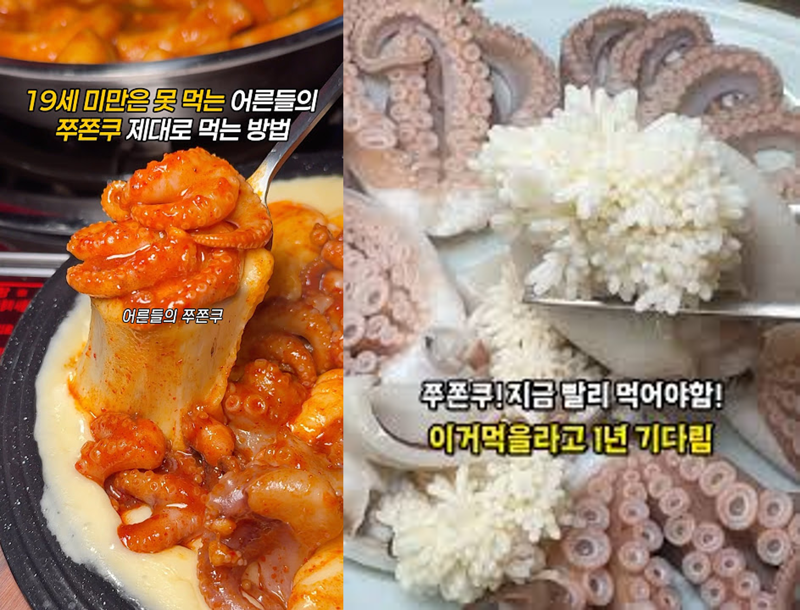
[Financial News] From bomdong bibimbap to Egg-filled webfoot octopus (al-jjukkumi), seasonal foods are taking over young people's social media feeds.
\r\n
Experts have dubbed this phenomenon "Seasonal-core."
\r\nHowever, some people are grumbling that "this has gone too far."
From bomdong bibimbap to Egg-filled webfoot octopus... Social media craze pushes both sales and prices up
According to social media posts on the 4th, Egg-filled webfoot octopus (al-jjukkumi) is being called "Jujjonku" or "Jjuzzonku."
The name comes from the way the egg clusters, which look like grains of rice, are wrapped in the octopus head, resembling last season's viral Dubai Chewy Cookie (Dujjonku).
As the image links back to the earlier Dujjonku trend, the phrase "Jjuzzonku for grown-ups" is also spreading on Instagram.
Mentions of Egg-filled webfoot octopus have surged as people connect it with the recent Dujjonku craze.
\r\n
According to AI trend analysis platform SomeTrend, mentions of "al-jjukkumi" between March 3 and April 2 jumped more than 640% from the same period a year earlier.
\r\nAs a result, restaurants serving Egg-filled webfoot octopus are packed.
Shops in Dohwa-dong, Mapo-gu, Seoul, Sadang-dong, Dongjak-gu, and Banghwa-dong, Gangseo District, Seoul—areas known as "al-jjukkumi hot spots"—see long lines even on weekday evenings.
Webfoot octopus builds up nutrients in its body ahead of the spring spawning season.
During this time, the flesh becomes plumper and the texture much chewier.
Female octopus in particular gains a richer, nuttier flavor as the eggs fill out.
As this seasonal taste is rediscovered through social media content, people are treating it like a "limited edition" that can only be eaten right now.
Earlier this year, bomdong bibimbap was the dish heating up social media. When TV personality Kang Ho-dong was shown eating bomdong bibimbap on an entertainment show, the clip was recut into short-form content and went viral. Mentions of "bomdong bibimbap" rose 888% year-on-year, and sales at some supermarkets climbed more than 37%. As demand surged, prices skyrocketed. According to the Korea Agro-Fisheries & Food Trade Corporation (aT), the wholesale price at Garak Market in Seoul for a 15 kg box of bomdong (top-grade) rose about 33.6% in just one month. As of March 4, a 15 kg box of bomdong at Garak Market even hit 47,099 won. A survey by the Korea Price Information Association found that the price of a single bowl of bomdong bibimbap jumped about 50%, from 8,000 won to 12,000 won. Kimchi brand Jongga, owned by food company Daesang, launched a seasonal limited product called "Jongga Spring Cabbage Kimchi." Within about two months of release, it sold 20,000 units, exceeding 22 tons in volume. "Seasonal-core trend" vs. "I'm tired of it. Just stop already" The retail industry has labeled this craze "Seasonal-core" (seasonal + core). Seasonal-core refers to a way of consuming foods, places, content, and events that strongly evoke a particular season. Behind the Seasonal-core boom lie social media virality and scarcity-driven consumption. Social media amplifies attention, while people in their 20s and 30s treat seasonal foods like limited-edition items. Together, these trends have created a Seasonal-core culture. This is closely tied to how people in their 20s and 30s consume. Before they weigh product quality or value for money, they get excited about rare or playful concepts and are willing to spend on them. Seasonal foods are the perfect stage for this kind of concept-driven consumption, because they are "limited editions made by nature" that are available only in spring, only right now. Experts say the seasonal food craze taps into consumers' "loss aversion" and "experience consumption." Professor Lee Hongjoo of the Department of Consumer Economics, Sookmyung Women's University, explained, "Seasonal foods by nature can only be eaten now, and you feel you have to eat them quickly." She continued, "In behavioral economics terms, the feeling that 'everyone else is doing it, so I'm losing out if I don't' falls under the factor of loss aversion." She added, "Posting on social media serves as a kind of social proof that you, too, have eaten the seasonal food. Rather than just buying ingredients, it reflects a trend of 'experience consumption' that lets people feel spring. The message shifts from 'I ate webfoot octopus today' to 'I enjoyed a warm spring day today,' so in the end, what they are consuming is the story." However, there is a downside. The supply of ingredients and the price market are thrown into turmoil again and again. Lee Dong-hoon, Head of Pricing and Cost Information, Korea Price Information, pointed out, "The rapid spread of a particular food through social media concentrates demand in a short period and becomes a factor that increases market volatility." In fact, this is not a problem unique to seasonal foods. When Dubai Chewy Cookie went viral, the price of its main ingredient, kadaif, soared 68.3%. In the case of Tanghulu, strawberry prices jumped 50%. Whenever a specific food gains attention on social media, prices of both the related ingredients and the finished products rise together in a repeated "synchronization phenomenon." Complaints are also piling up online. Readers reacting to related news articles have left negative comments such as, "I'm sick of it. Just stop already," "How many webfoot octopus places across the country actually have lines like that?" and "Do people really have to copy everything others do to feel satisfied?"
fair@fnnews.com Han Young-joon Reporter