"Will Oil Stay at $90 or $80?"...KOSPI Leaders Poised for a Major Shift
- Input
- 2026-04-04 09:08:12
- Updated
- 2026-04-04 09:08:12
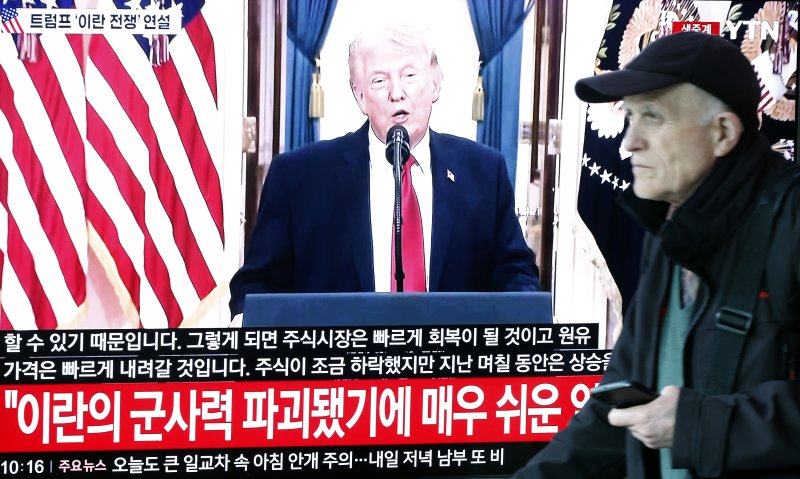
[The Financial News] US President Donald Trump has gone so far as to issue a hard-line warning to the Islamic Republic of Iran, saying he could "turn them back to the Stone Age," yet the domestic stock market has risen instead. Analysts say investors are focusing more on the trajectory of international oil prices than on the war itself, and are shifting their criteria for investment decisions. As a result, a full-fledged "oil-price-driven market" is expected, in which leading sectors and overall index direction will diverge depending on the level of oil prices.
■ KOSPI rebounds despite protracted war...brokerages on high alert
According to the securities industry on the 4th, the Korea Composite Stock Price Index (KOSPI) closed at 5,377.30, up 2.74% from the previous day. This marks a rebound after a sharp 4.47% drop on the 2nd. On the 1st, the index had already jumped by a hefty 8.44%. The KOSDAQ Index also rose 0.70% the previous day, reclaiming the 1,060 level.
In the initial shock phase of the war, the domestic stock market reacted sensitively, falling on heightened geopolitical uncertainty. Now, however, as the conflict drags on, the risk-on mood is returning, with escalation risks and the level of oil prices exerting a greater influence on investment decisions.
In this phase in particular, international oil prices have effectively emerged as the key variable determining the direction of the stock market. If the war continues but oil prices remain stable, the indices tend to rebound. Conversely, if high oil prices become entrenched, they erode corporate earnings and increase downward pressure on equities.
Lee Jae-man, a researcher at Hana Securities, noted, "Going forward, financial markets will gradually normalize as they monitor the number of vessels passing through the Strait of Hormuz and shifts in expectations for interest rate hikes," adding, "The path of oil prices and interest rates is now more important than the war itself."
Historical cases support this view. During the 2022 war between the Russian Federation and Ukraine, when international oil prices for West Texas Intermediate (WTI) stayed above $90 per barrel for about six months, the KOSPI operating margin fell from around 10% to the 8% range. It was a representative example of how high oil prices can damage corporate profitability and weigh on the stock market.
This time as well, the very character of the market is likely to change depending on how oil prices move. Even on the assumption that the global economy holds up, Lee Jae-man warned that "if WTI remains in the $90–$100 per barrel range, concerns over falling operating margins will make it difficult to pursue selective sector strategies."
■ Sector investment strategies by oil price level
As oil prices move into a more stable phase, attention is turning to sector-specific investment strategies. According to Hana Securities, when WTI is around $90 per barrel, industrial sectors such as the shipbuilding industry and the machinery sector tend to deliver relatively higher returns. At around $80, however, economically sensitive and materials-related sectors such as the automobile industry, the rechargeable battery industry, the steel industry and the chemicals sector come to the fore.
If oil prices fall further to around $70 per barrel, the market is likely to shift toward growth stocks, including the pharmaceuticals industry, the bio industry sector and software. In essence, declining oil prices ease valuation burdens and trigger a classic rotation of funds into growth names.
Lee Jae-man emphasized, "As oil prices move lower, it becomes possible to adopt more selective sector strategies," and added, "Because the leading sectors differ markedly by price band, investors need to build strategies based on the current level of oil prices."
A securities industry official commented, "The market is currently moving more in line with oil and interest rate trends than with the war itself," and said, "If oil prices stabilize below a certain threshold, there is a strong possibility that the uptrend led by the semiconductor industry will continue."
[email protected] Choi Doo-seon Reporter