Why Parents With Assets Worth 700 Million Won Refused 300,000 Won in Allowance... "My Children Are Poorer Than I Am" [Retiree X's Design]
- Input
- 2026-05-02 08:30:00
- Updated
- 2026-05-02 08:30:00

Unlike the parents' generation, which could buy a home with labor income alone, many in the children's generation are struggling even with the interest on jeonse loans. The rise of a generation of children who are poorer than their parents has created an era in which people may not be supported by their children in old age.

/Getty Images Bank [The Financial News] One morning last year on Parents' Day, Park Mi-sook, 60, a pseudonym, who lives in Nowon District, Seoul, stared for a long time at a KakaoTalk notification showing money sent by her daughter. In the end, she did not press "accept." Instead, she replied, "I'll just take the sentiment. Use it to help pay your jeonse loan interest." Her daughter and son-in-law are solid office workers with a combined annual salary in the 100 million won range. Even so, they spend more than 1 million won a month repaying the deposit loan on their apartment on the outskirts of Seoul.By contrast, Park and her husband have a net worth of more than 700 million won thanks to an apartment they bought before retirement. Of course, that money is not cash they can freely spend.Unlike the parents' generation, which could buy a home with labor income alone, many in the children's generation are struggling even with the interest on jeonse loans. The rise of a generation of children who are poorer than their parents has created an era in which people may not be supported by their children in old age.
"Most of it is in real estate, so I don't have much liquid money," Park said. "Still, my children's lives seemed so hard that I could not comfortably accept the 300,000 won my daughter gave me.
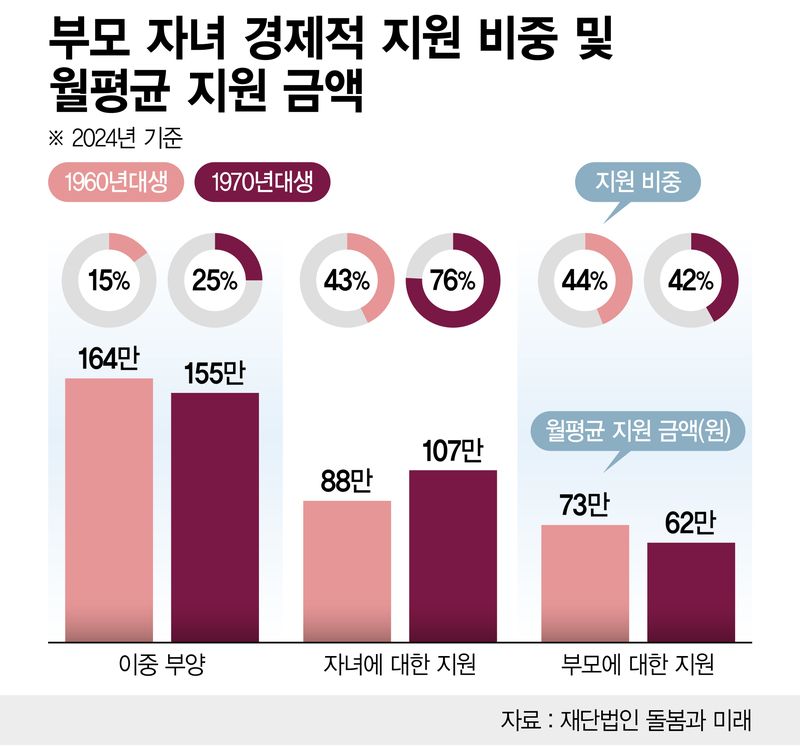
Unlike the parents' generation, which could buy a home with labor income alone, many in the children's generation are struggling even with the interest on jeonse loans. The rise of a generation of children who are poorer than their parents has created an era in which people may not be supported by their children in old age." 'The Ma-cheo Generation' — the hardest-hit generation survived 'Ma-cheo Generation' is a term used to describe people in their 50s and 60s today. It means the last generation to support their parents, while also being the first generation that cannot expect support from their children.They are a generation burdened on three fronts: caring for elderly parents above them, supporting adult children below them, and taking responsibility for their own retirement. Support for parents and children, and average monthly support amounts (as of 2024) / Graphic by Jeong Ki-hyeon The numbers make it even clearer.A survey by the Care and Future Foundation of 1,500 people born in the 1960s and 1970s, based on 2024 data, found that 44% of those born in the 1960s supported their parents, while 43% supported their children. Their average monthly support amounted to 730,000 won and 880,000 won, respectively.Among those born in the 1970s, 42% supported their parents and 76% supported their children. The share of people supporting both parents and children at the same time, so-called "Double Care," reached 15% among those born in the 1960s and 25% among those born in the 1970s.Even so, many said they felt burdened despite believing such support was only natural. On financial support for children, 46% of those born in the 1960s and 57% of those born in the 1970s said it was burdensome.For support for parents, the figures were 33% and 48%, respectively. Kim Yong-ik, chairman of the Care and Future Foundation, previously analyzed the survey results by saying, "For those born in the 1960s, the burden of supporting children has eased as their children have grown up and become independent.But those born in the 1970s are feeling an excessive burden because worries about supporting parents, educating children, and their own retirement are all piling up at once. " 'It was hard,' but 'assets' grew Yet time left this exhausted generation with a strange gift.Unlike the parents' generation, which could buy a home with labor income alone, many in the children's generation are struggling even with the interest on jeonse loans. The rise of a generation of children who are poorer than their parents has created an era in which people may not be supported by their children in old age.
They lived through a period of rising home prices and were able to buy homes when interest rates were low. Without intending to, they rode the wave of rising asset values.
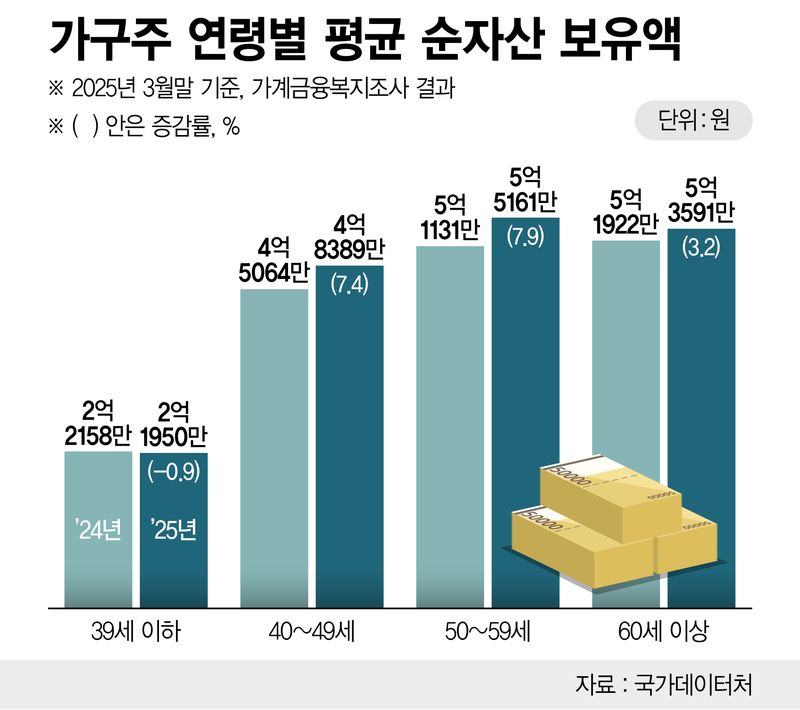
61 million won, ranking first among all age groups.
89 million won.
The gap is even wider when compared with people in their 30s, the children's generation.
5 million won.
The problem is the direction of change.
Net assets are increasing for people aged 40 and older, but they are actually declining for those under 30.
Unlike the parents' generation, which could buy a home with labor income alone, many in the children's generation are struggling even with the interest on jeonse loans. The rise of a generation of children who are poorer than their parents has created an era in which people may not be supported by their children in old age.
2%, respectively.
Unlike the parents' generation, which could buy a home with labor income alone, many in the children's generation are struggling even with the interest on jeonse loans. The rise of a generation of children who are poorer than their parents has created an era in which people may not be supported by their children in old age.9% from a year earlier.
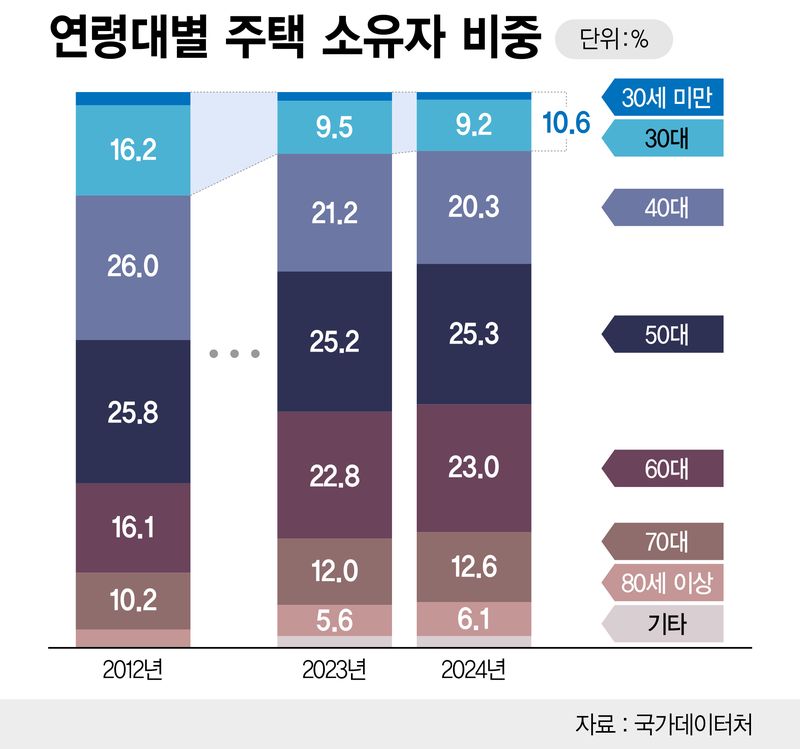
4%.The gap between generations is widening in both assets and income growth.Homeownership rates have also fallen sharply.Unlike the parents' generation, which could buy a home with labor income alone, many in the children's generation are struggling even with the interest on jeonse loans. The rise of a generation of children who are poorer than their parents has created an era in which people may not be supported by their children in old age.
0 percentage points in just 12 years.
In other words, parents became beneficiaries of rising home prices, while their children became victims of those same prices.
This shows that fears the 2030 generation will become the first to be worse off than their parents are becoming reality.
4%.Trends in homeowners and ownership rates / Graphic by Jeong Ki-hyeon Bigger expenses await beyond Parents' Day As the wealth gap widens, the scale of parental support also grows.13 million won.
01 million won, or 84% of the total.
64 million won.
That is an amount difficult for children to raise on their own.
4%.Naturally, parents step in.4%.And even after marriage support ends, there is more to come.Unlike the parents' generation, which could buy a home with labor income alone, many in the children's generation are struggling even with the interest on jeonse loans. The rise of a generation of children who are poorer than their parents has created an era in which people may not be supported by their children in old age.
The money in a May Parents' Day envelope is nothing compared with the money and time this generation spends on its children.
Unlike the parents' generation, which could buy a home with labor income alone, many in the children's generation are struggling even with the interest on jeonse loans. The rise of a generation of children who are poorer than their parents has created an era in which people may not be supported by their children in old age."I'll reinvest the allowance I gave".
Parents passing on investment know-how This change is also visible in the Parents' Day scene.In the past, it was natural to accept allowance from children.But now more parents are pausing to think about whether the money is needed by them or by their children.
What is clear, however, is that parents are not refusing the money because they are financially comfortable.They are making the sacrifice because they worry that their children will face even harder times than previous generations.4%.In some cases, parents are even using money given by their children as seed capital for investments or directly guiding them on investment strategies.Lee Jae-ho, 61, a pseudonym, from Seongnam-si, Gyeonggi Province, recently deposited the 300,000 won allowance he received from his daughter directly into a dividend stock pension fund (ETF) account.
Unlike the parents' generation, which could buy a home with labor income alone, many in the children's generation are struggling even with the interest on jeonse loans. The rise of a generation of children who are poorer than their parents has created an era in which people may not be supported by their children in old age.
Lee said, "My children's future looked too harsh for me to spend the money my daughter gave me.
Unlike the parents' generation, which could buy a home with labor income alone, many in the children's generation are struggling even with the interest on jeonse loans. The rise of a generation of children who are poorer than their parents has created an era in which people may not be supported by their children in old age.Instead, I plan to put it into stocks that pay good dividends and add it later when I need a lump sum." "Receiving is also love".Different Parents' Days depending on each family's circumstances Of course, turning down the envelope is not every parent's story.
Accepting an envelope from a child with joy, or even with a sense of apology, is also a parent's legitimate right.
Yoon Seong-cheol, 61, a pseudonym, from Bucheon, Gyeonggi Province, recently gratefully accepted 200,000 won in allowance sent by his son.After working nearly 30 years at a small and medium-sized company, Yoon retired and is now getting through the remaining years before his National Pension Service benefits begin in what he calls an "income gap period." For Yoon, whose only asset is an apartment worth more than 1 billion won, monthly cash flow is always precious.
Unlike the parents' generation, which could buy a home with labor income alone, many in the children's generation are struggling even with the interest on jeonse loans. The rise of a generation of children who are poorer than their parents has created an era in which people may not be supported by their children in old age.
Yoon said, "Honestly, 200,000 won is a big amount right now.
Unlike the parents' generation, which could buy a home with labor income alone, many in the children's generation are struggling even with the interest on jeonse loans. The rise of a generation of children who are poorer than their parents has created an era in which people may not be supported by their children in old age." "I also felt sorry, but when my son said, 'Dad, please buy yourself something tasty,' I felt deeply moved, as if my hard work had been recognized." The age of the hyper-individual, but families are different This is the age of the hyper-individual.Everyone is expected to live on their own.
Retirement, daily life, and responsibility all belong to each person.
But things are a little different in front of family.
Parents think once more, and children hesitate once more.There are also gaps within the older generation itself.Even among people in their 50s and 60s, the difference is large between households with cash flow from pensions and financial assets and those whose assets are tied up in real estate and lack liquidity.
Unlike the parents' generation, which could buy a home with labor income alone, many in the children's generation are struggling even with the interest on jeonse loans. The rise of a generation of children who are poorer than their parents has created an era in which people may not be supported by their children in old age.
More than half of people in their 50s carry debt, and many continue to hold debt even after retirement.
Unlike the parents' generation, which could buy a home with labor income alone, many in the children's generation are struggling even with the interest on jeonse loans. The rise of a generation of children who are poorer than their parents has created an era in which people may not be supported by their children in old age.Having a lot of assets does not necessarily mean being financially comfortable.
In the end, what matters is one thing: not assets, but cash that can be used right now.
If they have proper cash flow through private pensions, IRP accounts, and similar tools in addition to real estate, they may be comfortable.
If not, they need to create liquidity.
4%.The best filial piety is a child's independence As the times change, the definition of filial piety is also being rewritten.In the past, filial piety meant supporting one's parents.
Unlike the parents' generation, which could buy a home with labor income alone, many in the children's generation are struggling even with the interest on jeonse loans. The rise of a generation of children who are poorer than their parents has created an era in which people may not be supported by their children in old age.
Now, the greatest act of filial piety that parents point to is their children's independence.
Unlike the parents' generation, which could buy a home with labor income alone, many in the children's generation are struggling even with the interest on jeonse loans. The rise of a generation of children who are poorer than their parents has created an era in which people may not be supported by their children in old age.Park Mi-sook's real intention in refusing the allowance was closer to encouragement: "Save your money and get on your own feet as soon as possible." Parents do not lean on their children, and children do not ask their parents for help.Each side stays in its place so that neither becomes a burden to the other.
That is the new Parents' Day scene facing this era.
Unlike the parents' generation, which could buy a home with labor income alone, many in the children's generation are struggling even with the interest on jeonse loans. The rise of a generation of children who are poorer than their parents has created an era in which people may not be supported by their children in old age.
The old formula that "retirement equals exit" is breaking down.In an era of 83-year life expectancy, as Generation X enters full-scale retirement, the very concept of retirement is being redefined.Every Saturday morning, we bring readers the stories of their "second act in life" in Retiree X's Design Subscribe to the reporter page to receive it conveniently.
[email protected] Kim Ki-seok, Choi Yong-jun Reporter