Correction Orders Alone Cannot Justify Contract Termination...Industry Concerned as Fines and Penalties Are Excluded
- Input
- 2026-04-03 10:22:22
- Updated
- 2026-04-03 10:22:22
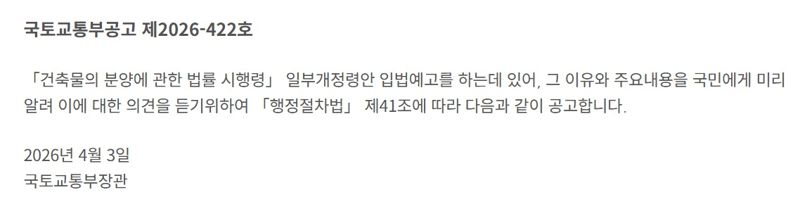
The construction and real estate industry expects that the draft amendment to the Enforcement Decree of the Act on the Sale of Buildings, which the government pre-announced on the 3rd, will help reduce disputes over contract termination. However, many remain concerned because the amendment is limited to correction orders and does not cover administrative fines or criminal penalties.
According to the Ministry of Land, Infrastructure and Transport on the 3rd, the ministry has pre-announced the related amendment and begun collecting public comments. The Act on Sale of Building Units applies to non-apartment properties such as officetels, commercial units, knowledge industry centers, and office buildings.
Under the current law, sales contracts must explicitly state that buyers may terminate the contract if the seller receives a correction order, a criminal fine, or an administrative fine. Correction orders were first listed as grounds for termination in the 2005 Enforcement Decree after fraudulent sales of commercial units became a social issue, and in 2017 criminal and administrative fines were added.
The newly pre-announced amendment focuses on refining the provisions related to correction orders as grounds for termination. Its core is to reasonably adjust the standard so that even if a correction order is imposed, termination is allowed only when the violation makes it difficult to achieve the purpose of the sales contract.
An industry official said, "After the Supreme Court of Korea recently ruled that contracts can be terminated even when a correction order is issued for a minor matter, we have seen various side effects such as planned, profit-seeking lawsuits," adding, "We expect the government's amendment to help reduce such disputes."
Still, there is considerable concern that administrative fines and criminal penalties have been left out of the amendment. This is because there are many cases where such fines are imposed for violations that are unrelated to the actual purpose of the sale.
In fact, at many project sites, collective lawsuits are underway not only over correction orders but also over administrative and criminal fines, most of which are considered planned lawsuits. Another industry representative argued, "Termination rights for cases involving administrative fines or criminal penalties should also be recognized only when there is a serious violation that makes it impossible to achieve the purpose of the sale," and pointed out, "This area has been excluded from the government's latest amendment."
A representative of H Law Firm noted, "For apartments, termination is allowed only when a material term of the contract is violated to the extent that the purpose of the contract cannot be achieved," and added, "There is also an issue of fairness in contract termination standards between similar systems."
Industry groups plan to convey their concerns to the government during the public notice period regarding the exclusion of administrative and criminal fines from the amendment. The new decree will take effect from the date of promulgation and will not apply retroactively; it will only apply to sales reported after the law comes into force.
[email protected] Lee Jong-bae and Choi Ga-young Reporter