Did a Single Trump Remark Shake the Market? "Ultimately a Recoverable Event"
- Input
- 2026-04-03 09:31:15
- Updated
- 2026-04-03 09:31:15
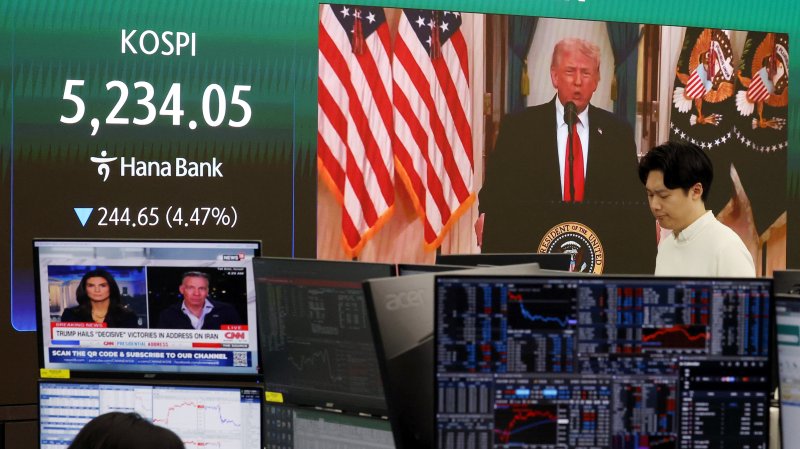
According to The Financial News, President Donald Trump’s national address rattled stock markets, but analysts say the downside is likely to remain limited.
Yoo Seung-min, a researcher at Samsung Securities, stated in a research report on the 3rd, "It is true that stock markets in Asia, including Korea, are relatively disadvantaged in this situation, but it is now time to look ahead based on objective data such as post-conflict energy prices."
The Korea Composite Stock Price Index (KOSPI) fell 4.47% to close at 5,234.05 on the 2nd after President Donald Trump’s speech. However, analysts expect a rebound when compared with past geopolitical crises.
Since the 1970s, there have been roughly 30 major geopolitical events that affected global financial markets. During those episodes, the Standard & Poor's (S&P) 500 Index declined for as long as 36 days. In the current US–Iran conflict, the index has fallen for 21 days based on the low on the 31st of last month, marking the fourth-longest losing streak on record. In terms of magnitude, the drop of about -7.8% is similar to the decline seen after the outbreak of the Russo-Ukrainian War in 2022.
Historically, stock markets have recovered about 52–58% of their losses one to three months after a geopolitical event, based on simple statistics. After six months to one year, 65–71% of markets had returned to their pre-event levels.
Yoo noted, "Of course, it is difficult to treat geopolitics as an independent variable that solely determines stock market performance, so this analysis has its limitations." Even so, he stressed, "History shows that market declines triggered by events, in the absence of a recession, have ultimately been short-lived and limited in scale."
He also pointed out that the global macroeconomy was in relatively good shape before this conflict began, which is another positive factor. Based on President Donald Trump’s latest address, Yoo expects the overall shock to remain contained.
He explained, "The probability of a recession was very low, and even that probability had been declining. Against a backdrop of long-term disinflation, major central banks were either keeping rates on hold or signaling further cuts."
Yoo said, "The key takeaway from President Donald Trump’s national address is his intention to end the war in a short period of time. While his warning of strong retaliation if no agreement is reached with Iran, and the lack of a clear solution for the Strait of Hormuz, are risk factors, we expect these to remain within a controllable range."
He added, "In that case, the impact on global growth and inflation is likely to be limited. There is still considerable uncertainty, of course, but major institutions currently estimate the probability of a global economic recession within 12 months after this shock at around 30–50%."
[email protected] Han Young-joon Reporter