Koo Yun-cheol Vows to Greatly Shorten Import Period for Hard-to-Source Paint and Other Chemicals
- Input
- 2026-04-03 08:46:55
- Updated
- 2026-04-03 08:46:55
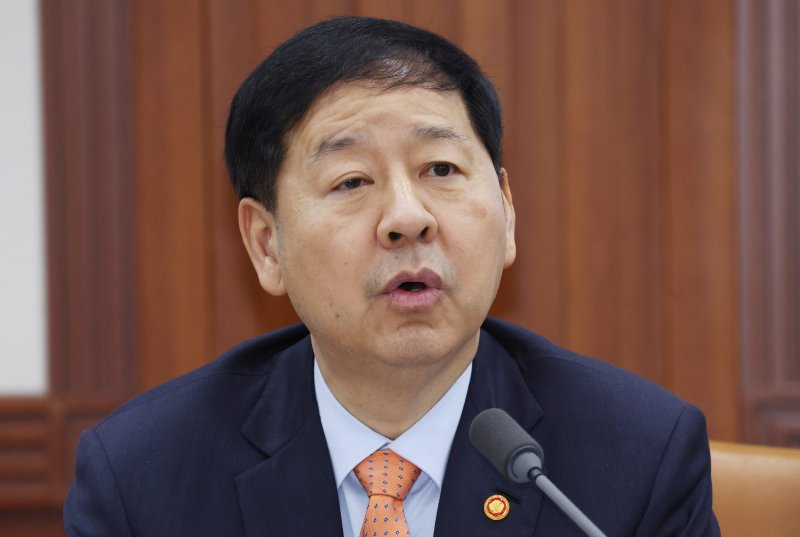
[The Financial News] Deputy Prime Minister for Economic Affairs Koo Yun-cheol, who also serves as Minister of Economy and Finance, said on the 3rd that in response to instability in the supply of Naphtha and petrochemical products caused by the war between the United States of America (US) and the Islamic Republic of Iran, "for chemicals facing supply concerns, such as paint, we will apply special measures to the import registration process and significantly shorten the time required for imports."
Presiding over the Emergency Economic Headquarters Meeting and Council of Economic Ministers at Government Complex Seoul that day, Koo stated, "Depending on future supply and demand conditions for Naphtha derivatives and petrochemical products, we will actively consider additional measures."
The meeting reviewed the government’s response to the war in the Middle East, discussed regulatory improvements to ease supply chain bottlenecks as part of emergency economic measures, and considered ways to improve the investment framework for advanced strategic industries.
Koo said, "Concerns over the supply chain that began with energy supply and demand are now spreading to everyday items such as various packaging materials that use petrochemical products," adding, "By temporarily suspending certain regulations, we will swiftly resolve procedural obstacles and supply chain bottlenecks for key items."
The government has been implementing emergency supply adjustment measures, including export controls, on Naphtha since the 27th of last month. It is coordinating supply by prioritizing essential items such as plastic bags and other basic necessities.
In addition, imported energy and raw materials will clear customs before berthing and unloading, and the government plans to apply special freight arrangements for companies importing goods from the Middle East.
To facilitate the use of alternative packaging materials for food, hygiene products, and pharmaceuticals, the government will temporarily ease labeling regulations on packaging. Requirements that currently mandate printing or engraving information directly on the packaging will be relaxed to also allow the use of stickers.
A fast-track system will be introduced to shorten the review period for product approvals of alternative packaging materials.
The regulatory framework for investment in the semiconductor industry and other advanced strategic industries will also be improved.
First, for investments in local regions, the government plans to ease regulations on great-grandchild companies under general holding companies, subject to review and approval by the Korea Fair Trade Commission (KFTC).
When a grandchild company receives investment from the Advanced Strategic Industry Fund or its collective investment vehicles, the required ownership stake in its great-grandchild company will be relaxed from the current 100% to 50%.
To enable faster construction of factories, strategic industry companies located in an industrial park will be allowed to lease or transfer land to third parties even before factory construction is completed, with expanded support from the government.
The government will also rationally revise hidden on-site regulations.
It has identified 251 "hidden regulations" imposed by public institutions that increase the burden on businesses and plans to rationalize them.
As a representative example, installation standards for liquid hydrogen refueling facilities—such as location and distance requirements—will be eased to match those applied to gaseous hydrogen refueling facilities, which have similar characteristics.
For companies selling through Public Home Shopping, the payment period for sales proceeds will be drastically shortened from 10 days after settlement closing to 2 days.
The number of regulatory communication channels within public institutions, known as Corporate Growth Response Centers, will be increased from the current 144 to 153 institutions so that hidden regulations can be identified and improved more proactively.
Koo said, "We will make every effort to overcome this crisis," and added, "We will actively rationalize regulations in various areas to support the recovery of corporate vitality."
[email protected] Jung Sang-geun Reporter