"When I lost my job, everything fell apart"... Homeless people on the streets, numb even to hateful stares [Chronicler of the Lowly]
- Input
- 2026-04-05 06:00:00
- Updated
- 2026-04-05 06:00:00
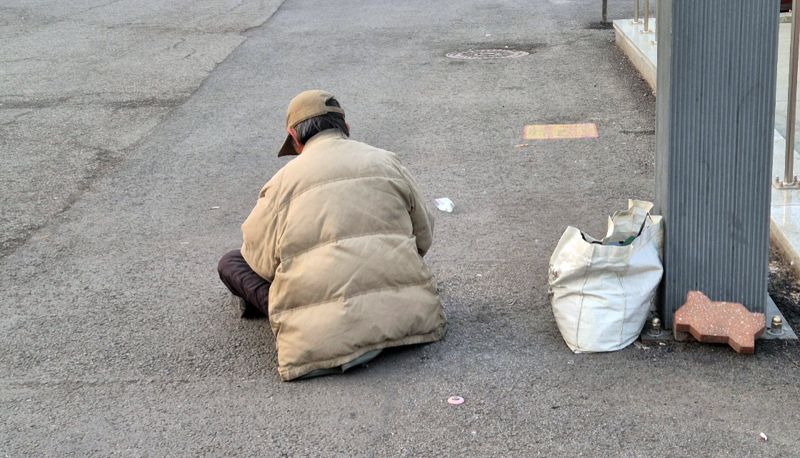
The free meal line was not only a place to get one meal. It was also where the realities of the streets came together. The reporter walked around the Seoul Station area, ate with homeless people, and listened to their stories. The report looks at why some leave shelters and remain on the streets, and at the reality of homeless women who must move even more cautiously despite being in the same situation.
[Financial News] "Is this the line for free meals?"
Around 7 p.m. on the 1st, in front of a free meal center near Seoul Station. When the reporter joined the end of the line, a man standing ahead turned around and nodded. Middle‐aged men with worn backpacks, older people carrying clothes in plastic bags, and people holding bottles of water were lined up in a long row. At first the line was sparse, but as serving time approached, it quickly grew longer.
When the reporting on homeless people began that day, the station exits and underground passages were relatively quiet. In front of the exits, along the walls, and under the stairs, there were bags, cardboard boxes, and folded blankets. As the sun went down, people slowly returned to their spots, and as the free meal time drew near, movement around Seoul Station converged on one place.
There appeared to be around 100 people in line. Among them, only about five were women. Most looked to be in their 50s. While men gathered in small groups to smoke or exchange a few words, the women stood more toward the edges of the line rather than in the middle. Many kept some distance from others or scanned their surroundings one more time.
Once serving began, lunch boxes, bananas, and water were handed out in turn. The reporter also received a meal and sat down on the ground.At first, the homeless people gathered in small groups said almost nothing.Only the sounds of lunch box lids opening and disposable spoons clinking could be heard. After a few bites, a man sitting next to the reporter spoke first. When told this was for a story, he asked, "Is this your first time here? If you stay here just a few days, you’ll recognize everyone’s face."
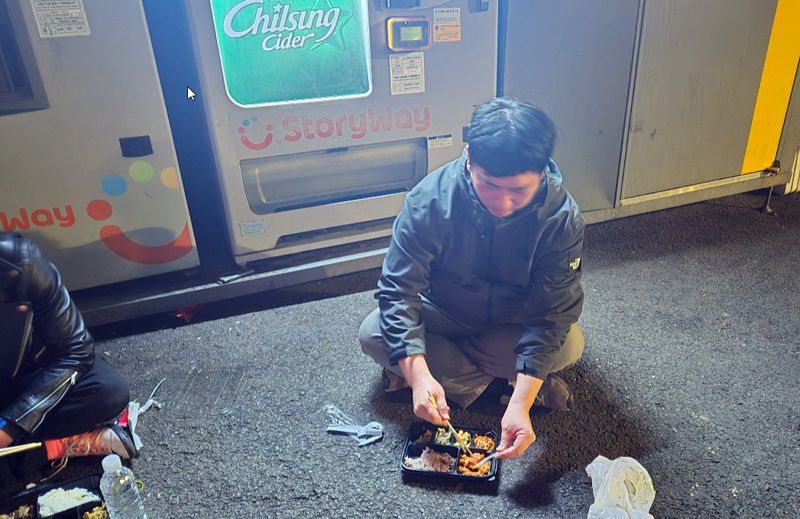
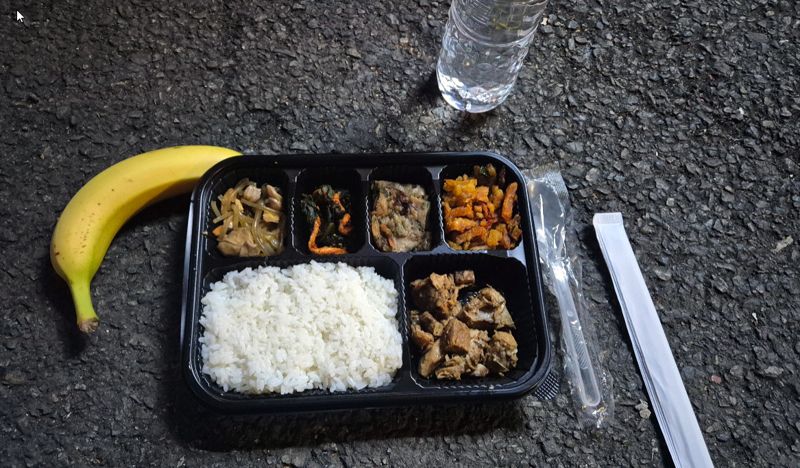
Some homeless people even came closer, saying, "Looks like you got more meat than we did."Sharing a meal together opened the door to detailed stories about their past lives and why they had no choice but to live on the streets.One man in his late 40s sighed as he explained that he had suffered a cerebral hemorrhage, which left him unable to keep working, and that depression and other illnesses had piled up, bringing him to where he is now.After finishing the lunch box, he lay down on the asphalt and watched office workers pass by. A foreign tourist, looking at the homeless people, remarked, "There are so many homeless people at Seoul Station." Turning his back on the cold stares directed at the homeless, the reporter closed his eyes for a short nap on the freezing ground.
"We know people curse us" Yet they still avoid shelters
A man in his 50s, who said he was staying in a nearby underground passage, only began to speak after he had finished his lunch box. Smiling, he said, "Now I feel like I can breathe a little." When asked where he stays, he replied, "It’s different every day. Sometimes I go up toward the station, sometimes I go down below." He added, "I eat breakfast and lunch near Jongno, and dinner here."When the topic of shelters came up, he immediately shook his head."They have set times for everything there. Meal times, curfew, bedtime. Having to match all of that feels even more suffocating."Hesaid, "Even if it’s uncomfortable, at least out here I can move on my own two feet."He went on, confessing, "People can say we’re just being picky, but I feel so uncomfortable there."A man in his 60s, surnamed Park, sitting across from him, joined in. "The problem with shelters isn’t the beds," he said. "It’s constantly bumping up against other people that wears you down. If you don’t get along with someone, you can’t last more than a few days." Another man nearby added, "I don’t know, it just feels stifling. Some people say they feel like they can’t breathe," and noted, "A lot of people go in and then end up coming back out again."
What the reporter heard on site is reflected in a survey by the Ministry of Health and Welfare. According to the 2024 survey on the status of homeless people and others, the most common reason street homeless people did not use residential facilities was "because of group living and rules" at 36.8%. This was followed by "because indoor spaces feel suffocating" at 16.6%, "because they don’t know much about the facilities" at 14.2%, and "conflicts with other residents" at 11.5%. In the same survey, 36.9% of street homeless people said they would sleep that night on streets or plazas, and 28.9% in underground spaces. The main reasons they chose their sleeping spots were "because it’s convenient to use toilets and other facilities" at 22.7%, and "because other homeless people are nearby" at 16.6%.
The Ministry of Health and Welfare survey also shows that health problems among homeless people are significant. In the 2024 survey, 28.7% were considered highly likely to have depression, and mental disorders were found in 25.8%, making them one of the most common conditions. This background makes it difficult to explain their reluctance to use shelters simply as a matter of personality or attitude.
Given this situation, the Ministry of Health and Welfare (MOHW) operates street outreach, temporary protection facilities, short‐term housing, and dedicated teams for homeless women in parallel. Because many people struggle to adapt to shelters due to rules, group living, and conflicts with other residents, outreach on the streets is combined with emergency protection and connections to housing support.
In many other countries, policy places more emphasis on connecting people to housing than on adapting them to shelters. In the United States of America (US), the "housing first" principle prioritizes permanent housing over whether someone can adjust to a shelter. Instead of making treatment, counseling, or service participation a condition for entry, the approach is to secure housing first and then attach the necessary support. Japan also does not treat admission to self‐support centers as the end of the problem. It focuses more on counseling and support to help people maintain their housing after leaving, so they do not return to the streets. The emphasis is on helping people settle in the community rather than keeping them in facilities for long periods.
"We don’t want to be seen" Homeless women who choose to remain invisible
Going back and forth between the free meal line and the area around Seoul Station, one thing stood out: there were few homeless women. But it would be too simple to say there were just fewer of them. Unlike the men, women rarely stayed in one place for long, and they often stood at the edges of the line.A woman in her 50s standing near the end of the line glanced around before giving short answers when the reporter approached her. "If you stand here too long, you draw attention for no reason," she said. Asked where she goes at night, she replied, "Somewhere near where there are at least some people. I can’t go anywhere too deserted." About shelters, she confessed, "I’ve been to one, but it was uncomfortable. Even when you just want to be quiet, it’s hard to do that there."Another womansaid, "Men can just sit around, but women can’t do that," adding, "Once it gets dark, you keep looking around."When the reporter remarked that it was hard to spot homeless women around Seoul Station, she replied with a question of her own: "Just because you don’t see us doesn’t mean we’re not here, right?"
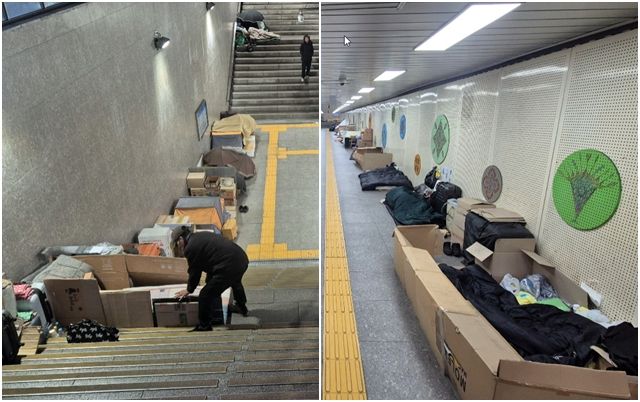
According to the Seoul Metropolitan Government’s 2020 survey on the human rights situation of homeless people and others in disaster situations, 10.1% of women and 0.7% of men said they had experienced sexual violence. Among female respondents, 31.8% said they chose their sleeping place because they thought it was safer than other locations. In a 2024 report, the Korean Women's Development Institute (KWDI) analyzed that many homeless women hide themselves to avoid stigma and the risk of violence. When MOHW announced a dedicated outreach program for homeless women in 2023, it stated, "In particular, homeless women on the streets are more vulnerable to danger and therefore require more meticulous protection."
The same differences were visible in the underground passages where many homeless people gather. At night, cardboard boxes, blankets, and backpacks reappeared under the stairs and along the walls. Some homeless people had already settled into their spots. Men were relatively easy to see near exits or along the passage walls, but many women moved their sleeping places later at night to the far ends of the passage or more secluded wall areas.
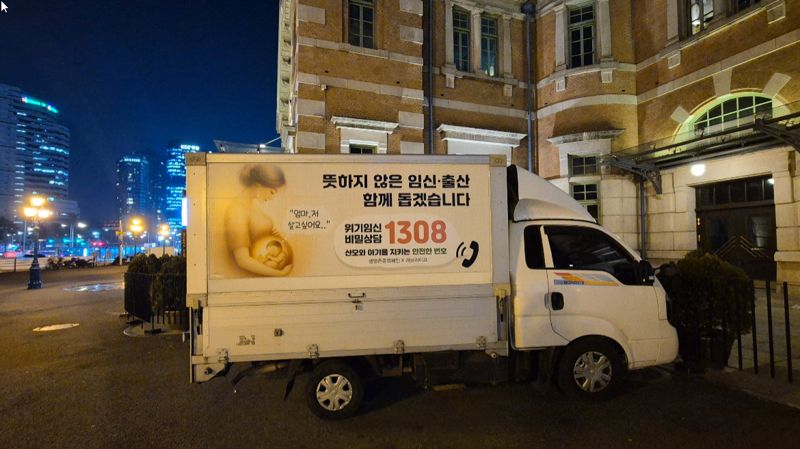
Near Seoul Station, there was also an information vehicle with the words "We will help you with unplanned pregnancy and childbirth" and "1308 Crisis Pregnancy Confidential Counseling Hotline" written on it. But the women the reporter met there spoke first about the dangers of the night rather than about support services. Their comments about standing out if they stay in one place too long, and about being unable to go anywhere too deserted, show why women move more cautiously than men even in the same spaces.
After 10 p.m., the free meal line had disappeared, but people did not completely disperse. Some sat on the ground in front of the exits, while others went down into the underground passages. Bags and belongings that had been packed away during the day were spread out again. The area around Seoul Station turned back into a sleeping space.Experts say this reality cannot be addressed simply by asking whether someone enters a shelter or not.At a forum titled "Legislative and Policy Tasks for the Human Rights and Inclusion of Homeless People as an Extremely Housing‐Vulnerable Group," held last November at the National Assembly Members' Office Building, Song Ah-young, a professor in the Department of Social Welfare, Yonsei University, stated, "Shelters are not housing," and explained, "Housing is a precondition for self‐reliance, not a reward for it." Seo Jeong-hwa, head of the Open Women’s Center, pointed out that depending on the type of facility, people may not receive sufficient self‐reliance support and welfare services, and stressed the need to institutionalize supported housing.
The reporting that day ended around midnight. The homeless people met in the free meal line spoke of the familiarity of the streets rather than of shelters, and the women moved toward places where they would draw less attention, even within the same streets.The night at Seoul Station raised a different question from "Why don’t they just go into shelters?" Instead, it asked why, for some people, shelters remain spaces that are ultimately too hard to enter.
We record dense stories of life in print. Rough as they may be, we try to capture the words we pick up directly on site. From alleyways, markets, and someone’s workplace, records of ordinary days we have passed by will find their way to you. To receive [Chronicler of the Lowly] comfortably, please subscribe to the reporter’s page.
[email protected] Han Seung-gon Reporter