Foreign ministers from more than 40 countries, including South Korea, hold virtual meeting, demand Iran end 'hostage-taking' in Strait of Hormuz
- Input
- 2026-04-03 07:01:16
- Updated
- 2026-04-03 07:01:16
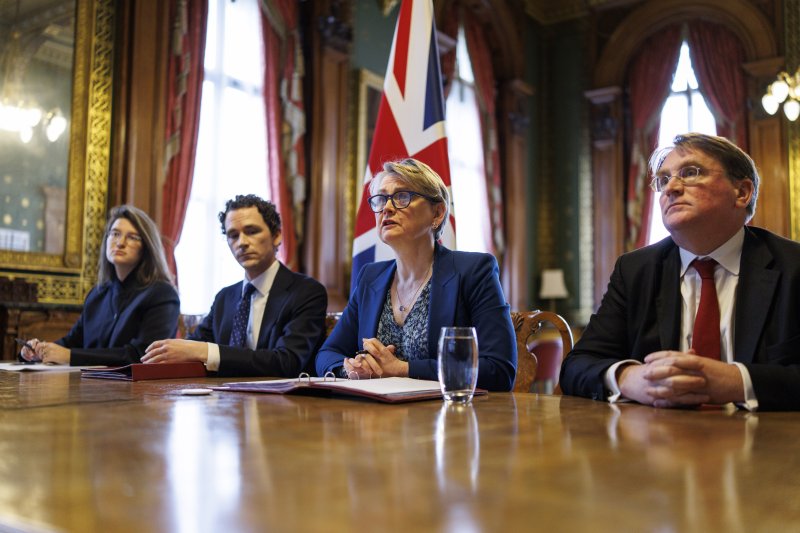
[The Financial News] Foreign ministers from more than 40 countries, including South Korea, held an emergency virtual meeting and called for the "immediate and unconditional reopening" of the Strait of Hormuz.
On the 2nd (local time), Agence France-Presse (AFP) and other foreign media reported that the meeting, led by UK Foreign Secretary Yvette Cooper, agreed to step up diplomatic pressure by urging respect for freedom of navigation and the principles of international maritime law.
Many of the countries that took part have suffered disruptions to supplies of essential raw materials such as oil, natural gas, liquefied natural gas (LNG), and fertilizer due to Iran’s maritime blockade.
The Ministry of Foreign Affairs of the Republic of Korea had earlier announced that Jeong Ui-hye, deputy foreign minister, would participate in the meeting on behalf of South Korea.
Cooper mentioned the possibility of additional economic sanctions alongside pressure through the United Nations (UN). She warned strongly, saying, "Iran is trying to hold the global economy hostage by using the Strait of Hormuz," and added, "We must not allow their attempt to succeed."
Italian Foreign Minister Antonio Tajani proposed opening a "humanitarian corridor" for essential goods such as fertilizer in order to prevent a food catastrophe in Africa.
Behind the diplomatic efforts, sharp disputes continued over the possibility of a military response. The Gulf Cooperation Council (GCC), including the Kingdom of Bahrain, asked the United Nations Security Council (UNSC) to authorize the use of "all necessary means," including force, to protect sea lanes.
However, Russia and China, both permanent members of the UN Security Council with veto power, as well as France, strongly opposed the request, leaving the council deadlocked. A spokesperson for the Ministry for Europe and Foreign Affairs of France stressed the need for a ceasefire first, saying, "It is impossible to ensure the security of the strait while the bombing continues."
Tensions between President of the United States Donald John Trump and European allies have also come to the surface.
A day earlier, President Trump, in a national address, urged oil-importing countries to intervene directly with military force, saying, "Do not just wait. Have the courage to seize the strait yourselves and protect it on your own." He has taken a hard line, insisting that he will consider a ceasefire only after the Strait of Hormuz is fully reopened.
In response, President of France Emmanuel Jean-Michel Frédéric Macron, who is visiting South Korea, drew a clear line, saying, "Liberating the strait by force is unrealistic" and "It is not an option we can choose."
According to the UK government, 37 countries, including the United Kingdom of Great Britain and Northern Ireland (UK), France, Germany, and Japan, have so far signed a statement pledging to help ensure safe passage through the strait. However, key parties such as the United States of America and China, as well as most Middle East countries, are absent from the list, raising doubts about the effectiveness of international coordination.
[email protected] Yoon Jae-joon Reporter