"Open the Strait of Hormuz": Around 40 Countries Launch Joint Search for a Solution, but US, China and Russia Stay Away
- Input
- 2026-04-03 05:54:22
- Updated
- 2026-04-03 05:54:22
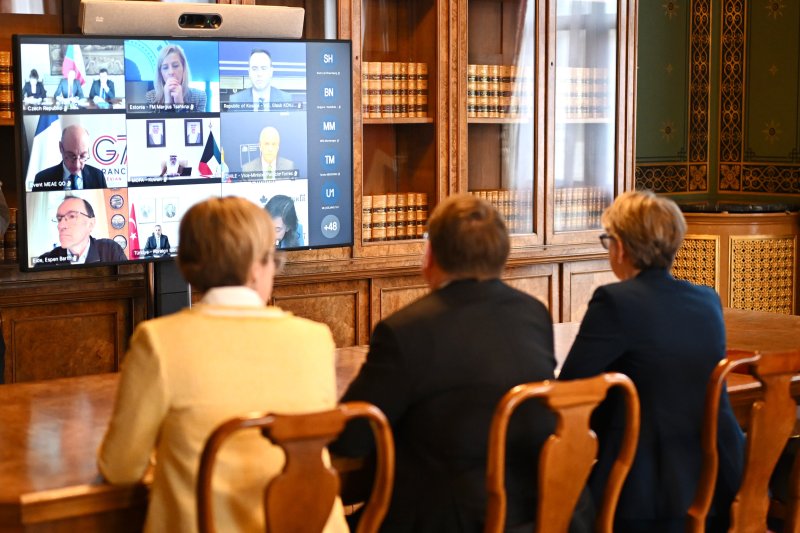
The meeting, held on the 2nd (local time) under the leadership of the United Kingdom (UK), brought together key North Atlantic Treaty Organization (NATO) members such as France, Germany and Canada. Gulf states including the United Arab Emirates (UAE), as well as the ROK, Japan, India and other Asian countries, also participated.
UK Foreign Secretary Yvette Cooper, who chaired the meeting, set out international diplomatic options for sending a clear and coordinated message to Iran through the United Nations (UN) and the International Maritime Organization (IMO). She also proposed exploring coordinated economic and political measures to increase pressure on Iran. "There have been more than 25 attacks on ships in the strait, and around 2,000 vessels and some 20,000 crew members are stranded," Cooper said, adding, "Iran's recklessness toward countries that have had no involvement whatsoever in this conflict is damaging global economic security."
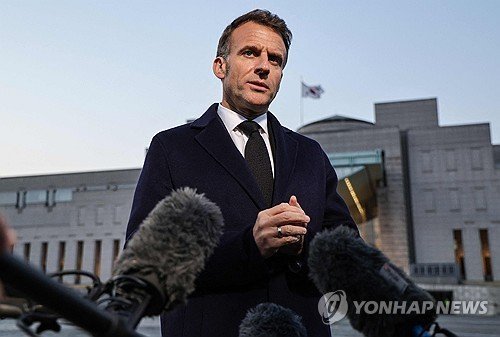
Cooper said that following this meeting, a gathering of military strategists will be held next week. Until now, international military strategy discussions have been led by France. The upcoming military meeting is expected to focus, after a ceasefire, on mine clearance and plans to rescue ships trapped in the Strait of Hormuz, rather than on new military operations. President of France Emmanuel Macron, who was on a state visit to the ROK that day, stated that militarily seizing control of the Strait of Hormuz is "unrealistic." He argued, "It would take an indefinite amount of time and would expose everyone seeking to pass through the strait to the risk posed by Islamic Revolutionary Guard Corps forces on the coast and to ballistic missiles."
China steps in as mediator, urges launch of "peace talks"
China, which did not attend the 40-country foreign ministers' meeting, held a separate series of contacts with the European Union (EU) and key European and Middle East foreign ministers. Chinese Foreign Minister Wang Yi spoke by phone with Kaja Kallas, the EU's High Representative of the Union for Foreign Affairs and Security Policy, Johann Wadephul, Germany's foreign minister, Faisal bin Farhan Al Saud, Saudi Arabia's foreign minister, and Abdullatif bin Rashid Al Zayani, Bahrain's foreign minister and the rotating chair of the Gulf Cooperation Council (GCC), a bloc of six Arabian Peninsula states.China's Ministry of Foreign Affairs said all of these calls were made at the request of the other side. The announcement was intended to underscore that the international community is looking to China to play a mediating role.
China and the Islamic Republic of Pakistan, which have been working to mediate the war involving Iran, have been calling for an immediate halt to hostile actions and for peace talks to begin as soon as possible.
On that day, Wang Yi said, according to China's Ministry of Foreign Affairs, "A ceasefire and an end to the war are the strong demand of the international community and the fundamental way to ensure safe passage through the Strait of Hormuz. Countries should build broader consensus and create the necessary conditions for this." He added, "The actions of the United Nations Security Council (UNSC) should focus on de-escalation, and must not put a veneer of legality on unauthorized military operations or further aggravate the situation."
Iran says it is drafting Strait of Hormuz transit rules with Oman, insists there will be no return to pre-war status
Secretary-General of the United Nations (UN Secretary-General) António Guterres urged the US, the State of Israel and Iran to halt armed clashes. "My message is clear," Guterres said at a press conference at United Nations Headquarters in New York City, calling on the US and the State of Israel that "it is time to stop this war, which is inflicting immense human suffering and has already triggered devastating economic fallout." He also demanded that Iran stop attacks on neighboring countries. Guterres said he had dispatched Jean Arnault, his special envoy on Iran, to the region to support diplomatic efforts.Iran, however, announced that it is working with Oman to establish rules to monitor ship traffic through the Strait of Hormuz. It argued that even in peacetime, vessels wishing to pass through the strait must coordinate with the coastal states, Iran and Oman.
Kazem Gharibabadi, Iran's deputy foreign minister for legal and international organizations, stated, "We are at war. No one should expect the pre-war rules to continue to apply."
He went on to stress, "Restrictions and bans on navigation for the aggressor states and those supporting them are unavoidable." Referring to recent attacks on major nuclear facilities in Iran, he warned that, if there is no protection from the international community, Iran could consider withdrawing from the Treaty on the Non-Proliferation of Nuclear Weapons (NPT).
[email protected] Kim Kyung-soo Reporter