[Editorial] An Endless War in Sight: An Emergency Energy Plan Cannot Wait
- Input
- 2026-04-02 18:39:35
- Updated
- 2026-04-02 18:39:35
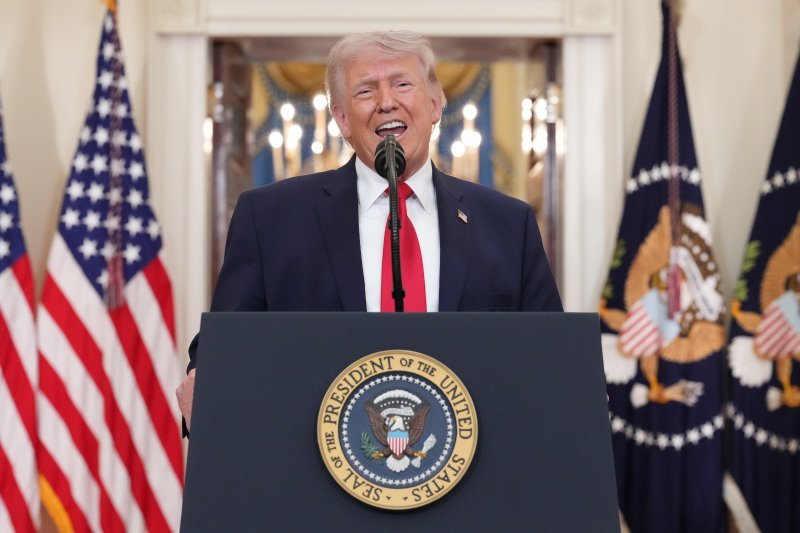
Markets reacted sharply to remarks that defied expectations. Stock markets in the Republic of Korea (ROK), as well as in Japan and Taiwan, all went into steep decline. International oil prices surged immediately after the speech, jumping back up to 104 dollars per barrel, and the won–dollar exchange rate swung violently. In this seemingly endless war, global uncertainty has only grown. The ROK government and businesses must brace themselves and at least double or triple their crisis-response capabilities.
The 18-minute speech, delivered during prime time in the USA, was primarily aimed at calming public anxiety. Trump claimed that the USA had achieved "a swift, decisive and overwhelming victory on the battlefield" and said he was pleased to report that "core strategic objectives are close to being fulfilled." Instead of presenting a concrete timetable for ending the war, he again stressed the need for rapid strikes, while insisting that the spike in fuel prices would not last long.
Trump also shifted responsibility for resolving the blockade of the Strait of Hormuz onto countries that rely on Middle Eastern oil. "We will help, but they must take the lead," he argued, reiterating a position he had already floated through foreign media.
Trump is effectively urging those countries either to buy oil from the USA or to muster the courage to manage the strait themselves. To make matters worse, Iran is moving to impose transit fees on ships passing through the Strait of Hormuz. According to foreign reports, a brokerage firm linked to the Islamic Revolutionary Guard Corps (IRGC) would collect data from vessels and set final tolls by taking into account country-specific ratings. The opening bid is said to be 1 dollar per barrel. For a Very Large Crude Carrier (VLCC), the fee could reach 2 million dollars per ship, or about 3 billion won.
If this becomes reality, the shock to the ROK—where 70% of crude imports come from the Middle East—would be almost impossible to fathom. The entire global economy is already shrouded in dark clouds because of the war with Iran, but in terms of the intensity of the blow, no country is as exposed as the ROK. The Organisation for Economic Co-operation and Development (OECD) has already sharply downgraded its growth forecast for the ROK this year due to the fallout from the Middle East conflict. For a country that does not produce a single drop of oil and relies on the Middle East for most of its supply, the shock from a Middle East war is little short of a foretold disaster.
For industry, every day feels like walking on thin ice. Refiners, whose crude procurement has been choked off, warn that their inventories will soon be exhausted and are at a loss over what to do. The petrochemical sector, already in the midst of a naphtha crisis, has cut operating rates down to the 60% range. Major companies have notified their clients that they may be forced to declare force majeure. The damage to logistics sectors such as shipping and aviation, where freight rates have soared, is beyond description. Semiconductor and automobile manufacturers, now facing disruptions in the supply of critical materials, are gripped by the same fear.
Even if a formal end to the war is declared, recovery will not be immediate. It will take considerable time for most facilities in the Persian Gulf region to return to normal. On top of that, the impact of Iran’s proposed transit fees for the Strait of Hormuz could be a problem of near-nuclear magnitude. The ROK must re-examine the state of its energy and raw-material supplies in detail and devise dense, multi-layered countermeasures from every angle. Practical tasks needed to diversify supply sources should be divided into short- and long-term priorities, and every effort must be made to achieve concrete results. Government, business, and the political sphere must close ranks and work together to find a way to survive.