[Editorial] President Lee: "The Current Crisis Is a Storm" That Must Be Overcome Through Cooperation
- Input
- 2026-04-02 18:39:33
- Updated
- 2026-04-02 18:39:33
As President Lee has diagnosed, the risk of high oil prices triggered by the Middle East crisis will not be easily resolved even after the war ends. Research institutes judge that, because of damage to energy facilities and disruptions in supply, international oil prices are unlikely to return to pre-war levels. Some even warn that if the war is prolonged, prices could surge beyond 100 dollars a barrel and reach as high as 170 dollars. This suggests that the war may become entrenched not as a temporary shock, but as a source of structural energy instability. The longer these external risks persist, the more inflation, exchange rates and even growth rates could be shaken in succession.
Against this backdrop, the 26 trillion won supplementary budget plan carries significance as an emergency measure aimed at protecting both people’s livelihoods and industry amid high oil prices and supply chain instability. It is commendable that funding for compensation for high oil price damage, the operation of a cap on petroleum prices, and support for exporters and small business owners has been secured through excess tax revenue rather than new government bond issuance. However, it remains to be seen whether such cash-based support will actually lead to price stability and a recovery in consumption. Medium- to long-term strategies to reduce dependence on energy imports and to strengthen the industrial structure are also lacking.
Above all, it is doubtful whether fiscal measures alone can break through the crisis bearing down on companies. Fears of a blockade in the Strait of Hormuz are heightening production disruptions and supply uncertainty in the petrochemical sector, while high oil prices and rising raw material costs are eroding the profitability of manufacturing. On top of this, a weaker currency, higher logistics and insurance costs, and disruptions in air and sea transport are all converging to increase the burden across the industrial landscape.
The shock of high oil prices is also spilling over to households. In March, consumer prices rose 2.2 percent, while petroleum product prices recorded their steepest increase in three years and five months. Long lines of cars at gas stations vividly illustrate the precarious reality facing ordinary people. If Middle East risks persist, the pain felt by low- and middle-income households will inevitably deepen. Prolonged high oil prices will unavoidably increase household burdens and dampen consumption, and this in turn could trigger a vicious cycle of economic slowdown. The entire economy is being drawn into a vortex of uncertainty.
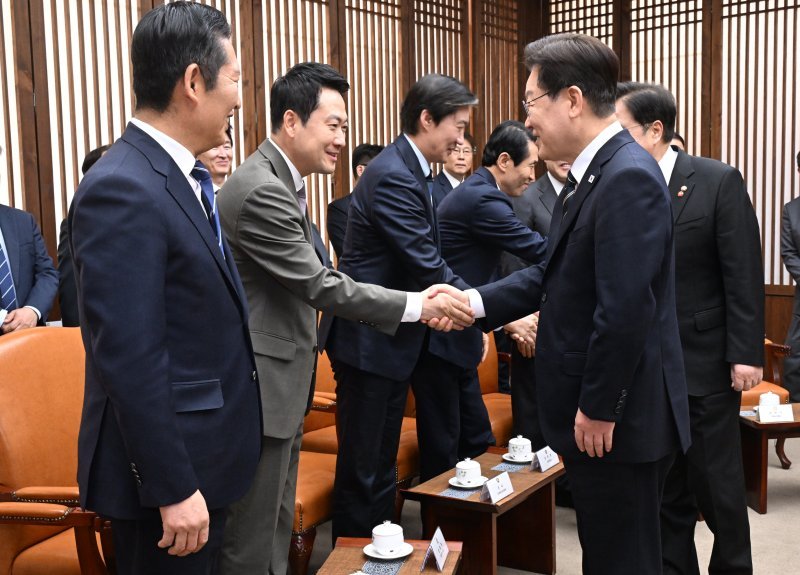
What matters now is a responsible response from the political class. If the ruling and opposition parties continue partisan infighting and conflict even in the midst of crisis, they will inevitably miss the critical window of opportunity for policy action. Swift execution of the supplementary budget, energy measures and industrial support policies requires bipartisan cooperation. The sight of the president and the leader of the main opposition party shaking hands on the occasion of the policy speech is a positive sign. With the national economy standing before a massive storm, politics must choose cooperation over conflict. Cooperative governance is the most realistic and responsible way to steer the country through this crisis.